

Pierluigi PaganiniSeptember 18, 2026
RatHat combines AI-driven screen control, Android debugging abuse and advanced credential theft to give attackers deep control of infected phones.
RatHat is the new Android trojan you should know about. Zimperium researchers just published a breakdown of a strain they’ve traced to China-based operators, and what makes it different isn’t the credential theft, which is standard fare by now. It’s what it does to get there.
It starts the way most mobile fraud does: a text message or a shady ad pointing to a fake app store. Once someone installs the APK, the malware doesn’t just ask for permissions and hope.
“RatHat is primarily distributed through deceptive phishing sites promotedring victims into manually downloading malicious APKs that appear to be legitimate apps” reads the report
The dropper hides its payload in two encrypted files. Both use the same simple decoding process: skip a 24-byte header, read the data length, apply a basic XOR and subtraction operation to each byte, and then decompress the result with Gzip. The second stage is a DEX file loaded directly into memory through reflection. It contains the code needed to unpack and install the final malware.
The droppers also abuse native Android SessionInstaller APIs to get around restrictions on app installation and Accessibility Services, allowing the malware to install its payload and access protected APIs.
RedHat uses four anti-analysis techniques. First, it modifies the ZIP container in ways Android ignores but tools such as unzip and apktool cannot handle correctly. Second, it uses a 61 MB AndroidManifest.xml containing unusual data blocks that can make analysis tools crash or run out of memory. Third, the DEX code contains invalid pseudo-instructions that break disassemblers even though Android can still run the app. Finally, strings are encrypted using StringFog and an additional custom scheme that swaps bytes and applies a 16-byte XOR key.
The malware also checks for debuggers, ptrace, debug settings, Frida, Xposed, root indicators and emulators, making analysis much harder.
The malware first tries to gain access to Android’s Accessibility Service. It then uses that access to silently enable Developer Options and Wireless Debugging on the victim’s phone. It doesn’t need a second device, a cable, or a user to manually approve a USB debugging connection.
This is the most interesting part of the attack. RatHat uses the same Accessibility Service to read the ADB pairing code directly from the phone’s screen. It then pairs with the phone’s own debug interface without any user interaction. In simple terms, the malware tricks the phone into giving itself control.
The malware then places two disguised native binaries in /data/local/tmp. Both are written in Go. One, liblocal-service.so, works as a shell command tool and handles persistence, battery settings and permission changes that are not visible in the main app code. The other, libmedia_codec.so, is a modified FRP reverse-proxy client. Its role is to create a tunnel that lets the attacker connect remotely to the phone’s ADB shell from anywhere on the internet.
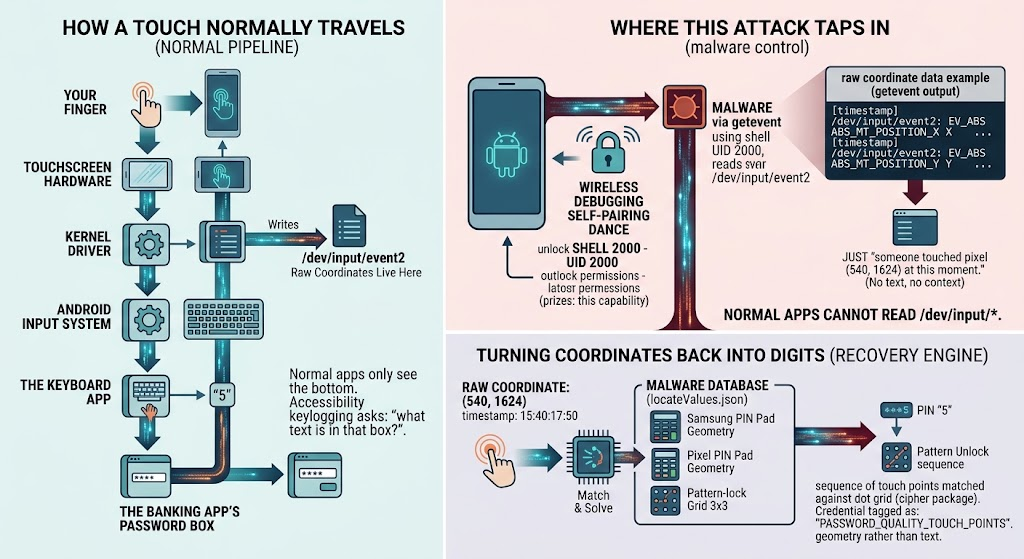
The credential theft itself runs on three tracks. There’s a standard Accessibility-based keylogger reading text fields, a second component scraping URLs straight out of browser address bars, and then something considerably more interesting: a hardware-level keylogger running from that same ADB shell, reading raw touch coordinates off /dev/input. Paired with a JSON file mapping out keypad layouts for every major phone brand, a screen tap becomes a digit. It’s a workaround for FLAG_SECURE, custom keyboards, and lock-screen protections all at once, because none of those defenses touch the input driver itself.
On the banking side, RatHat serves fake overlays on top of real banking and payment apps, WeChat and Alipay included, to grab PINs and login credentials while the person thinks they’re using the real interface. Combine that with SMS interception for 2FA codes and you’ve got full account takeover without the victim noticing anything unusual happened.
RatHat serializes the phone’s live Accessibility tree into XML and sends it to a mainstream generative AI assistant, which returns screen coordinates and text so the malware can decide where to tap next. The report puts it plainly:
“Generative AI UI-Automation Engine: This is a particularly unique feature.” continues the report.”The malware serializes the device’s live Accessibility tree to XML and communicates with one of the world’s most popular Generative AI assistants (Figure 4). This AI is used for non-malicious actions including:
- Resolving a named target’s centre coordinates on the screen as JSON to direct synthetic clicks.
- Resolving a target’s actual on-screen text from the XML (without translating).
- Signaling automatic navigation commands like SCROLL_DOWN.”
That single change is what separates RatHat from a decade of scripted Android RATs. Old-school automation breaks the moment a button moves or a layout changes on a new OS version. An AI reading the screen in real time doesn’t care. It just looks and taps, the same way a person would.
Persistence is where things get properly ugly. Uninstall the app and it throws up a fake Google Play error to cancel the removal. Manage to force it through anyway, and the Go agent running outside the app’s lifecycle notices, silently reinstalls the APK, and re-grants every permission, accessibility included, without a single tap from the user. As the researchers describe it:
RatHat uses several communication channels to maintain control of infected Android devices and steal data. The app registers with its C&C server over HTTP and keeps a WebSocket connection open for real-time communication. A separate Go-based agent runs a local server and uses a disguised FRP component to expose it to the internet, allowing attackers to bypass NAT and firewall protections. The C&C infrastructure can receive credentials, SMS messages, files, app lists, lock-screen data and logs, while sending commands, updates, screen-monitoring tools and other components to the device.
There is still an important weak point: the attack needs Accessibility Service access to get started. That makes a basic security rule more important than ever: don’t give Accessibility permissions to apps that have no clear reason to use them, even if the app provides a convincing explanation.
“RatHat’s multi-tiered architecture, reliance on out-of-lifecycle daemons, and use of real-time GenAI decision loops illustrate why traditional, signature-based mobile security controls are insufficient.” concludes the report.
Follow me on Twitter: @securityaffairs and Facebook and Mastodon
(SecurityAffairs – hacking, RatHat)
AndroidCybercrimeHackinghacking newsinformation security newsIT Information SecuritymalwarePierluigi PaganiniRatHatRatHat malwareSecurity AffairsSecurity News
