

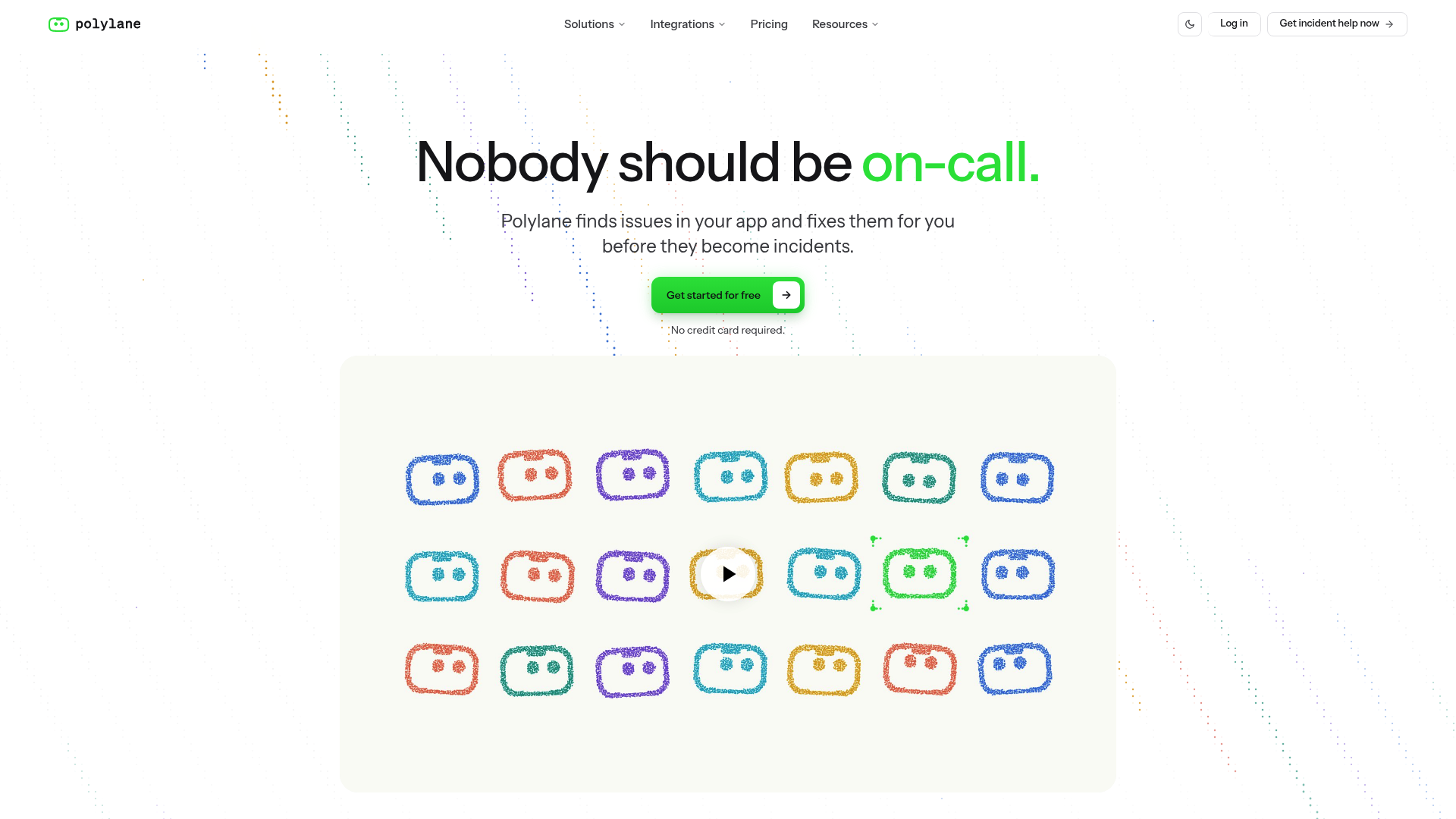
Polylane automates production observability, incident response, and root-cause analysis for engineering teams across cloud infrastructure and telemetry data.
Ai Tools · 9 Nov 2026 · 2 min read
Polylane is an AI-powered reliability tool designed for engineering teams and site reliability engineers aimed at automating production observability and incident response. It monitors cloud infrastructure, code repository activity, and telemetry data to detect unusual behavior, provide root-cause analysis, and even generate pull requests with proposed fixes—all with evidence cited and before issues escalate.
Key Features
Polylane’s core offering is a closed feedback loop that spans detection, investigation, and remediation. It builds a live context graph by connecting your cloud accounts, repositories, and observability tools so that agents reason over the system topology in real environments. Unusual metric drift or unmonitored event patterns are flagged via built-in and custom checks. Each alert triggers investigations that surface logs, deploy history, and configuration details. When possible, Polylane generates fixes automatically, pushing pull requests for human review through your code review pipeline. It supports an API and REST/MCP interfaces that work with tools such as Slack, your code editor, and terminal. The system also includes on-demand comparisons of pull requests against live production to assess risk before merges. Security measures include SOC 2 Type II and ISO 27001 certifications, end-to-end encryption, and data isolation per organization.
Pricing
Polylane offers several self-serve pricing tiers plus an Enterprise option. There is a Free plan at zero cost that includes 2 team members, 2 cloud accounts, 10—or in some displays, up to 50—pull-request reviews per month, unlimited repositories and integrations, and the base level of credits. Paid plans begin with Starter at $80 per month billed monthly, rising through Team, Business, Scale, Premium, and Ultimate—each offering progressively larger credit pools, more PR review capacity, and additional cloud account connections. The highest-tier plans (Scale and up) allow optional pay-as-you-go overage usage under a spending cap. The Enterprise plan provides unlimited usage, custom volume pricing, and options such as using your own LLM provider, bringing your own AI gateway or cloud infrastructure.
Who is it for?
Polylane is best suited for small to large engineering teams operating cloud-native environments—particularly those that run infrastructure on AWS, Cloudflare, Vercel, Kubernetes, or similar providers. It serves teams seeking to reduce on-call overhead, improve incident response, and raise code quality through automatic risk assessment in pull requests. DevOps leads, reliability engineers, and teams with mature CI/CD pipelines will benefit most. It may be less suitable for teams whose infrastructure or code practices rely heavily on providers or version control platforms not well-supported by Polylane’s integrations.
Final thoughts
Polylane positions itself not merely as a monitoring tool, but as an autonomous safety net that covers the lifecycle of production issues—from early detection through to remediation. Its strengths lie in its ability to connect disparate sources of truth (cloud, code, telemetry), generate actionable insights, and automate parts of the fix cycle, all while preserving human oversight. The pricing structure offers scalability, though the credit model may require early evaluation to gauge real-world usage. For any organization striving for higher reliability, fewer outages, and more proactive operations, Polylane offers a compelling option to consider.
Visit the official website for more.
Keep up to date with our stories on LinkedIn, Twitter, Facebook and Instagram.
Tags
#observability#devops#automation
From the floor
Closer to this story than we are?
If you’re building in this space — or watching it reshape your market — pitch us. We edit it; you get the byline.
