

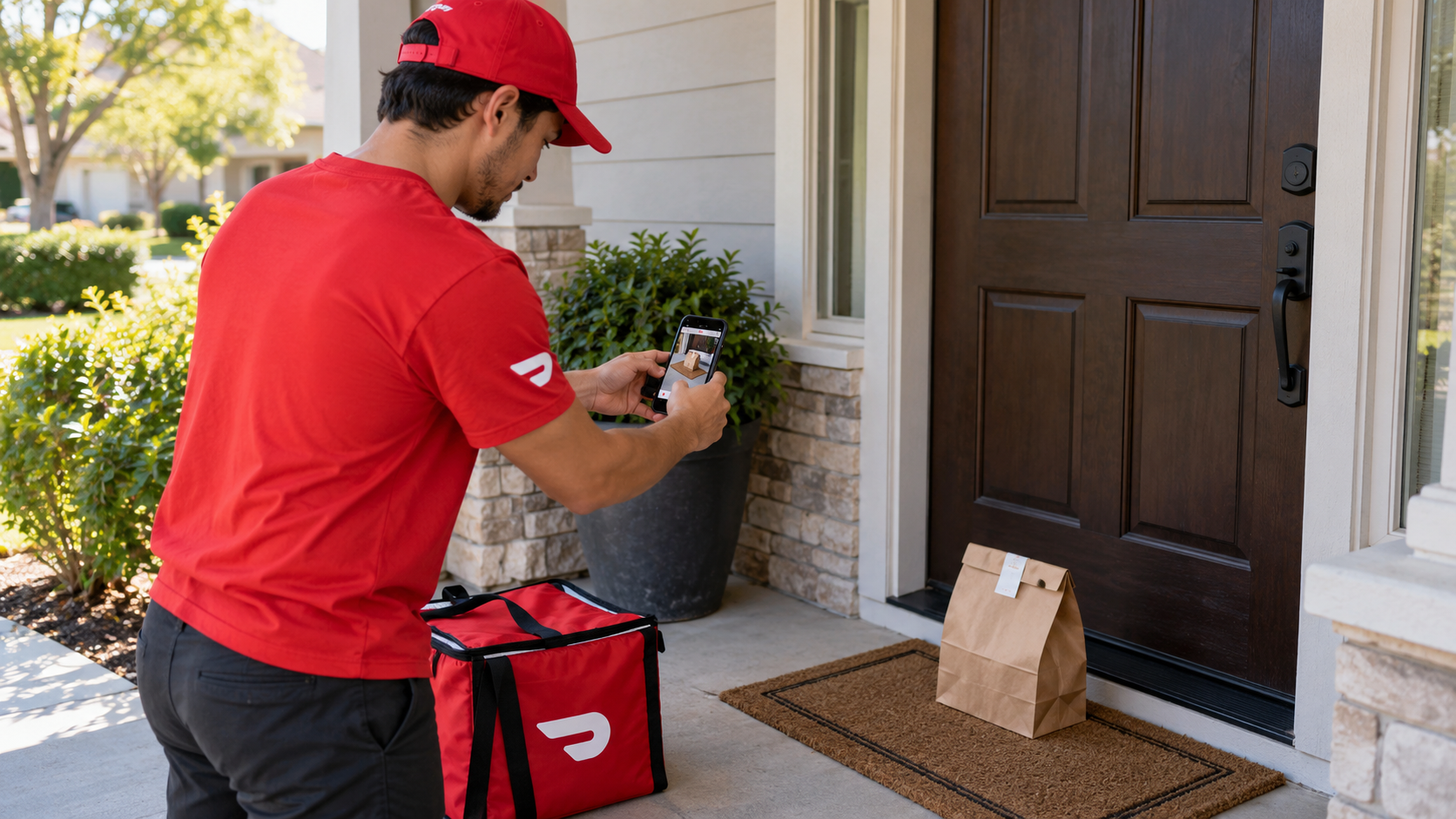
No matter how many times I get food delivered or order from Amazon, it never is not weird seeing a random image of my front door on the image.
But after looking into Amazon’s AI-powered glasses for delivery drivers, I started thinking about those pictures differently. The glasses aren’t simply putting directions in front of drivers’ eyes. They contain cameras, and recent reporting suggests they can capture several thousand images over the course of a shift, including images of people and private property.
That got me wondering about something delivery companies have already been doing for years, which is photographing the spot where they leave our stuff. I wanted to know how many companies have pictures of my front door, and what happens to those pictures after I pick up my package.
DoorDash actually wants your house in the picture
I’m starting with DoorDash because its instructions to delivery drivers are surprisingly specific. For a no-contact delivery, DoorDash tells Dashers to take a picture of where the food was left, and it doesn’t just want a close-up of the bag. That same guidance says a good photo should capture the food along with the house or apartment door and, when available, the house or apartment number, while a separate DoorDash help page encourages drivers to include surrounding features like a tree, a doorway or decor.
What’s much harder to figure out from DoorDash’s public documentation is what happens to that specific photo afterward. DoorDash’s privacy policy doesn’t give a retention period for proof-of-delivery photos, and instead says how long the company keeps personal information depends on several factors, including how long it needs the information for the purpose it was collected. I couldn’t find a DoorDash page saying anything as straightforward as “we delete your delivery photo after X days,” and that’s exactly the kind of information I’d like to know.
Uber doesn’t always require a picture
Uber Eats handles things slightly differently. When a customer chooses to have an order left at the door, Uber’s guidance for couriers tells them to take a photo of the order to show it has been delivered, although the photo doesn’t appear to be strictly mandatory, since drivers say the app offers a skip button that lets them mark the order delivered without one.
The purpose makes sense, because a picture tells the customer where the order was left, but figuring out what happens afterward isn’t quite as straightforward. There is one place where Uber gets unusually specific, and that’s Uber Direct, the company’s delivery service for businesses. Uber’s developer documentation says proof-of-delivery photos are automatically turned on for leave-at-door deliveries, and that the images stay in the Uber Direct Dashboard for seven days and remain available through its API for 30 days.
That’s refreshingly specific, but it describes how long a business can pull up the photo rather than when Uber deletes it, and Uber Direct and Uber Eats aren’t the same product. I wouldn’t assume the same window applies to the picture of my dinner sitting outside my house, and I couldn’t find an equivalent public retention period for ordinary Uber Eats drop-off photos.
Still, Uber Direct shows how simple this disclosure could be when a company decides to spell out what it captures and how long that capture sticks around.
Instacart is taking pictures too
Instacart has a similar system. If you ask for your order to be left at your door, the shopper gets a prompt to take a picture of the order at your door before leaving.
It can happen in other situations, too. If an eligible order was supposed to be handed over but the shopper can’t reach the customer after a 10-minute wait, Instacart guides the shopper to leave the order securely at the door and photograph where it was placed, and the photo, the location and the delivery time are then shared with the customer.
Once again, I couldn’t find a public expiration date for those delivery photos. Instacart’s privacy policy instead ties retention to how long the company needs information to provide its services, comply with legal obligations, resolve disputes and enforce its agreements. That’s a reasonable privacy policy, but it still doesn’t tell me whether the picture of my groceries sitting in front of my house disappears tomorrow, next month or considerably later.
Now even USPS trucks are getting more cameras
It isn’t only the companies delivering packages and dinner that are putting more cameras on our streets. The U.S. Postal Service is testing dashboard cameras from dashcam maker Nextbase in 100 mail trucks in the Washington, D.C. area, according to a USPS letter that a letter carriers’ union branch posted online and that 404 Media first reported. The pilot was scheduled to begin September 21 and is expected to run for several months.
The forward-facing cameras begin recording once a mail truck is in drive and has left the postal facility, and the letter says they will scan and analyze roads and signage and map roadways and sidewalks as carriers travel their regular routes. The idea is actually pretty clever, because USPS trucks travel through the same neighborhoods day after day and could give the Postal Service an enormous, constantly refreshed
A USPS spokesperson told 404 Media that the limited pilot is meant to assess whether vehicle-mounted cameras can help identify roadway conditions and support community safety, and that it includes privacy safeguards. The cameras in the pilot don’t run automatic license plate reader software, according to 404 Media, but Gizmodo notes that Nextbase’s website says its dashcams can record in 4K and capture details like road signs and license plates.
These also aren’t the first cameras on postal vehicles, since USPS trucks already carry 360-degree cameras that capture the outside of the vehicle, according to the same 404 Media report.
For now this is a limited pilot in one part of the country, and there’s no indication USPS is deliberately photographing individual front doors the way a DoorDash driver photographs a food delivery. But it adds another piece to a much larger picture.
Amazon’s AI glasses change the equation
A delivery photo shows where a driver left my package. Amazon’s smart glasses could collect much more.
The glasses reportedly take still photos almost constantly while drivers are on foot — potentially thousands per shift. They capture whatever the driver sees, including people and private property, to feed Wellspring, Amazon’s AI-powered mapping system.
Amazon says faces and license plates are blurred before human review. But customers reportedly can’t view images of themselves or their property or request deletion, and Amazon hasn’t disclosed how long it keeps them. The company also confirmed that police can obtain the images with a warrant.
Amazon plans to equip 5,000 drivers this year and more than 20,000 by the end of 2027. Wearing the glasses is voluntary for drivers, but that leaves unanswered questions for the people they photograph.
Even ordinary delivery photos may already serve a second purpose. Amazon says Wellspring identifies entrances and mailrooms partly by analyzing past proof-of-delivery photos. The picture of a package on my porch can become data for Amazon’s map — a shift from 2018, when customers could opt out using a “Don’t take delivery photos” button.
Are delivery photos a good idea?
I actually like delivery photos. Because of them I know whether the driver left it on the front step, at the back door, or recently, at a friend’s house when I completely forgot to change the delivery address. Before calling customer service to complain that my package was missing, I instantly knew it was me who had forgotten to change back to the default address.
So, yes, I’d much rather see a picture showing exactly where the driver put it, and if my DoorDash order somehow winds up outside the wrong house, a picture of the door could help me find it. That photo also protects the driver, since it gives them evidence that they actually left the package or food where they said they did.
The strange part is how quickly all of this became normal. Delivery drivers don’t just know my address anymore, because depending on the service and the type of delivery, their apps may ask them to photograph my front door, my house number and the recognizable features surrounding my home.
One picture of my takeout order isn’t particularly alarming, but multiply that across Amazon, DoorDash, Uber Eats, Instacart and years of deliveries, and I have absolutely no idea how many pictures of my front door are sitting on company servers or when any of them will disappear.
Bottom line: answers shouldn’t be so hard to find
Every delivery service that takes a picture at someone’s home should make it easy to find out what gets photographed, how long the image is stored, who can see it, whether it’s used for anything beyond completing and verifying the delivery and whether the customer can have it deleted.
Some of that is technically available already, since DoorDash and Instacart both accept general deletion requests under state privacy laws, but those requests cover personal information broadly rather than delivery photos specifically, and DoorDash’s policy notes it may keep some information even after processing one.
Those questions get more important as AI gives companies new reasons to pull useful information out of images. The picture proving my sushi arrived and an image analyzed to helpbuild a map of the physical worldused to be two very different things, and Amazon’s approach suggests the line between them is already blurring. Consumers should know which one they’re agreeing to.
- Amazon drivers are getting AI smart glasses — but my warehouse tour reveals their 1-million strong automated robot workforce is the real story
- What is the ‘Hotel Lobby’ AI trend — and why is it raising concerns?
- Your ChatGPT history is worth saving — here’s how to back it up
