

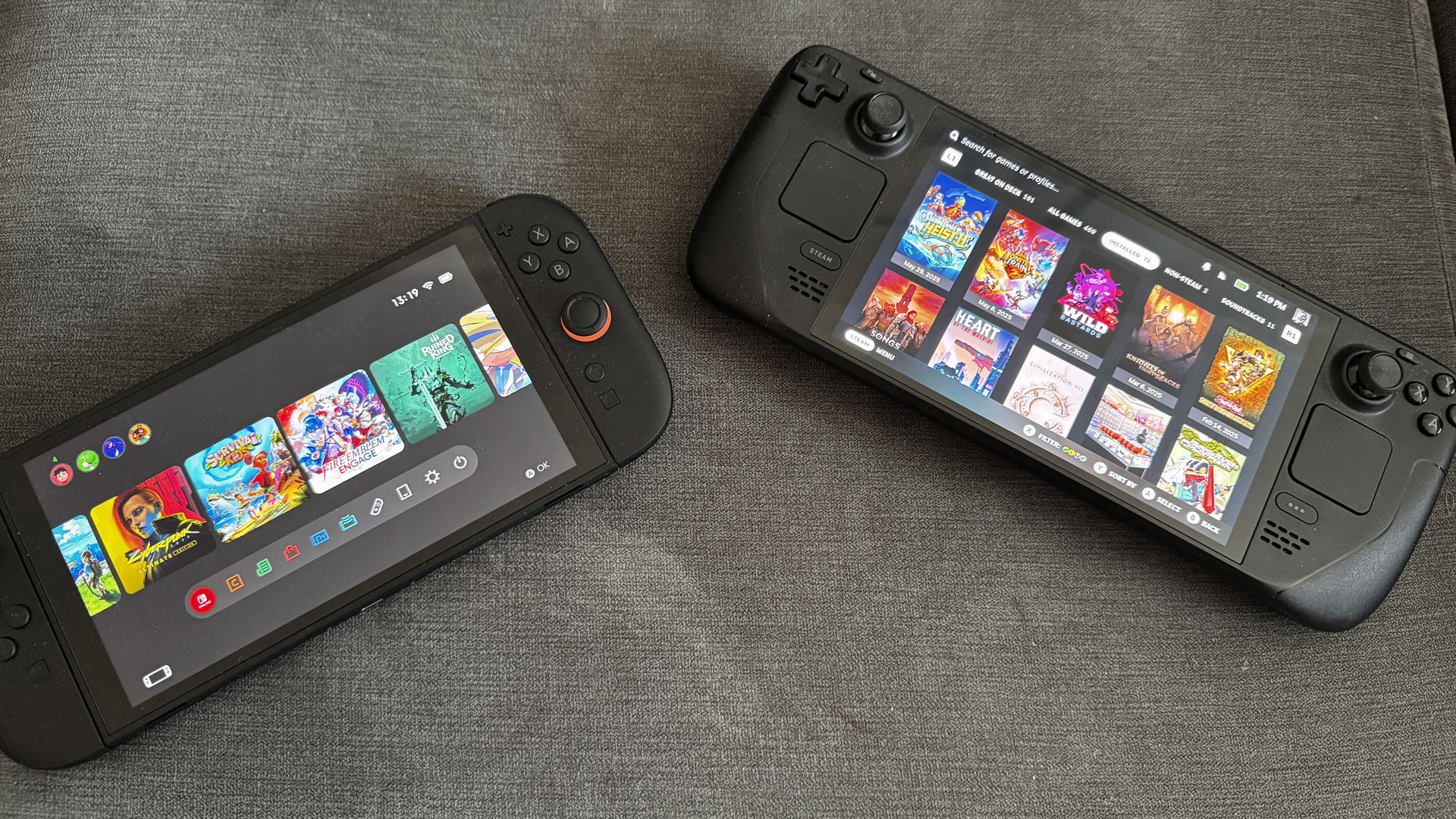
When the original Steam Deck was first announced back in mid-2021, it was a revelation. Valve proved that handheld gaming PCs could be cost-effective and still powerful enough to run demanding software at playable framerates. The first-generation Deck would ship in February 2022, with the Steam Deck OLED model later innovating with a larger, prettier screen, improved refresh rate, and a superior battery in November 2023.
The Steam Deck impressed at the time with its respectable semi-custom AMD APU complete with its four-core (eight threads) CPU clocked between 2.4 and 3.5 GHz, and 8 RDNA 2 Compute Units clocked at 1.6 GHz.
In short, the hardware inside meant that pushing the best PC games to 30 FPS (and above in some cases) at its native 1280 x 720p resolution was a possibility, but the competition has proven that it’s time for Valve to go back to the drawing board if it wants to stay competitive.
That’s because the Steam Deck is now fairly underpowered when compared to the best PC handhelds on the market. The competition have Full HD (1080p) displays (or <a href="https://myappsplus.com/a-better-grip-on-iphone-photography/” title=”A Better Grip on iPhone Photography”>better), and feature vastly superior hardware in the form of AMD Ryzen Z1/Z2 or Intel Arc G3 APUs that run rings around the previous-generation frontrunner. So, what does Valve need to do to ensure the Steam Deck 2 can compete if, and when, it launches?
1. A 120Hz Full HD (1080p) OLED display as standard
Both the Steam Deck LCD and Steam Deck OLED models feature a native resolution of 1280 x 720p with either a 60Hz or 90Hz refresh rate. Considering when the former was launched, this was an acceptable trade-off for providing playable framerates. However, every competing product in the oversaturated space has since eclipsed this, meaning the Steam Deck 2 absolutely needs a 120Hz 1080p display at a minimum to be viable.
You only need to look as far as the biggest rivals from back in 2023; the Steam Deck’s panel was passé less than a year after the hardware debuted, as evidenced by the Asus ROG Ally and Lenovo Legion Go. Both devices could confidently be called true Steam Deck rivals. The first-generation ROG Ally had a 7-inch 120Hz 1080p panel, whereas the original Legion Go had a 144Hz 8.8-inch QHD+ screen.
I’ll always argue that anything above 1080p on a display as small as seven or eight inches ultimately results in a waste of resources, and it seems hardware companies got the hint in 2024. More than two years ago, the MSI Claw A1M launched with a 7-inch Full HD screen, as did the Zotac Zone, Asus ROG Ally X, Asus ROG Xbox Ally X, Lenovo Legion Go S, and Lenovo Legion Go 2, as well as recent releases such as the MSI Claw 8 EX AI+. There’s no need for Valve to look to 1440p (QHD), but the company needs to get with the times to avoid being left behind; lacking a decent screen would kill the Steam Deck 2.
2. A semi-custom AMD Zen 4 and RDNA 3.5 APU (or better)
It’s never been Valve’s style to throw standardized components into its hardware. While the competition was comfortable using the AMD Ryzen Z1 or Z2, or gave Intel Arc graphics a go, the Washington-based company had to go a different route. We saw this with the semi-custom APU inside the Steam Deck and Steam Deck OLED, but this design philosophy has since been repeated with the recently released Steam Machine.
Valve’s living room PC features a semi-custom AMD APU that utilizes a six-core (12 threads) Zen 4 CPU and an RDNA 3-powered GPU with a total of 28 Compute Units and 8GB of GDDR6 VRAM. This home-console rival was said to offer “six times the horsepower” of the Steam Deck, and the tech could act as the perfect blueprint for what should be inside the Steam Deck 2.
Now, considering the portable nature of a Steam Deck successor and the lack of an active cooling solution, combined with the price tag (I’ll get to that further down the page), it’s unlikely that the Steam Deck 2 will be as powerful as the Steam Machine, but it could close the gap. The Steam Machine uses around 170W of its total power draw when plugged into mains, with 110W dedicated to the GPU, 30W for the CPU, and the rest of the components (RAM, fans, SSD, etc.) accounting for the other 30 to 60W of draw.
When plugged in, the Steam Deck OLED draws a maximum of 45W (or 15V at 3000mA). When on battery power, Valve’s handheld draws anywhere from four to 27W depending on the task at hand. Obviously, battery life has to be a huge consideration here as well, so we aren’t going to see upwards of 100W for a handheld. Today’s competition, chiefly the MSI Claw 8 EX AI+, can provide 30-60 FPS in High settings in 1080p in either 17W or 35W on battery, but that comes at its own (literal) cost.
That’s the power potential, but what about a close approximation of how a semi-custom RDNA 3 or RDNA 3.5-backed APU could perform inside the Steam Deck 2? Well, the closest we can get is with the performance jump from the AMD Ryzen Z2 compared to the Z1. At lower TDPs, the Z2 offers a generational leap anywhere from 4W to 40W, offering playable framerates of at least 30 FPS in 1080p, which is the only standard requirement for a Steam Deck Verified game in 2026. In particular, the Z2 Extreme features 16 RDNA 3.5 Compute Units with a total boost clock of up to 2.9 GHz and 24GB LPDDR5x-8000 memory; Valve could use something similar.
3. A sub-$1,000 / £1,000 price tag
When the Steam Deck was first revealed and distributed, it was sold at a loss. Prior to the original model’s release, Gabe Newell said this decision was “painful” but “critical” for the hardware to break through to the market. Affordability and competitive performance took priority over outclassing the competition, and that was the core appeal of the Steam Deck, especially in the early years.
Well, it’s nearing the end of 2026 now, and hardware companies (including Valve itself) have not learned from this example. The Steam Deck was successful because it was an affordable and powerful entry point into PC gaming, but that’s a reality that’s (unfortunately) becoming harder to remember as time marches on. The ongoing RAM crisis has meant the Steam Deck OLED shot up in price by 50%, and sales are also plummeting, and consumers have already begun to argue that handheld gaming PCs are back into the unaffordable niche product they were pre-2021.
To course-correct, Valve needs to offer the Steam Deck 2 for less than $1,000 / £1,000 / AU$2,000, at least for its base and mid-range configurations. We’ve seen growing backlash from gamers against rising prices recently, particularly with the eye-watering MSRPs of the new Asus ROG Xbox Ally X20 (starting at $1,299.99 / £1,299.99) and the aforementioned MSI Claw 8 EX AI’s shocking $1,799.99 / £1,399.99 entry point. To remain competitive, Valve needs to undercut the competition here, even if it means sacrificing some superficial features and maybe even peak performance.
In other words, Valve needs to remember why the Steam Deck succeeded in the first place: it was powerful enough and affordable enough to make everyday people consider PC gaming. It’s a tall order given we’re currently in one of the worst times in the computing industry in recent memory, where the price of GPUs, RAM, SSDs, and anything else that uses memory are skyrocketing with no signs of slowing down. Even if the Deck 2 is originally sold at a small loss, it would go a long way to prove that Valve can be pro-consumer again, as it lost favor with the Steam Machine’s so-so performance for the price tag.
4. TMR sticks and mechanical buttons
Now that we’ve covered a prospective Steam Deck successor’s price tag, specs, and screen, it’s time to talk about ergonomics. While both versions of the Steam Deck are comfortable in the hand for long play sessions, the actual buttons and sticks leave a lot to be desired. Likely due to a price constraint, the handhelds utilize the standardized potentiometers, with physical parts that can cause wear and tear over time. If left unchecked for long enough, it can eventually lead to stick drift, which can be frustrating (and expensive) to repair.
Magnets are the way to go, then. It’s tough when weighing up what would be the better technology for the Steam Deck 2’s analog sticks, as both Hall Effect and TMR (Tunnelling Magnetoresistance) have their pros and cons. However, it’s TMR that pulls ahead in this case for a couple of key reasons: it’s more sensitive, accurate, and (thankfully) cheaper to implement now than a couple of years ago. There’s a reason why so many of the best PC controllers on the market are already using TMR, so Valve would be missing an open goal if it cheaped out unnecessarily here.
TMR sticks and magnetic sensing technology as a whole are far superior and lead to fewer points of failure, ensuring longevity. It’s essential for a handheld like the Steam Deck 2. Modern PC controllers, such as the Scuf Envision Pro 2 and the Scuf Omega, have led the charge with microswitch buttons and D-pads.
They not only provide instant actuation for more precise inputs, but they will also last longer than a pure membrane alternative. It’s not just about immediacy and feel in the hand, but also about how this design decision could influence long-term use. Ideally, you would want a Steam Deck 2 to feel as good as the day you bought it, even five years afterwards.
5. A bigger and more efficent battery for longer (or more demanding) sessions
Any good portable device, whether it’s the best phone or a Steam Deck successor, lives and dies on how good the battery life is. The original Steam Deck featured a 40 Wh (or 5200 mAh battery, whereas the Steam OLED bumped things up to 50 Wh (or 6,470 mAh). That netted you anywhere from two to 12 hours depending on the kinds of games you were running, with indies at low brightness yielding better playtime than a AAA release at full brightness would. On average, though, around two to four hours is considered the standard.
That’s fine, sure, but Steam Deck rivals have since included larger batteries with longer average playtimes, and this is something Valve can directly address. For example, the Asus ROG Ally X has an 80Wh battery, meaning it can last anywhere from four to six hours of playback of intensive games played at 25 to 30W under the right conditions. That’s a battery size increase of 60%; considering how many more lithium-ion batteries are being made in a compact or portable form factor, it means that this component cost could be cheaper than in 2021/22, and a larger battery could be among the top features of the successor device.
Ultimately, we want the ability to sit down and play our games on the sofa or on the move for longer, so offering a bigger battery with a superior lifespan would give the Steam Deck 2 the edge it would need. If Valve can bump the resolution up, tighten the ergonomics, increase the horsepower, and keep the costs down, then the second-generation of its handheld could be the best on the market.
