

OpenAI added connected apps to ChatGPT’s voice mode on Wednesday. If you ask Live about your email, your calendar or a Slack thread, ChatGPT can now pull the answer from that service while you talk and show written responses in the chat. The feature works on the web, iOS and Android. Free and Go users get it too, limited to the plugins their plan supports. Voice also arrives in ChatGPT Work, the area for documents, presentations and spreadsheets, which requires both Voice and Work access.
The update does not create new access. According to OpenAI, “Existing app connections, permissions, and usage limits apply.” If Gmail is already connected with permission to send, as ChatGPT has allowed for two Google accounts at once since August, voice mode can use those same rights.
Approval happens on the display
The main limit is spelled out in OpenAI’s Voice FAQ: “If an action needs your approval, Voice will prompt you to review it on screen. Use the on-screen controls to approve or decline; spoken approval is not supported.” Saying “yes, send it” after ChatGPT reads out a draft does not send the email. In the car or with the phone in a pocket, the task waits until you look at the screen.
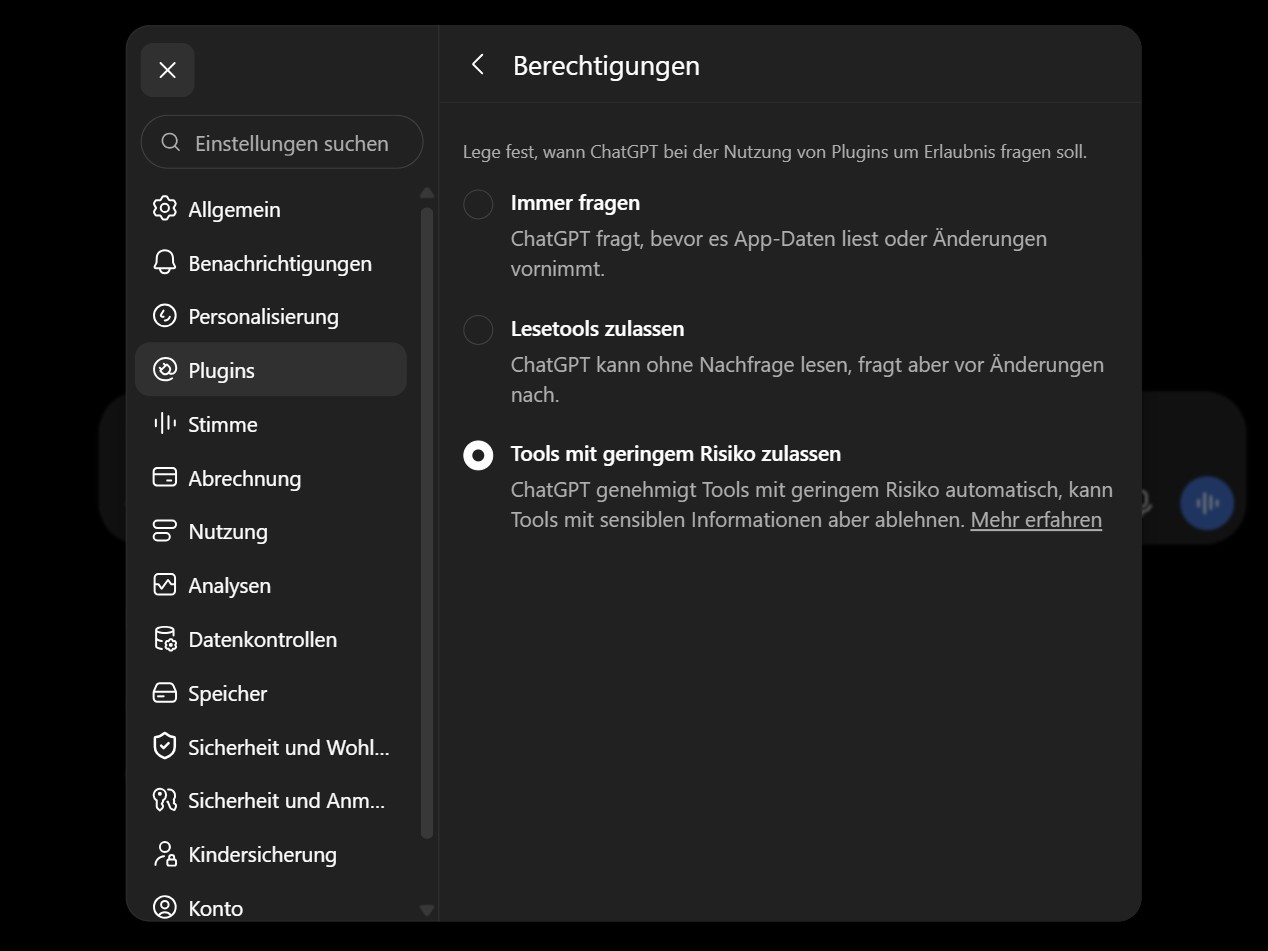
When ChatGPT asks at all depends on a setting under Settings, Plugins, Permissions. With “Always ask,” ChatGPT asks before it reads app data or makes changes. “Allow read actions” reads without asking and asks before changes. “Allow low-risk actions” approves lower-risk items automatically and asks for the rest. That third option was selected in a personal German account we checked, which had never connected a plugin. OpenAI lists sending an email, message, comment or invitation as higher-risk, along with creating, editing or deleting files, changing security settings and financial transactions. The help page also describes “Allow all actions,” which skips approval prompts. It did not appear in the personal account we checked.
How to disconnect an app
For voice mode, read access matters more than sending. Under “Allow read actions,” a question like “What’s in my inbox today?” gets an answer from Gmail without a prompt, and the low-risk option will usually behave the same way. If you want a prompt every time, switch to “Always ask.” OpenAI points out that “Changing an app permission does not disconnect the app or revoke access already granted.” To cut access, open Settings, Plugins, select the app and disconnect the account there.
The conversations leave records as well. OpenAI keeps audio clips from Live conversations for 30 days and deletes them with the chat unless it needs them for security or legal reasons. The new privacy center does not change defaults like these.
OpenAI Help Center: ChatGPT release notes, plugins in Voice and Voice in Work, September 23, 2026
OpenAI Help Center: ChatGPT Voice FAQ, on-screen approval and audio clip retention
OpenAI Help Center: Managing app permissions in ChatGPT and disconnecting apps
9to5Mac: OpenAI upgrades ChatGPT Voice with plugins for email, calendar and Slack
<a href="https://techcrunch.com/2026/09/23/chatgpt-mobile-app-gets-voice-based-agentic-features/” rel=”nofollow noopener” target=”_blank”>TechCrunch: ChatGPT mobile app gets voice-based agentic features
⟨
Previous article
First hands-on photos of Casio’s limited-edition MRG-B2100HR showcase unique dual-nature finish
> Expert reviews and news on laptops, smartphones and tech innovations > News > News Archive > Newsarchive 2026 09 > ChatGPT Voice can now use your apps, but approvals stay on screen
Steffen Zahn, 2026-09-26 (Update: 2026-09-26)
