

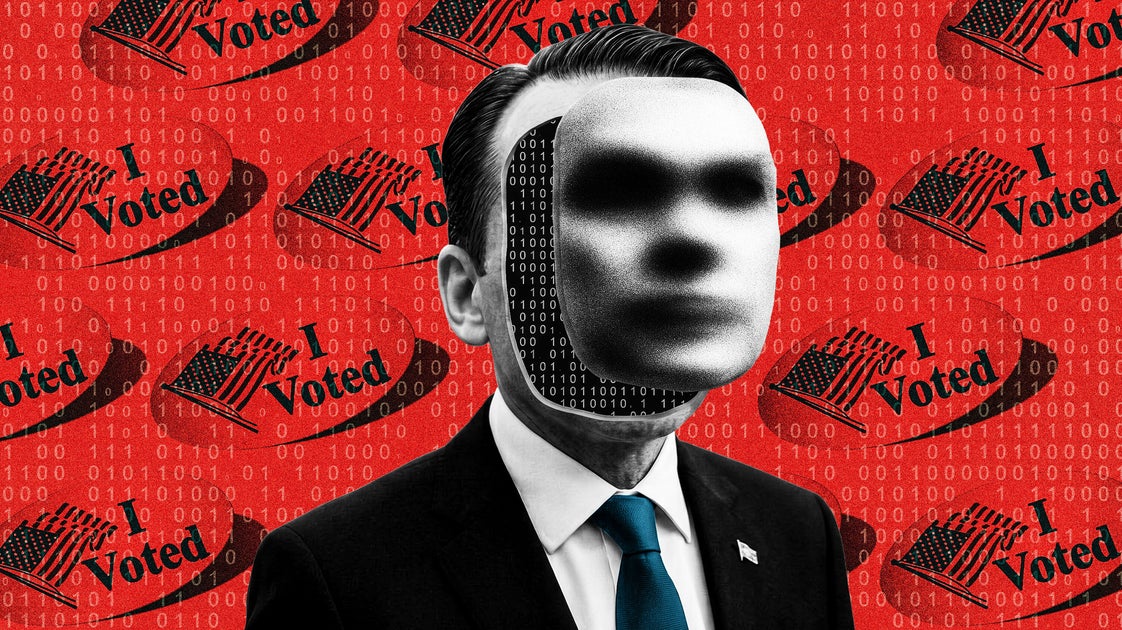
It’s roughly 45 seconds into the clip when the salient point is revealed: “This ad was created with AI.”
The words come from the mouth of Pennsylvania Gov. Josh Shapiro (D). Except it isn’t Shapiro. It’s an AI “deepfake” version of him in a video supporting his Republican challenger, Stacy Garrity.
Welcome to “the first AI election.” That’s how Travis Ridout, co-director of the Wesleyan Media Project, sees the 2026 midterms, the first in which campaigns have truly embraced artificial intelligence.
According to Wesleyan University’s tracking of election advertising, $137 million was spent on 220 ads that are at least partly AI-generated up until Oct. 11, with most of the spots sponsored by Republican candidates or groups. By contrast, the project identified just $50,000 in spending on AI-generated ads in the 2024 cycle.
Researchers and campaigns agree that AI-assisted ads are here to stay. Ad directors talk enthusiastically about how technology has allowed creativity to flourish on tight budgets and carry out the menial “laundry” work that buys space and time to work on the bigger thinking.
But explosive growth from 2026 onwards is not a given, they say. Voters are deeply uncomfortable with “AI slop,” controversy engulfs deepfakes, and a patchwork of laws has led to a “de facto ban” on the technology in some states.
And it would be a reach to say the midterms have reached a nightmarish “slopocalypse,” where AI-fueled drivel is overwhelming. The $137 million AI spend is a drop in the bucket compared to the billions of dollars lavished on campaigns.
“I suspect a lot of campaigns are going to wait and see how well this is received before jumping in with both feet in the future,” said Ridout.
“What is the appetite of professionals to put AI front and center in ads if the public is turning against AI?”
– Trent Wisecup, partner and creative director at FP1 Strategies and consultant for GOP campaigns
The Shapiro ad represents perhaps the most heightened version of a tactic — generating a “candidate likeness” — that, as of now, is predominantly being used by Republicans, often in battleground races.
Georgia Sen. Jon Ossoff (D) warned of “a slippery slope toward the destruction of truth in political debate” after a fake version of him was depicted in a hair and nail salon in a disclaimer-free 30-second ad hyping his GOP rival, Rep. Mike Collins.
Ads supporting Bruce Blakeman, the Republican candidate for New York governor, in his battle against Gov. Kathy Hochul (D) are so frequently AI fabrications that a complaint has been filed with electoral officials over “misleading” voters.
Democrats have made a point of their relative abstention from AI in the New York race. “Unlike Bruce Blakeman, we don’t use AI to make our videos,” wrote New York City Mayor Zohran Mamdani while introducing an ad that hails Hochul as “the real deal.”
Ridout argues that many of the ads labeled as AI-assisted are not especially problematic. AI might have generated background actors, not unlike creating customized secondary “b-roll” footage that directors would typically pull from an agency such as Getty or
For Trent Wisecup, a political consultant involved in Republican campaigns in almost all of the battleground Senate races, AI is “embedded into every aspect of our creative process.” This includes producing background footage but also testing ideas with supplementary focus groups that he calls “synthetic panels of AI personas.”
On the other side of the aisle, Larry Huynh, the managing partner of Democratic consulting firm Trilogy Interactive, uses AI to streamline manual work, which frees up time to “work on the things that really get you juiced.” He cites using AI to enhance existing content, specifically removing a buzzer sound interrupting a candidate while making a clip-worthy statement at a debate.
Far more contentious is how AI ads are labeled, thanks to laws dictating how transparent candidates should be.
Four states — California, Maryland, Minnesota and Texas — have laws that prohibit certain uses or types of AI-generated deepfakes in political messaging, and 27 states insist on some form of disclosure.
It’s a patchwork, which largely explains the Wesleyan Media Project’s uneven findings. It discovered ads assisted by AI in 34 states, suggesting some markets are no-go zones. And only 27% of the ads researchers came across included a disclaimer, which raises questions about honest disclosure.
Ridout thinks concern should focus less on whether AI is used as a tool to produce an ad, and more on how far a spot is a “departure from reality.” He thinks this quandary may inform how states approach labeling ads in the future.
“If I’m using it to do some very simple things, but technically I then have to have a disclaimer that I’m using AI, you get concerned that that affects the entire impact of your ad.”
– Larry Huynh, managing partner of Democratic consulting firm Trilogy Interactive
Wisecup says it’s “unfortunate” that opaque regulations are stopping the “incidental uses of AI in campaigns,” pointing to how Michigan requires a spoken disclaimer on ads — a “de facto ban on the use of AI” in the state. “Nobody really wants to go through that many hoops to deploy AI in an ad,” he said.
Huynh, who is co-chair of the American Association of Political Consultants’ committee on AI, calls the regulations a “mess,” problematic even for the limited use of AI in campaign videos. “If I’m using it to do some very simple things, but technically I then have to have a disclaimer that I’m using AI, you get concerned that that affects the entire impact of your ad,” he said.
The public’s dim view of AI is perhaps the most powerful restraint on wall-to-wall AI advertising in 2026.
According to Ridout, using AI deepfakes is a high-wire strategy. “There are risks to using them as well as potential rewards. I don’t know which outweighs the other at this point,” he said, adding that around 45% of the AI-assisted ads the college researchers identified included a “photorealistic deepfake” of a candidate.
Wisecup, a partner and creative director at FP1 Strategies, says future public opinion is among a series of “unknowns” potentially undermining the rise of AI ads. “What is the appetite of professionals to put AI front and center in ads if the public is turning against AI?” he asked.
And yet he believes AI is “transformative technology,” allowing a director on a tight production budget to think like a Madison Avenue ad man and push ahead with an idea that would otherwise have been junked because of cost.
Wisecup is an advocate for ads created entirely with generative AI, especially as a tool for satire and parody, if it’s used responsibly and ethically. “I think it plays better if it has a humorous bent to it,” he said.
He highlights a 30-second ad he created for a super PAC supporting the South Carolina gubernatorial campaign of Republican Attorney General Alan Wilson, which mocks rival Rep. Nancy Mace (R-S.C.) and what the ad portrays as her liberal tendencies.
The ad, “Name That Nancy,” uses a game show conceit, complete with a studio audience and an announcer. In it, contestants are presented with a quote and asked whether the words were uttered by Mace or Democratic Party grandee Rep. Nancy Pelosi (D-Calif.).
An ad that would have cost $100,000 to make in the real world took Wisecup six hours to produce with AI.
“Nobody’s going to focus on the AI and be like, ‘Oh, they’re trying to deepfake me and dupe me into thinking something,’” he said. “It was just a funny, clever ad.”
But if they use deepfakes, campaigns risk entering a “danger zone” because “voters are going to reject that in probably a real and profound way,” he added.
On the Democrat side, Huynh says he has yet to find “a use case” for creating video entirely with generative AI.
“I think there is, at least on our side, some hesitancy on creating something with AI that didn’t exist before,” he said. It echoes the Wesleyan Media Project finding that only 12% of the AI ads it came across were sponsored by Democrats, and doubtless reflects the party’s candidates often opposing the unchecked expansion of AI data centers.
His team has “played around” with AI, Huynh said. But generative videos have “visual cues that feel like it was generated by AI,” which puts him off of the idea. Huynh is not certain AI ads will take off in the future since “people’s reaction to something that they feel is AI slop is real.”
“The public’s comfort with AI has changed very quickly,” he said, adding: “Even if I did something great with AI, and I’m trying to still convince voters of voting for my candidate or voting against another candidate, but they really hate AI right now, or AI is incredibly unpopular, I don’t know if I want to be associated with something like that.”
