

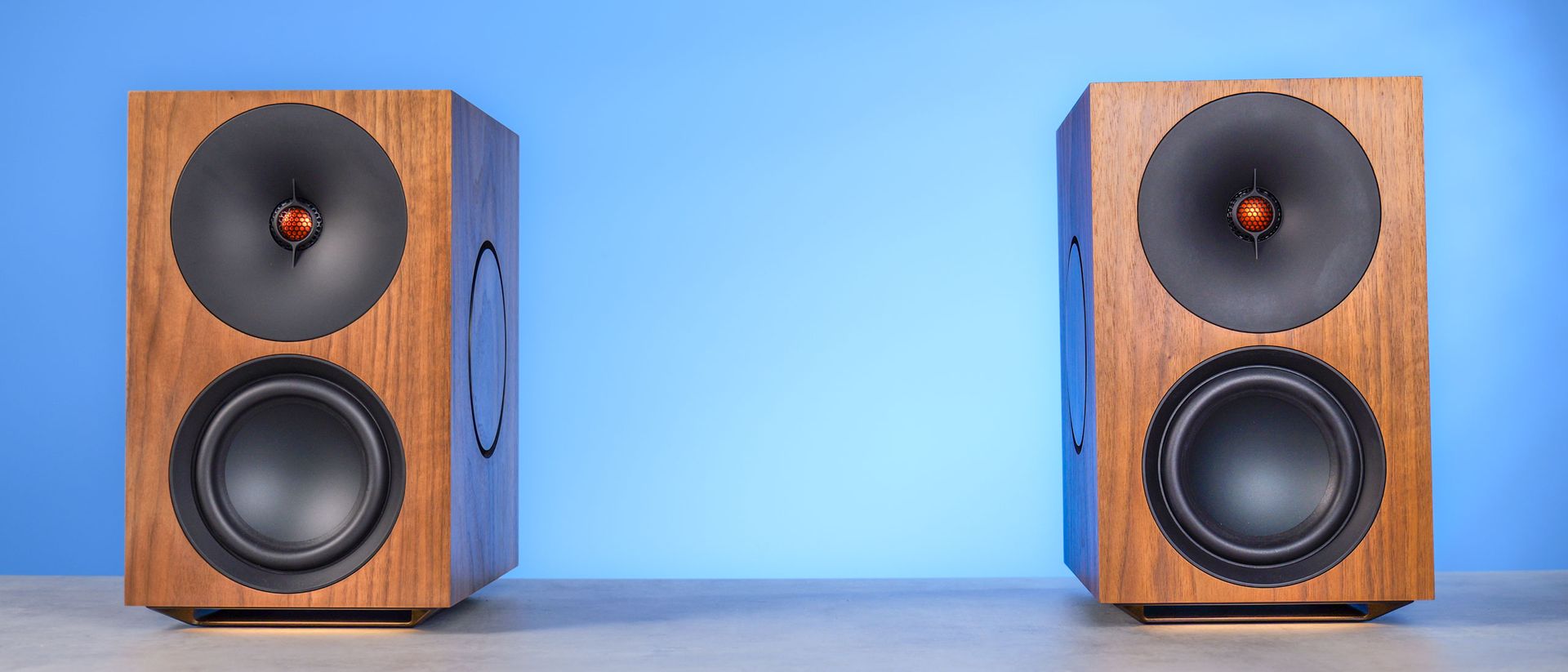
Cambridge Audio L/R X: Cheat sheet
Price: 3/5
Sound quality:4.5/5
Design:4/5
Connectivity: 5/5
Features:4.5/5
Overall score:4/5 (4.2)
Best for: Space-constrained hi-fi enthusiasts
Back at High End 2026 in Vienna, deeply fragile after a preceding night of plentiful Austrian lager, I took a trip to Cambridge Audio’s stall — the folks there were rather keen to show me something. After being supplied with a bottle of water and kindly reassured that I would survive, I was ushered into a testing room, beckoned into a chair and asked for a song pick.
I was then treated to a demonstration of the L/R X, the latest, largest and most powerful member of Cambridge’s L/R compact speaker range. And heck: hungover as hell though I was, it was indeed a treat. And that’s saying something — at High End, I heard no shortage of incredible audio gear.
I’ve since spent a couple of months testing the L/R X at home, and I’ve gotta say, I’m actually a huge fan of them all round. Aside from their relatively steep price, I have no major complaints. So could these be some of the best speakers for you? Find out in my full Cambridge Audio L/R X review.
Cambridge Audio L/R X review: Key specs
|
1x 1.1-inch tweeter; 2x 5-inch woofer; 2x 6-inch passive radiator |
|
|
Active w/ wireless speaker link & wired speaker link |
|
|
USB-C; USB-A; Phono; Aux RCA; HDMI eARC; Optical |
|
|
Wi-Fi; AirPlay 2; Google Cast; Qobuz/Tidal/Spotify Connect; Amazon Music; Bluetooth; Internet Radio. |
|
|
Black; White; Blue; Walnut; Orange; Green |
Cambridge Audio L/R X review: What I like
- Powerful bass and hi-fi sound
- Striking neo-retro design
- Plentiful connectivity & features
Powerful hi-fi sound, a dashing neo-retro aesthetic and bags of connectivity options and customization features — there’s a lot to love about the L/R X.
Sound quality
The L/R X might look like they have a single tweeter and 5-inch woofer, but don’t be deceived: inside the cabinet, Cambridge has squeezed a second 5-inch downfiring woofer. Combined with two 6-inch passive radiators, the result is bags of low-end power.
Now, don’t get me wrong, a second woofer is no replacement for an actual sub. The L/R X response bottoms out at 35Hz, so on any songs straddling that boundary, subbiness tends to come in fits and starts.
Still, for a set of bookshelf speakers these things go impressively low, with ample power low down. The bottom woofer gives you the same sense of upwards swooping bass as a sub, demonstrated perfectly during the enormous wave of sub bass at the end of SOHN’s ‘Antigravity’ (which was truly window-shaking, especially in the bass boost EQ preset). It’s all deftly controlled, though, despite the power — each undulation of bass guitar in Odetta’s ‘Hit Or Miss’ was easy to trace, with no muddying or booming at all.
My only slight issue was a lack of attack in the lower mid-range, especially on busy tracks with heavy basslines. The dual distorted guitar riffs of Melvins’ ‘Honey Bucket’ felt a little smeared into one another, and I had the same problem on other sludgy songs like Metallica’s ‘Seek & Destroy’ and ‘Siva’ by The Smashing Pumpkins. However, this was mostly solved with a tweak to toe angle and some messing around with the software room acoustics settings found in the Cambridge app (more on this later).
Vocals sound absolutely fantastic, with Kelly Jones’ smoky voice carrying beautifully above the kick drums and guitars of Stereophonics’ ‘Just Looking’. And the higher end proved nice and crisp, with the ethereal vocals and delicate percussion of James K’s ‘Hypersoft Lovejinx Junkdream (Priori remix)’ sounding airy and spacious.
You’ll definitely want these speakers on stands. Obviously, speakers tend to sound better on them anyway, but that downfiring woofer will naturally shake anything underneath it to cause ugly rattles. Cambridge supplied me with a set of prototype stands, so although I can confirm they’re definitely in the works, you can’t buy any at the time of writing.
The stands I was sent were just basic flat-topped stands, atop which the L/R X’s weight keeps the speakers firmly planted — that means a basic set of third party flat-topped stands will do the trick.
Listen along to my testing playlist onQobuz, in our opinion thebest music streaming servicefor audiophiles.
Design
Just like their little siblings, the Cambridge L/R S and L/R M, the L/R X utilize a modern and clean design, with a dash of neo-retro from the tweeter housing. I think they look great, and I absolutely love the gentle mood lighting between the cabinet and metal riser. There are also the passive radiators on each side, which visibly vibrate when music is playing — so cool.
Of course, beauty is all in the eye of the beholder, so while I behold the L/R X well, my wife does not, disparaging them each time she enters the room. I guess you could call them divisive at worst, but honestly I think that’s unfair. In hindsight, I probably ought to have asked for a review unit in one of the many other colors Cambridge offers — the dark blue or green to match our lounge decor might’ve been a better shout. Alas.
If I were to rank them, then yeah, I prefer the timeless look of my Ruark Sabre-R, and also the more minimalist, monochromatic look of the Kanto TUK Grand Gen 2. But I much prefer the L/R X styling over the über-futuristic DALI Kupid.
Size-wise, oh they big. If your media unit is already full or you have shallow bookshelves, this could be an issue — the mid-sized L/R M or Ruark Sabre-R might be a better shout. That said, one of the L/R X’s crowning glories is the wireless hookup between speakers, which I’ll cover more later. In short, it gives you a lot of flexibility with placement and could remedy any worries about space.
Connectivity
These are some hooked-up speakers! And not just the normal stuff. Sure, there’s Bluetooth, Qobuz/Tidal/Spotify Connect etc etc. There’s a remote control, app hook-up, yada yada. Most importantly, though, each speaker is individually powered (so no amp or AVR required) and can connect wirelessly to the other with up to 24-bit/192KHz transfer, meaning there’s no need for a connecting cable. As I mentioned above, that gives you lots of flexibility with placement, providing you have each near a power outlet. It was lovely being able to move the L/R X around for the best sound without an annoying cable.
A swanky braided USB-C cable is included for wired pairing, though. The speakers will only pair over the same Wi-Fi network, with the main speaker connected to the StreamMagic app. If your Wi-Fi goes down, just hook up
I/O-wise, you’ve got USB-A and USB-C input, phono AUX in, a phono stage for turntables, an Optical port, and an eARC HDMI slot for hooking up to your TV. There’s also a sub out port if you want even more subbiness. A decent array.
Features
These speakers are dripping with features, settings, tweaks, whatever you need. I’ve already touched on a few throughout this piece, and it all comes down to the extensive capabilities of the StreamMagic companion app. There’s a 10-band equalizer, which, while rather simplistic (I would’ve preferred a parametric EQ) is always handy nonetheless. Cambridge has tuned the L/R X for large rooms, but there’s a dedicated room acoustics panel to account for room length, speaker placement/wall gaps, and furnishings.
Initially I found the L/R X a little too bright and fatiguing, but simply tweaked the furnishings slider to compensate — a super quick fix that stopped me needing to mess around with EQ, placement or furniture. As I mentioned above, I had to play with toe angle and spacing anyway to clean up the mid-range, and used the room acoustics panel to make software refinements as I did.
There’s also a setting called DynamEQ, which boosts bass and treble at quieter volumes. That means you don’t have to sacrifice top and bottom end clarity if you can’t (or aren’t inclined to) blast it.
You can customize lighting, choose the primary speaker positioning, set standby times, and apply volume limiters. It’s an impressive roster of controls, and I’m not sure how I can go back to speakers without all this. It’s worth noting that I haven’t had a single issue with the StreamMagic app, either. It’s slick, polished, and has worked reliably throughout my entire time testing.
Cambridge Audio L/R X review: What I don’t like
This section’s gonna be pretty thin, as there’s only one thing I don’t like about the L/R, and that’s the price. In the world of high-end hi-fi, though, they aren’t beyond the pale.
Price
The Cambridge Audio L/R X cost $2,399 / £1,799 per pair direct from Cambridge Audio. Alternatively, you can buy them from Cambridge’s authorized retailers, which includes Sweetwater and Upscale Audio in the States; or Richer Sounds in Britain.
Obviously, these will be a considered purchase. $2,399 isn’t an impulse spend for most people. That said, hi-fi gear is simply expensive. And besides, the L/R X pack plenty of low-end power, which could save you buying a subwoofer.
As I’ll cover below, though, you can pick up similarly powerful speakers for a lot less than this, like Klipsch’s The Nines ($1,599 MSRP).
Cambridge Audio L/R X compared
As I touched on above, the L/R X are pricier than other large bookshelf speakers, but they offer a lot of power and tons of features. If you’re looking to save a little money you could check out the Kanto TUK Grand Gen 2 ($1,199 a pair), or the DALI Kupid ($600 a pair). Both are passive speaker sets so need amplifying. Although they pack plenty of power, bass lovers will probably want a sub.
The L/R X’s fiercest rivals are Klipsch’s active speakers, The Sevens and The Nines. The Sevens feature 6.5-inch woofers, while The Nines feature massive 8-inch woofers for excellent bass performance. Even at the $1,599 MSRP, The Nines have the L/R X beat, although you can find them for under a grand. The L/R X’s upper hand is their increased wireless connectivity and slicker app — essentially they’re a better blend of power and usability.
Who should buy the Cambridge Audio L/R X?
If you’re a serious hi-fi enthusiast who wants big sound, yes. That’s especially true if you’re somewhat space constrained or simply want to go without wires as much as possible. The L/R X offer tons of clarity and power, but give you the flexibility to put them wherever you need and tweak the sound easily to whatever room they’re in. They’re pricey, yes, but they’re aimed at people willing to spend for the right sound. And in my eyes, the completeness-of-package offered by the L/R X simply can’t be matched.
