

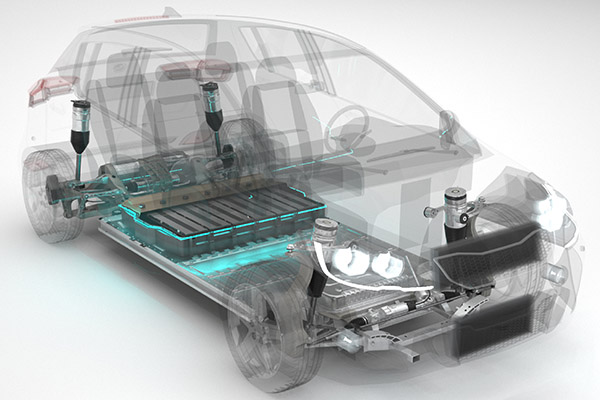
The Breaking It Down series aims to inform and inspire people by putting advanced manufacturing technologies and processes into simpler terms.
Banner Color
Light Text on a Dark Overlay (Default)
Jump To
Anatomy
Uses
Support
Get Involved
Learn More
With electric vehicles (EVs) that get us places, cell phones that connect us to others, and utility-scale electric grid storage that powers our homes, batteries are all around us.
Batteries can be either mobile, like those in electric vehicles, or stationary, like those needed for utility-scale electricity grid storage.
Trivia Question

When was the first battery invented?
Read on to find out!
What Is a Battery Made of?
You’ve probably heard of lithium-ion (Li-ion) batteries, which currently power consumer electronics and EVs. But next-generation batteries—including flow batteries and solid-state—are proving to have additional benefits, such as improved performance (like lasting longer between each charge) and safety, as well as potential cost savings.
These next-generation batteries may also use different materials that purposely reduce or eliminate the use of critical materials, such as lithium, to achieve those gains.
Lithium- or Sodium-Ion Batteries
The components of most (Li-ion or sodium-ion [Na-ion]) batteries you use regularly include:
- Electrodes (cathode, or positive end and anode, or negative end)
- Electrolytes, which are generally liquid solutions
- A separator, which keeps electrodes and electrolytes separate and is made of metal
- A current collector, which stores the energy.
Today’s Li-Ion Batteries

Tomorrow’s Na-Ion Batteries

Solid-State and Flow Batteries
Tomorrow’s Solid-State Batteries
Solid-state batteries use solid electrolyte solutions, which don’t need a different separator. That makes them safer because they are less prone to leakage from damage or swelling in hot temperatures.
Tomorrow’s Flow Batteries
Flow batteries, which are powered by reduction-oxidation (redox) reactions, involve two different liquid electrolytes that pass ions or protons back and forth through a porous membrane. These batteries can store larger amounts of energy—as much as the size of the electrolyte cells can contain—and don’t use flammable or polluting materials.


What Are Next-Generation Batteries Used for?
Innovations in battery technology over recent decades have unlocked a wide range of technologies for various uses, many of which we rely on in our daily lives, such as:
- Portable electronics, like phones, laptops, power tools, wearable technology, sensors, and augmented reality devices.
- Transportation, including EVs, e-bikes, scooters, drones, boats, or ferries.
- Stationary storage, such as grid-scale energy storage to integrate advanced energy sources, balance supply and demand, and provide backup power.
- Industry, providing uninterrupted power supply for critical equipment in case of outages.
- Medical devices, which can be portable and implantable, such as insulin pumps, pacemakers, and hearing aids.


What Are the Advantages and Challenges for Batteries?

Since their invention, batteries have come to play a crucial role in enabling wider adoption of advanced energy and transportation technology.
Think about it: Having a place to store energy on the electric grid can allow advanced energy technology—like solar—to produce and save energy when conditions are optimal, ensuring there’s round-the-clock reliable energy on those (literal) rainy days.
Next-generation batteries are also safer (less likely to combust, for example), try to avoid using critical materials that require imports, rare minerals, or digging into the earth, and can store more energy (letting you drive further in your electric vehicle before finding a charging station, for example).
How Are We Supporting Next-Generation Batteries?
The U.S. Department of Energy (DOE) and its Advanced Materials and Manufacturing Technologies Office (AMMTO) is helping the U.S. domestic manufacturing supply chain grow to fulfill the increased demand for next-generation batteries.
Trivia Answer

The first battery was invented by Italian physicist Alessandro Volta in 1800 and eponymously named the “Voltaic Pile”. (The unit of electromotive force, “volt”, also comes from Volta).
Through DOE and AMMTO support, members of the industry, academia, government, and entrepreneurial sectors are reducing costs and increasing the availability and performance of next-generation batteries to meet future demand.
Instead of starting from scratch every time, manufacturers can customize and expand upon standardized tools and methods—often referred to as platform manufacturing technologies—that are designed to be flexible and adaptable, saving manufacturers time and resources.
That can also reduce the time to market for next-generation energy storage materials and devices and bridge knowledge gaps between small-scale R&D and large-scale commercial manufacturing, leading to immediate impact, increasing the commercial domestic supply of battery storage devices.
With a more robust battery manufacturing industry, not only can we increase the nation’s energy independence, but we can also create good-paying jobs for Americans.
Get Involved!
Learn more about the opportunities we’re supporting to bring next-generation batteries to the forefront.
Apply to Open Funding
- Funding Opportunity: Platform Technologies for Transformative Battery Manufacturing
- Lab Call: Battery Manufacturing Lab Call
- Funding Opportunity: Li-Ion Battery Recycling and Remanufacturing Technologies
Join Other Opportunities
- Funding opportunities
- Careers and fellowships
Follow AMMTO
Catch up on AMMTO’s other areas of research, news, success stories.

Funding Notice: Over $10 Million Available for High-Performance Computing Innovation Program
DOE will award up to $400,000 to small and medium-sized manufacturers and their National Laboratory, university, and non-profit partners.
Learn More about Funding Notice: Over $10 Million Available for High-Performance Computing Innovation Program
12 High-Performance Computing Projects Awarded $4.8 Million to Help Strengthen America’s Manufacturing Competitiveness
The funded projects will advance American high-performance computing innovation.
Learn More about 12 High-Performance Computing Projects Awarded $4.8 Million to Help Strengthen America’s Manufacturing Competitiveness
DOE Seeks Input on Strengthening America’s Power Electronics Sector
The U.S. Department of Energy’s (DOE) Advanced Materials and Manufacturing Technologies Office (AMMTO) released a request for information (RFI) to solicit feedback from stakeholders on AMMTO’s Wide Bandgap Power Electronics Strategic Framework draft.
Learn More about DOE Seeks Input on Strengthening America’s Power Electronics Sector
We Want Your Feedback on Enhancing Manufacturing of Materials for Harsh Service Conditions
AMMTO released a request for information (RFI) to gather input on its draft harsh environment materials (HEM) research, development, and demonstration landscape document.
Learn More about We Want Your Feedback on Enhancing Manufacturing of Materials for Harsh Service Conditions
DOE Announces Phase 1 Winners of E-Scrap Prize To Advance Critical Material Recovery From Electronics Waste
Ten teams from seven states have been awarded a collective $500,000 in funding plus national lab support as Phase 2 of the prize opens.
Learn More about DOE Announces Phase 1 Winners of E-Scrap Prize To Advance Critical Material Recovery From Electronics Waste
DOE Seeks Input to Dramatically Increase Energy Efficiency of Semiconductor Applications
Information will help inform the EES2 Initiative and associated roadmap.
Learn More about DOE Seeks Input to Dramatically Increase Energy Efficiency of Semiconductor Applications
U.S. Department of Energy Solicits Feedback on Its Plan To Increase Products and Materials Efficiency
Draft framework identifies opportunities and challenges to use circularity to improve industry efficiency, secure supply chains, benefit communities, and create jobs.
Learn More about U.S. Department of Energy Solicits Feedback on Its Plan To Increase Products and Materials Efficiency
Small Businesses Receive AMMTO Funding to Advance Innovative Manufacturing and Material Technologies
Each of the companies will receive approximately $1.15 million for Phase II SBIR awards.
Learn More about Small Businesses Receive AMMTO Funding to Advance Innovative Manufacturing and Material Technologies
Advancing Critical Materials
The Geothermal Technologies Office (GTO) has selected seven projects at four DOE national laboratories to receive more than $6 million for research and development that can directly aid in advancing and developing U.S. critical material supply chains.
Learn More about Advancing Critical Materials
33 Innovators Selected for the U.S. Department of Energy’s Lab-Embedded Entrepreneurship Program
In the latest round of cohorts in its Lab-Embedded Entrepreneurship Program (LEEP), 33 innovators will be embedded across four U.S. national laboratories to work with an extensive network of mentors and experts.
Learn More about 33 Innovators Selected for the U.S. Department of Energy’s Lab-Embedded Entrepreneurship Program
