


Hiring slows and competition remains high, govt report finds.
Despite high competition for roles, Australian IT employers ‘report challenges in finding candidates with specific technical skills’. Image:

The recruitment rate of Australia’s information technology (IT) industry fell “well below” the all-industry average in the last financial year, new government analysis shows.
Only 32 per cent of surveyed Australian IT employers were recruiting in the 2025-26 financial year, which is below the 49 per cent average across all other sectors, according to analysis by government agency Jobs and Skills Australia (JSA), released on Thursday.
The reportcited “subdued hiring activity” in the IT industry, as only 16 per cent of IT employers expected to raise their staffing numbers in the three months after they were surveyed – the lowest proportion in recent years and below the all-industry average of 19 per cent.
“While long-term [IT] employment projections remain positive, other labour market indicators point to changing conditions, including lower levels of online job advertisements, softer recruitment activity, and more subdued employer staffing expectations,” the report found.
The analysis used data from JSA’s Recruitment Experiences and Outlook Survey (REOS), with a sample size of almost 100 Australian IT employers from among more than 10,000 businesses who responded to the survey.
The agency’s findings “should be interpreted in their broader labour market context and not in isolation”, JSA said, due to what it called a “relatively small sample size for the IT industry”.
A similar drop in the industry’s recruitment rate also occurred in 2023-24, according to the report.
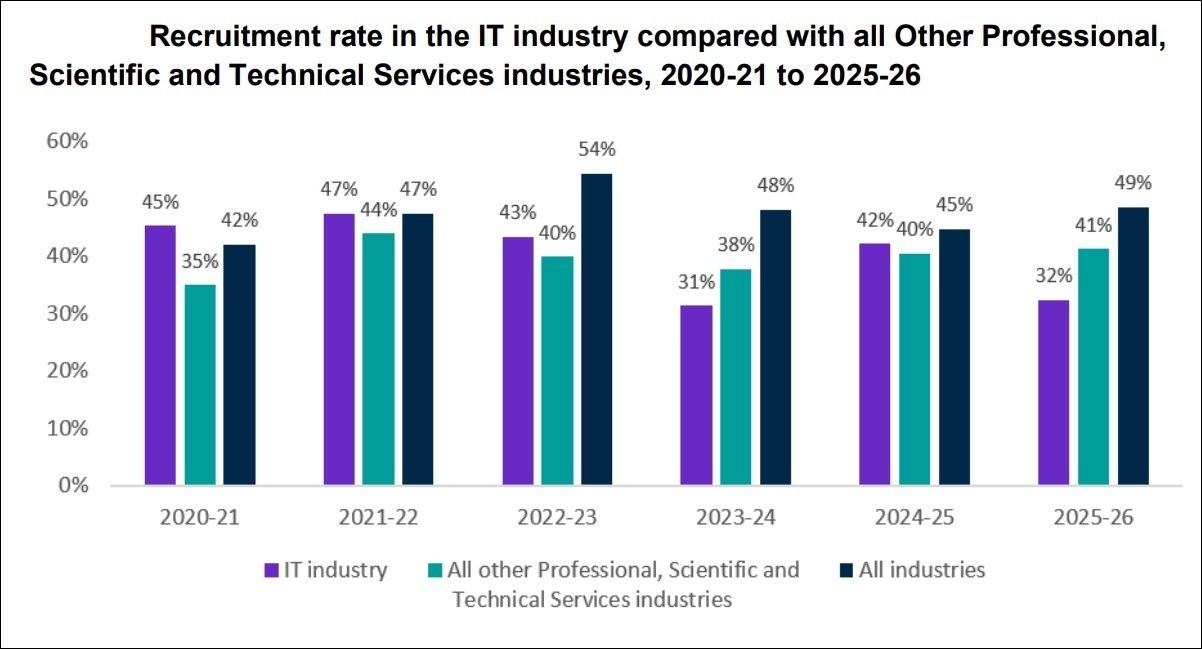
Chart: Jobs and Skills Australia ‘Recruitment trends in the IT industry’ REOS report
No shortage of applicants, but ‘a lack of technical skills’
Australia’s IT industry still has a “relatively large” applicant pool compared to other sectors, the report found, with around 34 per cent of recruiting employers receiving 20 or more applications per job vacancy.
This was the second-highest proportion of applications per role among the industries surveyed by JSA, behind only goods wholesaling, in which 37 per cent of recruiting employers received a similarly large number of applications.
Around 26 per cent of other professional, scientific, and technical services industries reported the same proportion of applicants, while the average across all industries was lower, at 19 per cent.
But the IT figures “should be interpreted with caution”, the JSA report suggested, because around one-third of recruiting employers “were unable to provide” information on the number of job applications they received.
Despite high competition for IT roles, employers “continue to report challenges in finding candidates with specific technical skills”, the JSA analysis found.
“A very low proportion of employers [5 per cent] cited a lack of applicants as a reason for difficulty, while a relatively high proportion [50 per cent] cited a lack of technical skills,” the agency said.
“… The findings suggest recruitment difficulties in the IT industry may be more closely linked to technical skill mismatches or an oversupply of candidates than a broad shortage of applicants.”
IT industry associations have reported skill shortages for several years, with some groups urging the federal government to improve domestic upskilling, and to better support skilled migration amid a “slowing down” in visa processing.
The key concerns of IT employers have also “shifted from recruitment and retention challenges to a lack of demand for products or services”, the JSA report suggested.
This included “a significant increase” in the proportion of IT businesses which cited a lack of demand, which has risen from only 8 per cent in 2023-34 to 43 per cent in 2025-26.
Still, the analysis found IT recorded the second-lowest recruitment difficulty rate over the past six years – second only to food retailing.
IT workers pessimistic as wage growth slows
A July survey of more than 700 Australian IT professionals by recruitment firm Clicks found only 23 per cent were optimistic about the sector’s current job market, while 44 per cent were actively pessimistic, and the remainder felt neutral.
The firm’s 19th annual IT Workforce Insights report, released earlier this month, found a record 45 per cent of respondents reported receiving no pay increase in the previous 12 months– and 19 per cent reported a pay decrease, in what Clicks said was a 10-year high.
“Confidence remains historically weak and salary growth is at its lowest level in our comparative data, yet technology professionals remain highly open to new opportunities,” Clicks CEO Tamara Ryf said.
“More than half of permanent employees intend to look for another role in the year ahead, while salary expectations have returned to longer-term levels after an unusually flexible 2025.”
The latest Australia’s Digital Pulse report by the Australian Computer Society (ACS) – the publisher of Information Age – found the nation’s technology workforce shrunk for the very first time in 2025, to around 967,000 workers.
As the sector has contracted, the Australian government’s industry department has also quietly stopped measuring its performance towards Labor’s goal of having 1.2 million workers in technology-related jobs by 2030.
recruitmentitjobs and skills australiaskillspayworkgovernment
