

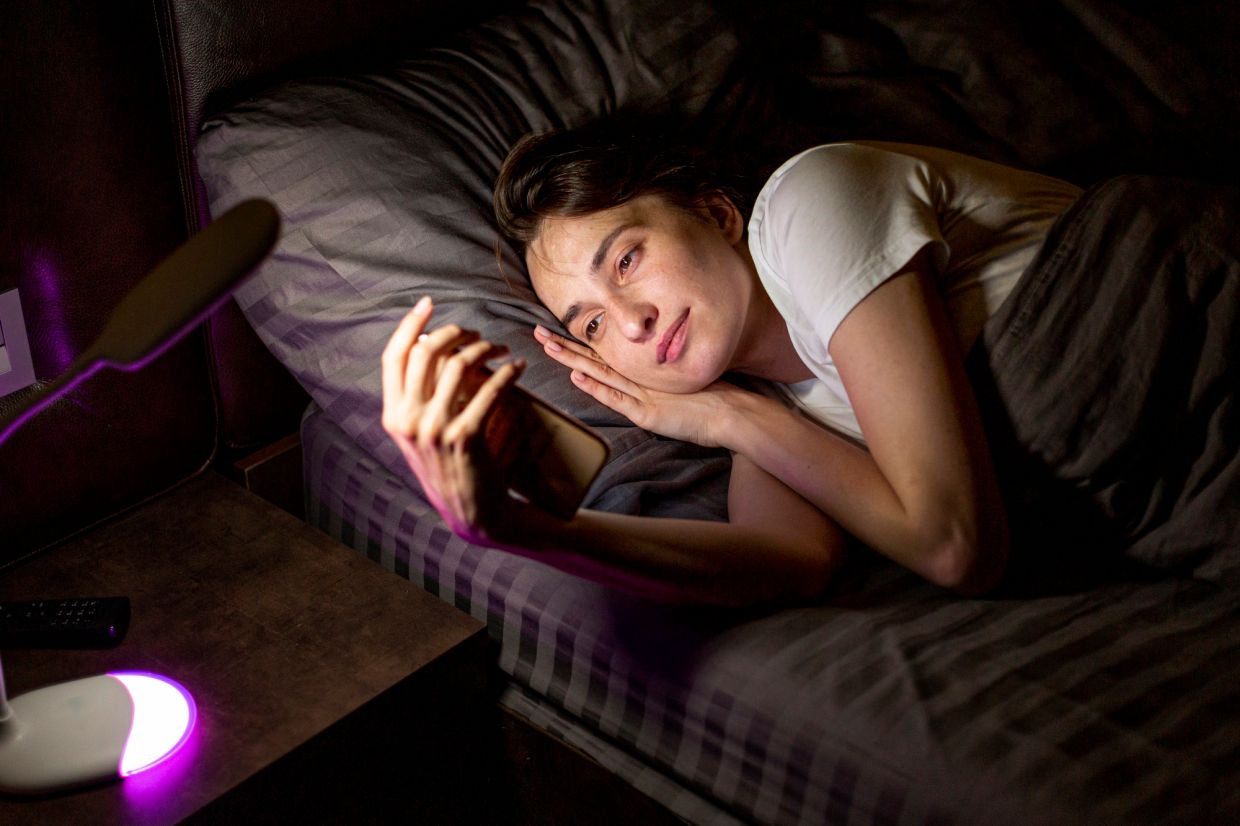
Many people want to reduce their screen time, but just can’t get themselves to do it. After all, our devices are filled with endless distractions and apps built to reward us like slot machines. And so an entire sector of apps and devices has sprung up to help us stop the endless scrolling.
Certain apps simply make your phone less appealing to use by putting it in grayscale, while some block apps entirely. Other apps and internal settings turn your device into a “dumb phone” by creating a minimalist interface that sits atop the phone’s full functionality.
Some are even willing to pay a premium for technology to physically lock them out of their most tempting apps and websites. The Brick, a physical device that blocks apps upon tapping your phone to it, costs US$59 (RM240). A yearly subscription to popular screen time blocking app Opal is US$99 (RM403), though it does offer a free version with substantially fewer capabilities.
The screen time management software market was valued at US$3.8bil (RM15.49bil) in 2025 according to market research firm Dataintelo. They expect the market to grow, estimating a value of US$9.7bil (RM39.55bil) by 2034. But with hundreds of apps and a burgeoning market of physical blockers now available to curb screen time, it can be hard to find what works for your needs and budget. Beyond those factors, actually getting yourself to use these apps or not disable blockers is a battle unto itself.
Here’s why screen time apps don’t always work – and what dedicated users can do to unstick their phones from their faces.
The struggle to resist temptation is not a new phenomenon by any means, but Ulrik Lyngs
aims to address these problems through a modern lens. As the co-founder of the Centre for Digital Habits
based at the University of Oxford
, Lyngs has a doctorate in computer science and a master’s degree in cognitive and evolutionary anthropology. He’s also studied religion, receiving a bachelor’s and master’s degree at Aarhus University
in Denmark
.
“ St. Paul in his letters was writing about the evil things he doesn’t want to do, and yet does, and then the good things he wants to do, and yet he can’t,” Lyngs said. “He’s like, ‘Oh, I just don’t have the power to do this good thing’, so it’s not that self-control challenges are unusual.”
But Lyngs said these motivational issues are more challenging than ever before, “because, I mean, Paul didn’t have a magical piece of glass that he could bring with him to the toilet.”
That magical piece of glass of course being our cellphones.
Lyngs started the Centre as a collaboration with Maureen Freed
, Oxford University’s then-Deputy Head of Counseling Services, as a workshop to determine what students wanted to change about their phone use and if screen time can be reduced with digital self control tools, like focus apps, blocking devices or web extensions.
“ I teamed up with our counseling service because they were seeing that our students, in increasing numbers, were fighting a losing battle with their attention and self-regulation on their digital devices,” Lyngs said.
These workshops helped find real, individualized solutions for students and provide solid data to build out larger trends. In 2024, the Centre, then called the Reduce Digital Distractions workshop, became a not-for-profit organisation.
The workshop has been replicated across a variety of settings including universities across the UK
, high schools in Denmark
and a university in Thailand
. The Centre also consults policy makers working on social media laws.
From their findings, Lyngs and other researchers on the project were able to rank which tools worked the best for the most users. In a paper presented at the 2024 Conference on Human Factors in Computing Systems (CHI), aptly titled “I finally felt I had the tools to control these urges,” researchers broke down these tools into four categories.
The groups were apps that block or remove distractions, the tracking platforms, goal reminders and making goals more attractive. The blocking category was found to be the most useful to students in the workshops and goal reminders the least. Other studies validate that mere nudges or reminders do little to impact screen time.
Laura Zimmermann
is a professor of marketing at IE Business School
in Madrid, Spain
where she researches consumer behaviour. She has found people appreciate knowledge of their screen time, even if it doesn’t necessarily help them reduce it.
“ The correlations were not really high between the actual screen time and what they were guessing, but then through the process of tracking the screen time they became a lot better and they became a lot more aware of their screen time,” she explained. “But that didn’t actually help them reduce their screen time – it doesn’t necessarily translate into actual behavior change where people would automatically reduce their screen time.”
Actual tools that provide changes to design either visually through grayscale, or remove distractions like the recommended videos page on YouTube have more measurable impact. This research provides a good foundation to develop more tools that alter the environment and design without as much action needed on the part of the user.
When entrepreneur and software engineer Scott Harvey
realised he was losing the battle with his screen time, he created Screenzen. The app, launched in 2021, is free to use and functions through wait times to open apps, time limits and total blocking.
It aims to help users regain control over their device and provides various customisations rather than prescriptive blocks. For example, you could place a block on Instagram overnight and program five daily opens during the day for ten minutes each.
For Harvey, Screenzen started as a personal solution for his excessive screen time, and then he decided to make it available to the public. Despite not spending any money on social media marketing, the app has over 1 million downloads. Instead of targeted ads or billboards, it spread through word of mouth and recommendations from online creators like YouTuber Drew Gooden
who has over 4.8 million subscribers.
The only spending Screenzen does on marketing is defensive advertising to prevent other apps from being promoted in the Apple App Store
when users search specifically for the term “screenzen”. The company says it’s the only donation-funded screen time app, running off of optional tips instead of required subscriptions.
And yet, even after building his own successful screen time app, Harvey found himself maintaining certain bad habits his app couldn’t fix.
“I built this app, but I found myself still using my phone in bed,” he said. So while Screenzen became a valuable tool for him and its users, Harvey began researching how to make it even better by adding another layer of friction.
At first, he experimented with a physical blocking device like others on the market where you have to tap in to enable the blockers and tap it to turn them off.
“At the end of the day, if you have to take [a proactive] action at all, then you’re going to maybe do it a few times, but then stop,” Harvey said. “That’s actually what I had gotten from talking to people who had used competing products like Brick, where they would start tapping, and then they kind of fall off tapping.”
But then, he thought, what if the problem of doomscrolling in bed could actually be solved by making the bedroom a no-scroll zone?
So, Harvey put his experience as the co-founder of a precise mapping start-up, Civil Maps, to use. “It’s just so funny because I’ve worked in self-driving cars, and the thing I did was positioning,” he said. “You need to have like ten-centimeter level accuracy for self-driving cars, and I sort of had this like ‘Aha!’ like I could apply that concept from self-driving cars to screen time.”
Screenzen’s new blocking device, called the Halo, began shipping out their first batch on Feb 27
. This US$49 (RM199) device blocks apps within a specific geographic radius after a one-time set up. Controlled through the app and enabled by bluetooth, the device adds another functionality of blocking physical areas automatically – no tap in or out action required.
Taking any willpower to block apps out of the equation solved a huge problem for Harvey. It also helped make the bedroom a screen-free atmosphere without having to block the apps from his phone entirely. If you really want to scroll, just walk out of the blocked radius – no tapping needed.
“It’s really environment versus willpower,” Harvey said. “Whenever you’re asking the user to have willpower to remember to do the right thing, it’s likely they’re going to fall off. Whenever you change the environment completely, then it’s always active for them.”
“ I think we should expect, theoretically, that it would be a good idea,” Lyngs said of the Halo. “Again, because it kinda matches what we are doing in the physical world, and definitely what we heard from a lot of people during Covid was that what they found particularly difficult was partitioning of different physical spaces for different purposes.”
Lyngs noted that the functionality of the device would have to be practically bulletproof because users are not very tolerant of glitches in devices meant to block them from their (de)vices. Based on current reviews of the device, Halo’s geofencing appears to be largely effective – and recent software updates have strengthened its capabilities. However some users have recently reported bugs in Screenzen’s dedicated Discord server.
While no single tool is going to magically solve all of our screen time issues, removing steps to block apps – and adding more steps to unblock them – could prove to be an effective strategy.
“If you don’t use your phone in bed you’re gonna get better sleep, you’re going to maybe read in bed instead,” Harvey said. “You’re gonna maybe spend some time with your partner, you’re gonna wake up less stressed, so I think that’s where I’m kind of excited in hearing that type of feedback from our initial users is it’s a little more benefits based.” – Inc./Tribune News Service
