

Abstract
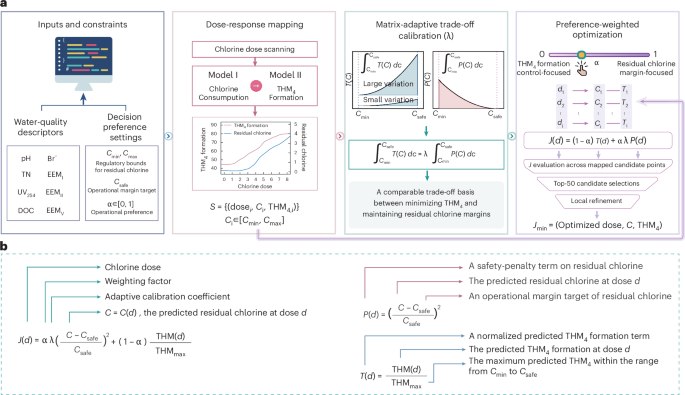
Drinking water disinfection effectively prevents waterborne disease outbreaks but inevitably results in the formation of carcinogenic disinfection by-products (DBPs). Mitigating DBP formation without compromising microbial safety remains a critical challenge. Here we developed DISoptimizer, a water-quality-adaptive optimization framework designed to determine the optimal chlorine dose across heterogeneous water matrices, thereby maintaining a user-defined residual chlorine target as an operational surrogate for disinfection reliability while minimizing four trihalomethane (THM4) formation. Using machine learning models trained on experimental datasets covering diverse water quality conditions, DISoptimizer predicts residual chlorine and THM4 formation after 24 h, representing the point of delivery. Crucially, DISoptimizer incorporates a weighting factor to encode user-defined preferences, allowing utilities to adjust the operational emphasis on maintaining residual chlorine margins versus mitigating THM4 formation in response to fluctuating water quality and different management priorities. Computational simulations coupled with external validation demonstrated that DISoptimizer achieved a 5–35% reduction in THM4 formation compared to the empirical fixed-dosing strategies, while consistently maintaining residual chlorine margins. This work advances disinfection management from DBP concentration prediction towards proactive chlorine-dosing decisions, supporting the management of health risks associated with microbial contamination and DBP exposure in drinking water.
This is a preview of subscription content, access
Access options
- Purchase on SpringerLink
- Instant access to the full article PDF.
Prices may be subject to local taxes which are calculated during checkout
Subjects
- Civil engineering
- Water resources
Data availability
The dataset used for model development in this study is availables paper
Code availability
All code created in this work is available
References
-
United Nations General Assembly. Transforming Our World: The 2030 Agenda for Sustainable Development Resolution A/RES/70/1 (United Nations, 2015).
-
McGuire, M. J. Eight revolutions in the history of US drinking water disinfection. J. AWWA98, 123–149 (2006).
-
Plewa, M. J. & Richardson, S. D. Disinfection by-products in drinking water, recycled water and wastewater: formation, detection, toxicity and health effects: preface. J. Environ. Sci.58, 1 (2017).
-
Rosario-Ortiz, F., Rose, J., Speight, V., Gunten, U. von. & Schnoor, J. How do you like your tap water? Science351, 912–914 (2016).
-
Khor, Y., Aziz, A. R. A. & Chong, S. S. Recent developments and sustainability in monitoring chlorine residuals for water quality control: a critical review. RSC Sustain.2, 2468–2485 (2024).
-
Sikder, M., Daraz, U., Lantagne, D. & Saltori, R. Effectiveness of multilevel risk management emergency response activities to ensure free chlorine residual in household drinking water in southern Syria. Environ. Sci. Technol.52, 14402–14410 (2018).
-
Wagner, E. D. & Plewa, M. J. CHO cell cytotoxicity and genotoxicity analyses of disinfection by-products: an updated review. J. Environ. Sci.58, 64–76 (2017).
-
Evlampidou, I. et al. Trihalomethanes in drinking water and bladder cancer burden in the European Union. Environ. Health Perspect.128, 17001 (2020).
-
Liu, H., Wang, R., Hu, C., Plewa, M. J. & Liu, C. Unveiling the mammalian cell cytotoxicity of tyre-impacted water in disinfection. Nat. Water3, 902–912 (2025).
-
Liu, M. et al. Spatial assessment of tap-water safety in China. Nat. Sustain.5, 689–698 (2022).
-
Guidelines for Drinking-Water Quality 4th edn incorporating the first and second addendum (WHO, 2017).
-
Stage 2 Disinfectants and Disinfection Byproducts Rules (US EPA, 2008).
-
Stage 1 Disinfectant and Disinfection Byproduct Rule (US EPA, 1998).
-
Li, X. F. & Mitch, W. A. Drinking water disinfection byproducts (DBPs) and human health effects: multidisciplinary challenges and opportunities. Environ. Sci. Technol.52, 1681–1689 (2018).
-
Han, J., Li, W. & Zhang, X. An effective and rapidly degradable disinfectant from disinfection byproducts. Nat. Commun.15, 4888 (2024).
-
Cooper, W. J., Mitch, W. A., Richardson, S. D. & Gonsior, M. Mitigating disinfection byproducts: chloramination or granular activated carbon treatment? Environ. Sci. Technol.59, 17387–17389 (2025).
-
Chen, Y., Li, S. & Hu, J. Photoelectrocatalytic degradation of organics and formation of disinfection byproducts in reverse osmosis concentrate. Water Res.168, 115105 (2020).
-
Wang, P. et al. Removal of disinfection by-product precursors by Al-based coagulants: a comparative study on coagulation performance. J. Hazard. Mater.420, 126558 (2021).
-
Yang, M. & Zhang, X. Current trends in the analysis and identification of emerging disinfection byproducts. Trends Environ. Anal. Chem.10, 24–34 (2016).
-
Hua, L. C., Tsia, S. R., Wang, G.-S., Dong, C. D. & Huang, C. Increasing bromine in intracellular organic matter of freshwater algae growing in bromide-elevated environments and its impacts on characteristics of DBP precursors. Environ. Sci. Technol. Lett.8, 307–312 (2021).
-
Chowdhury, S. Effects of seawater intrusion on the formation of disinfection byproducts in drinking water. Sci. Total Environ.827, 154398 (2022).
-
Du, Z. et al. Does snowfall introduce disinfection by-product precursors to surface water? Environ. Sci. Technol.56, 14487–14497 (2022).
-
Du, Z. et al. Disinfection by-product precursors introduced by sandstorm events: composition, formation characteristics and potential risks. Water Res.244, 120429 (2023).
-
Zhao, C. et al. Extreme precipitation amplified the cumulative effects of DOM availability on organic-sourced DIC in the Yangtze River. Water Res.287, 124312 (2025).
-
Chen, X. et al. Novel insights into impacts of the “7.20” extreme rainstorm event on water supply security of Henan Province, China: levels and health risks of tap water disinfection by-products. J. Hazard. Mater.452, 131323 (2023).
-
He, J. et al. Removal of CX3R-type disinfection by-product precursors from rainwater with conventional drinking water treatment processes. Water Res.185, 116099 (2020).
-
Zhang, W., Wang, L., Yang, Y., Gaskin, P. & Teng, K. S. Recent advances on electrochemical sensors for the detection of organic disinfection byproducts in water. ACS Sens.4, 1138–1150 (2019).
-
Wujcik, E. K., Duirk, S. E., Chase, G. G. & Monty, C. N. A visible colorimetric sensor based on nanoporous polypropylene fiber membranes for the determination of trihalomethanes in treated drinking water. Sens. Actuators B.223, 1–8 (2016).
-
Liang, Y. et al. Machine learning-guided prediction of chlorinated/chloraminated disinfection by-product formation in drinking water treatment. Water Res.283, 123849 (2025).
-
Hossain, M. M., Sikder, R., Hua, G. & Ye, T. From model development to mitigation: machine learning for predicting and minimizing iodinated trihalomethanes in water treatment. Environ. Sci. Technol.59, 11638–11652 (2025).
-
Sikder, R., Zhang, T. & Ye, T. Predicting THM formation and revealing its contributors in drinking water treatment using machine learning. ACS ES and T Water4, 899–912 (2024).
-
Maliwan, T., Do, Q. T. T., Nguyen, C. M., Teo, W. K. & Hu, J. Exploring the co-occurrence of microplastics, DOM and DBPs inside PVC pipes undergoing chlorination by correlation analysis and unsupervised learning. Chemosphere373, 144171 (2025).
-
Zhang, C. & Lu, J. Optimizing disinfectant residual dosage in engineered water systems to minimize the overall health risks of opportunistic pathogens and disinfection by-products. Sci. Total Environ.770, 145356 (2021).
-
Hu, G. et al. Appraisal of machine learning techniques for predicting emerging disinfection byproducts in small water distribution networks. J. Hazard. Mater.446, 130633 (2023).
-
Zhang, J. et al. The combination of multiple linear regression and adaptive neuro-fuzzy inference system can accurately predict trihalomethane levels in tap water with fewer water quality parameters. Sci. Total Environ.896, 165269 (2023).
-
Wang, H., Liang, Q., Hancock, J. T. & Khoshgoftaar, T. M. Feature selection strategies: a comparative analysis of SHAP-value and importance-based methods. J. Big Data11, 44 (2024).
-
Marcilio, W. E. & Eler, D. M. From explanations to feature selection: assessing SHAP values as feature selection mechanism. In Proc. 2020 33rd SIBGRAPI Conference on Graphics, Patterns and Images 340–347 (IEEE, 2020).
-
Wang, P. et al. Enhanced coagulation for mitigation of disinfection by-product precursors: a review. Adv. Colloid Interface Sci.296, 102518 (2021).
-
Krasner, S. W. et al. Occurrence of a new generation of disinfection byproducts. Environ. Sci. Technol.40, 7175–7185 (2006).
-
Hua, G., Reckhow, D. A. & Abusallout, I. Correlation between SUVA and DBP formation during chlorination and chloramination of NOM fractions from different sources. Chemosphere130, 82–89 (2015).
-
Hua, G. & Reckhow, D. A. Evaluation of bromine substitution factors of DBPs during chlorination and chloramination. Water Res.46, 4208–4216 (2012).
-
Deborde, M. & von Gunten, U. Reactions of chlorine with inorganic and organic compounds during water treatment-Kinetics and mechanisms: a critical review. Water Res.42, 13–51 (2008).
-
Criquet, J. et al. Reaction of bromine and chlorine with phenolic compounds and natural organic matter extracts – electrophilic aromatic substitution and oxidation. Water Res.85, 476–486 (2015).
-
Heeb, M. B., Criquet, J., Zimmermann-Steffens, S. G. & Von Gunten, U. Oxidative treatment of bromide-containing waters: formation of bromine and its reactions with inorganic and organic compounds – a critical review. Water Res.48, 15–42 (2014).
-
Dickenson, E. R. V., Summers, R. S., Croué, J. P. & Gallard, H. Haloacetic acid and trihalomethane formation from the chlorination and bromination of aliphatic β-Dicarbonyl acid model compounds. Environ. Sci. Technol.42, 3226–3233 (2008).
-
Langsa, M., Heitz, A., Joll, C. A., Von Gunten, U. & Allard, S. Mechanistic aspects of the formation of adsorbable organic bromine during chlorination of bromide-containing synthetic waters. Environ. Sci. Technol.51, 5146–5155 (2017).
-
Forster, A. L. B., Wiskur, S. L. & Richardson, S. D. Formation of eight classes of DBPs from chlorine, chloramine, and ozone: mechanisms and formation pathways. Environ. Sci. Technol.59, 15594–15611 (2025).
-
Gallard, H. & Von, U. Chlorination of natural organic matter: kinetics of chlorination and of THM formation. Water Res.36, 65–74 (2002).
-
Helbling, D. E. & VanBriesen, J. M. Free chlorine demand and cell survival of microbial suspensions. Water Res.41, 4424–4434 (2007).
-
Chen, L., Shi, H., Medema, G., van der Meer, W. & Liu, G. Long-term impacts of free chlorine and monochloramine on the development of drinking water biofilm. Water Res.281, 123566 (2025).
-
Australian Drinking Water Guidelines Paper 6 National Water Quality Management Strategy (National Health and Medical Research Council, 2011).
-
Standards for Drinking Water Quality (Ministry of Public Health of China, 2022).
-
Initial Distribution System Evaluation Guidance Manual for the Final Stage 2 Disinfectants and Disinfection Byproducts Rule (US EPA, 2006).
-
Chen, W., Westerhoff, P., Leenheer, J. A. & Booksh, K. Fluorescence excitation-emission matrix regional integration to quantify spectra for dissolved organic matter. Environ. Sci. Technol.37, 5701–5710 (2003).
Acknowledgements
We thank C. Ye, Z. Du, R. Zhang, R. Xiao, Y. Kong, F. Ao and Y. Li for assistance with water sample collection.
Funding
This work was supported by the National Natural Science Foundation of China (52325001 to W.C. and 52500010 to P.W.) and the Fundamental and Interdisciplinary Disciplines Breakthrough Plan of the Ministry of Education of China (JYB2025XDXM908 to W.C.). Jing-Jin-Ji Regional Integrated Environmental Improvement-National Science and Technology Major Project (2026ZD1211901 to W.C.).
Authors and Affiliations
Contributions
W.C. and P.W. conceived the work. P.W., Y.Y. and Z.W. conducted the experiments. P.W. and Y.Y. developed and tested the machine learning framework. C.W. and P.W. analysed the results. P.W. wrote and revised the paper. W.C. and S.D. provided constructive advice on result interpretation and paper preparation. All authors discussed and reviewed the final paper.
Ethics declarations
Competing interests
The authors declare no competing interests.
Peer review
Peer review information
Nature Water thanks Xiaoliu Huangfu and the other, anonymous, reviewers for their contribution to the peer review of this work.
Additional information
Publisher’s note Springer Nature remains neutral with regard to jurisdictional claims in published maps and institutional affiliations.
Supplementary information
Supplementary Figs. 1–13, Text 1 and 2 and Tables 1–7.
This file contains the statistical
Rights and permissions
Springer Nature or its licensor (e.g. a society or other partner) holds exclusive rights to this article under a publishing agreement with the author(s) or other rightsholder(s); author self-archiving of the accepted manuscript version of this article is solely governed by the terms of such publishing agreement and applicable law.
About this article
Cite this article
Wang, P., Wu, Z., Yang, Y. et al. A machine learning-driven framework for optimizing disinfection in drinking water treatment.
Nat Water (2026). https://doi.org/10.1038/s44221-026-00702-0
-
Version of record:25 August 2026
-
DOI
:https://doi.org/10.1038/s44221-026-00702-0
