

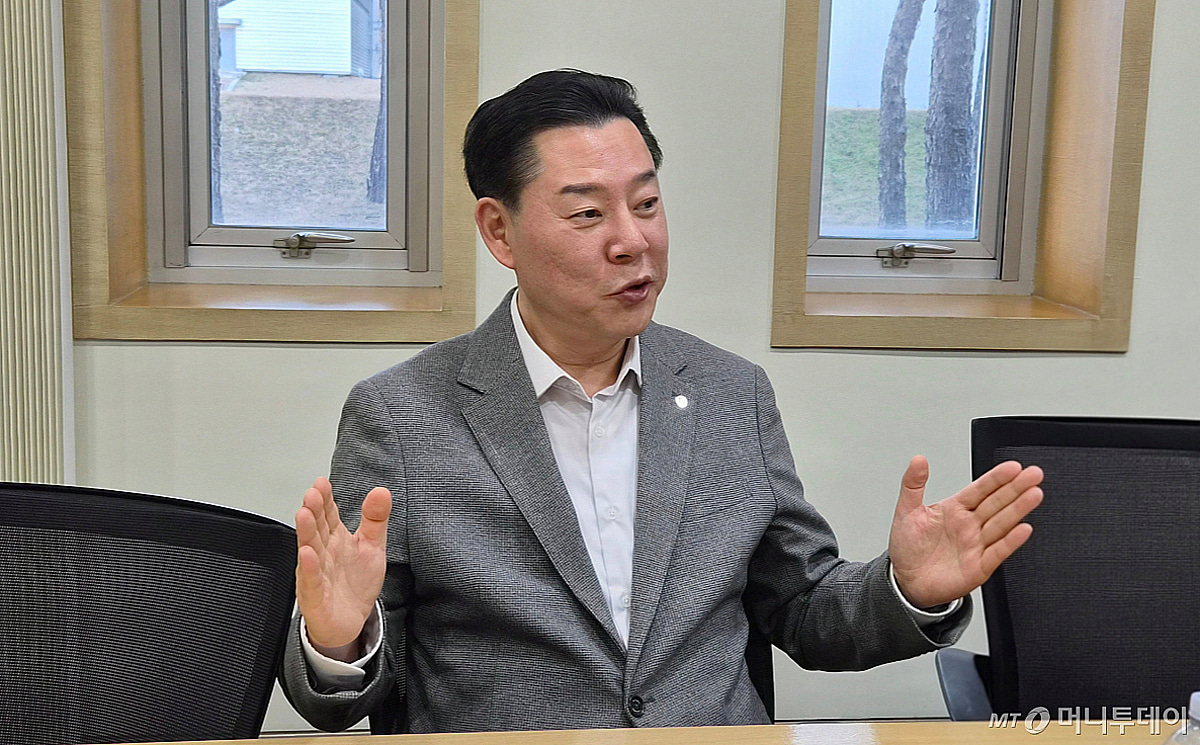
“By introducing AI, automating processes with robots and expanding solar power facilities, we have reduced our cost of sales ratio from 61 percent in 2023 to around 50 percent this year. We will continue to grow steadily and improve through AI and automation.”
Park No-yong, CEO of Yuyu Pharma, held a press briefing at the company’s plant in Jecheon, North Chungcheong Province, on Nov. 26, unveiling the results of its cost innovation and transition to smart manufacturing.
After launching an AI task force last year and introducing robots and expanding solar power facilities this year, the company is on track to surpass 100 billion won in annual standalone revenue again, backed by improved profitability.
At the Jecheon plant, robots were moving and packing boxes containing pharmaceutical products. Heavy raw materials were lifted not by workers but by vacuum grippers.
When a worker placed a vacuum gripper on a material with one hand, suction pressure lifted it with ease, significantly reducing physical strain and the risk of back injuries. Solar panels were installed across the factory roof and grounds.
Cost of sales ratio falls 11 percentage points, boosting profitability and financial stability
“Yuyu Pharma had posted losses for three consecutive years as of 2023, so improving profitability and financial stability was our first priority,” Park said. “We set three goals for cost reduction: AI, robots and solar power. Results through the third quarter this year have been very strong, and we expect standalone revenue to exceed 100 billion won.”
In the first nine months of this year, the company’s standalone revenue, operating profit and net profit reached 81.5 billion won, 13.2 billion won and 10.9 billion won, respectively, up 14.1 percent, 53.1 percent and 91.4 percent from a year earlier.
Park placed particular emphasis on automating the existing plant, which was built in 2006.
“The factory was not originally designed with automation in mind, so we identified robot manufacturers that could meet the plant’s needs and had customized systems developed and installed,” he said.
“Employees also submitted ideas through internal contests on AI, and with help from the IT team, we developed our own programs tailored to the company for analysis and other tasks. The results exceeded our expectations,” he said. “We can continue improving the programs as needs change, while also accumulating data.”
AI cuts raw material checks to seconds, robots boost productivity 2.7-fold
AI has enabled five teams to jointly manage production, testing and shipping schedules through a single application. The time required to check raw material retest results has fallen from 20 to 30 minutes to just a few seconds. The time needed to convert logistics serial numbers has dropped 88 percent, from 25 minutes to three minutes.
Automation of seven secondary packaging processes for omega soft capsules, which account for about 30 percent of Yuyu Pharma’s revenue, along with the introduction of autonomous mobile robots (AMRs) and vacuum grippers, has increased productivity 2.7-fold.
The product defect rate has been halved from 0.4 percent to 0.2 percent, while the workforce assigned to the processes has been reduced by 50 percent, from four employees to two. Annual cost savings amount to about 110 million won.
“Beyond improving factory efficiency, the changes have reduced the risk of workplace accidents and helped prevent musculoskeletal disorders,” Park said. “We reassigned surplus workers to other processes, helping address local labor shortages. Employee satisfaction is high because we improved productivity and safety without involuntary layoffs.”
Saves 130 million won in electricity costs and cuts emissions, preparing for ‘quantum leap’ in three to 5 years
The company’s third solar power installation, with a capacity of 869 kilowatts, was introduced in August at a cost of 690 million won. Its total solar power capacity now stands at 995.6 kW.
The third installation is expected to recoup its investment in 2.8 years, and the company currently generates 31 percent of the plant’s electricity needs itself.
Electricity cost savings from January through November this year totaled about 130 million won. The solar installations are expected to reduce annual carbon dioxide emissions by about 674 tons, equivalent to the amount absorbed by approximately 39,000 pine trees in a year.
Yuyu Pharma is considering linking its solar power facilities to an energy storage system (ESS) to store surplus electricity, as well as expanding AI and automation.
“We have built up our internal capabilities and accumulated momentum, and we have also formed a task force to develop new products and continuously generate ideas,” Park said. “We are preparing for strong growth over the next three to five years.”
