

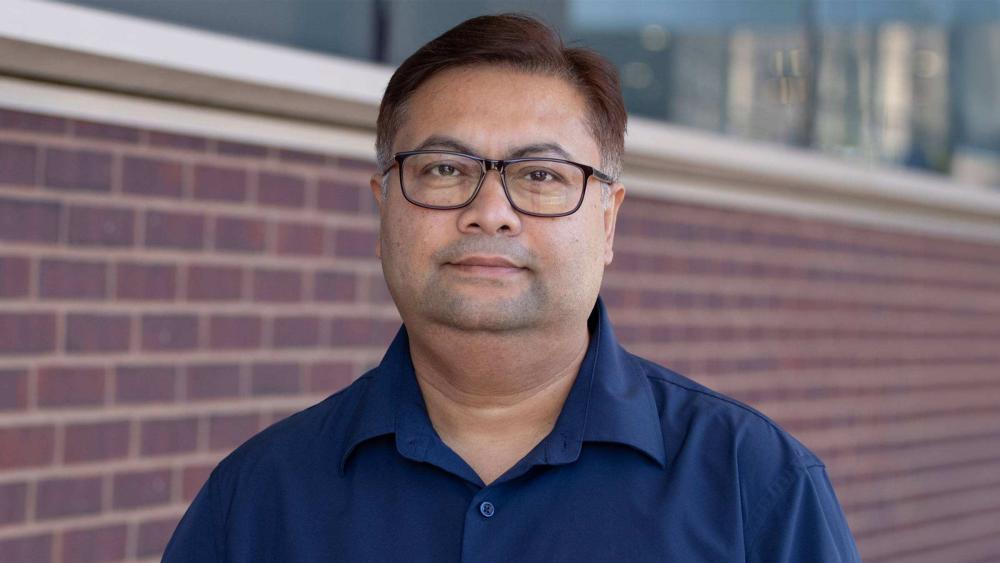
Pa. — To help engineering students learn with artificial intelligence (AI) without sacrificing critical thinking, academic integrity or authentic learning, a Penn State faculty member is implementing an AI-enabled adaptive tutoring platform. Suman Saha, associate teaching professor of computer science and engineering at Penn State, was awarded a two-year, $199,009 U.S. National Science Foundation Research Initiation in Engineering Formation grant to support this work
The tutoring platform, called ALAASKA (Adaptive Learning for All through AI-Powered Student Knowledge Assessment), was developed previously by Saha and his collaborators.
In this Q&A, Saha discussed challenges and opportunities for the future of engineering education, the ALAASKA platform and the comparative study he and his collaborators are conducting to identify student learning difficulties and how AI could help.
Q: What do you see as the biggest challenges and opportunities for engineering education with regard to generative AI?
Saha:The biggest challenge is not simply that generative AI can answer questions, but that it can make it easier for students to bypass the reasoning that engineering education is meant to develop. Engineers must learn to examine assumptions, compare alternatives, learn from mistakes and exercise professional judgment. If students rely on AI mainly for polished final answers, they may complete an assignment without developing those habits.
At the same time, the technology creates an important opportunity. When designed as a learning scaffold rather than an answer generator, AI can provide timely questions, hints and feedback, particularly in large courses where instructors cannot offer individualized support at every moment. The goal is therefore not to exclude AI from the classroom, but to help students use it critically: understand its capabilities and limitations, question its outputs and recognize when human judgment must remain central.
Q: When did you develop ALAASKA, how does it work and how has it been used previously?
Saha:We began developing ALAASKA in 2025, building on earlier classroom work with short AI-generated learning activities such as quizzes, flashcards, summaries and videos. ALAASKA adapts as a student works: It uses the student’s responses to gauge current understanding and then provides a targeted explanation, question, hint or brief knowledge check. Rather than solving the problem, it helps the student identify and work through the next step.
We first deployed ALAASKA in spring 2026 in an upper-level artificial intelligence course, where students used it across nine homework assignments and four projects. Students often valued its ability to break difficult problems into manageable steps without revealing the answer. One early analysis found that, in 21 of 119 student-AI interactions, evidence of reasoning appeared during the conversation but was absent from the submitted answer. This finding suggests that instructors may learn more by examining the problem-solving process, not only the final product.
Q: What do you hope to achieve with this grant?
Saha:With this grant, we want to determine whether conversational microlearning — a teaching approach in which AI offers questions, hints and feedback during short exchanges to guide students’ reasoning instead of providing completed answers — can help students understand why a problem matters, persist when the work becomes difficult and reflect on their reasoning. We also want to learn whether patterns in student-AI conversations can help instructors recognize when those behaviors are emerging and when students may need additional support.
To study this, we will compare two sections of the same large computing course. One section will use ALAASKA, while the other will complete equivalent activities through the course learning management system. In other words, both sections will complete equivalent activities and reflections, but only one will receive ALAASKA’s adaptive AI tutoring. The comparison tests whether that conversational support — not AI use in general — improves learning. It does not assume students in the comparison section never use external AI tools.We will examine surveys, course performance, interaction records and student reflections so that we can understand both what students achieve and how they work toward those outcomes.
The broader goal is to develop practical design guidance, assessment tools and methods for analyzing student-AI interactions that other instructors and researchers can adapt. The award will also help me build deeper expertise in mixed-methods research, assessment and inclusive engineering education, supporting a longer-term research program on responsible AI-supported learning.
Q: How does this work tie intoPenn State’s AI Transformation initiatives?
Saha: This work aligns with Penn State’s AI Transformation priorities by contributing classroom-based evidence related to AI literacy, teaching and assessment, and responsible, human-centered uses of AI. Rather than asking only whether AI can be added to a course, the project examines how it can be designed and evaluated to strengthen learning while keeping reasoning, judgment and responsibility with the student.
Although the initial study will take place in a large computing course, the approach could extend to other courses where students must work through complex problems, explain their decisions and reflect on their reasoning. Because ALAASKA adapts to students’ responses during an activity, it does not require an extensive history of student data before providing support.
We plan to share the resulting design guidelines, assessment instruments and methods for analyzing student-AI interactions through faculty-development activities with Penn State’s Leonhard Center for the Enhancement of Engineering Education. In the longer term, we hope to test and refine the approach across additional courses, Penn State campuses and partner institutions.
Stephanie Cutler, associate research professor and director of assessment and instructional support in the Leonhard Center, andIbukun Osunbunmi, assistant research professor in the Leonhard Center, are co-principal investigators on this project.
Last Updated November 13, 2026
