

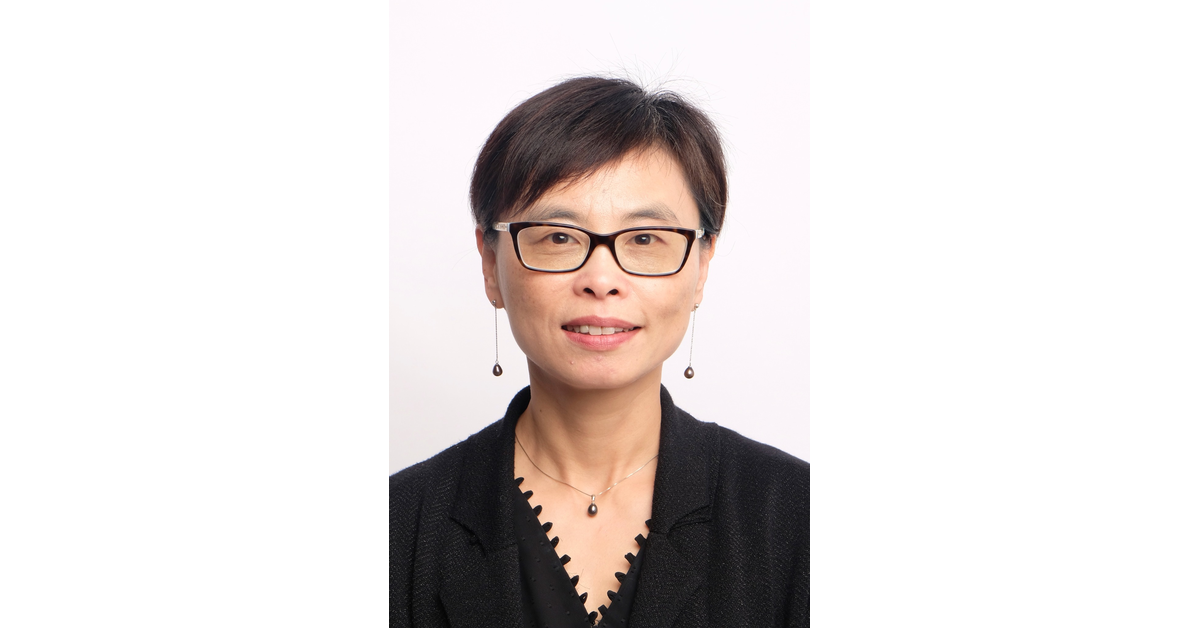
From neurons to generative artificial intelligence, Yusu Wang uses geometry and topology to uncover the structures hiding beneath some of data science’s most complex problems.

Published Date
Article Content
- UC San Diego Professor Yusu Wang uses geometry and topology to uncover hidden structures in complex data, helping machine-learning systems capture relationships that conventional approaches can miss.
- Her group is studying the inner workings of generative artificial intelligence and how neural networks learn and generalize.
- As director of TILOS, Wang brings AI and optimization together to tackle computationally difficult problems in chip design, robotics and communication networks.
Oct. 15, 2026 — For most of us, a cup of joe and a sprinkle doughnut have little in common beyond breakfast. But for a topologist? They’re essentially the same shape.
“Topologists are those who cannot differentiate a coffee mug and a doughnut,” joked Yusu Wang, professor at UC San Diego’s Halıcıoğlu School of Data Science and Computing, director of the Institute for Learning-enabled Optimization at Scale, orTILOS, and Halıcıoğlu Data Science Institute Endowed Chair (read about TILOS’ Phase II funding announcement here). One can be continuously deformed into the other, she explained, because they share something more fundamental than their outward appearance.
It sounds like a mathematical parlor trick. For Wang, however, it illustrates something much more consequential: The power of stripping away details that don’t matter in order to find the structure that does.
“Topology lets you focus on things that are more core, more essential, without focusing on unnecessary details,” Wang said. “This is why topology can give us ways to categorize hidden features.”
That deceptively simple idea has animated much of Wang’s career, taking her from the study of three-dimensional shapes to some of the most challenging questions in modern artificial intelligence (AI). Her research spans geometric and topological data analysis, geometric deep learning, graph learning, representation learning and neural algorithmic reasoning, with applications including neuroscience, materials science and particle physics. As director ofTILOS, she also leads research at the intersection of AI and optimization across areas including chip design, robotics and communication networks.
Yet ask Wang how she arrived at this particular intersection of mathematics and computer science and she traces it back to something much simpler.
“I’ve always been interested in understanding shapes and the structures around us,” she said.
The dimensionality of data
Wang began her research career in computer graphics, exploring how a shape could be computationally analyzed. Her doctoral work at Duke University moved more deeply into 3-D shapes and computational methods for comparing them in both low- and high-dimensional settings. After earning her Ph.D. in computer science, she completed a postdoctoral fellowship at Stanford University and later became a professor at Ohio State University before joining UC San Diego.
Along the way, Wang received a National Science Foundation CAREER Award and a U.S. Department of Energy Early Career Principal Investigator Award and was named an Association for Computing Machinery Distinguished Member. But as her research evolved, she became increasingly interested not simply in visible shapes, but in the shapes and structures hidden inside data.
“We are living in an era of data,” Wang said. “What we are seeing is the complexity of data has really gone to a scale we haven’t seen before, not only in terms of the volume of data and the dimensionality, but also in the form of the data.”
The challenge is not simply that researchers have more data to sift through. The data itself is increasingly complicated. A scientific dataset might represent a collection of complex objects such as graphs, geometric shapes or cells with elaborate physical structures. A neuron, for example, has a branching, tree-like morphology that affects how it interacts with other neurons. Even seemingly ordinary data can exist mathematically in extraordinarily high-dimensional spaces: A 100-by-100-pixel image, for example, can be represented using 10,000 values.
Yet those 10,000 dimensions can be misleading. A collection of images may occupy a much simpler hidden structure within that enormous mathematical space.
“You can think of puzzle pieces that look complex, but maybe there are a few key pieces that can help us connect to other pieces, such as corners or edges,” Wang said.
In other words, what looks impossibly complicated on the surface may contain a much simpler organizing structure underneath. Finding that structure is where geometry and topology become powerful tools.
Seeing the shape of the neuron, not just the pixels
One of the clearest examples comes from Wang’s work with neurons.
Researchers can use machine learning to analyze microscopy images and segment individual neurons from their backgrounds. A conventional machine-learning approach can become extremely good at evaluating an image pixel by pixel: Does this pixel belong to the neuron, or does it belong to the background?
Yet a neuron is not simply a collection of correctly identified pixels. Its branching structure matters.
“If you only use this information, you miss the global shape of the neuron,” Wang said.
Imagine a machine-learning system that identifies nearly every pixel correctly but misses several pixels connecting two branches. By one measure, the model may still appear highly accurate. Structurally, however, it has produced something fundamentally wrong: A neuron that is broken where it should be connected.
Wang uses another analogy.
“Imagine you have a road,” she said. “There is a segment connecting two places, but there is a gap in the road.”
Nearly every piece of the road might be represented correctly on the map, but if there is a break between two sections, the map fails at one of its most important jobs — showing how one place connects to another.
Wang and her collaborators have developed topology-based algorithms that capture this continuous structure and incorporate it into the machine-learning process. The goal is an output that is not simply accurate pixel by pixel, but also structurally faithful to the object scientists are trying to understand.
“There are certain things the machine-learning pipeline is good at, but it doesn’t have global structure information,” Wang said.
It is a neat encapsulation of Wang’s broader approach: Let machine learning do what machine learning does exceptionally well, then use mathematics to capture something it might otherwise miss.
When AI looks a little like magic
These days, the “shape” Wang is trying to understand may not be a physical object at all. Some of her group’s recent work turns geometry inward, using it to investigate the hidden workings of generative AI itself.
Wang is particularly interested in diffusion models, a powerful class of generative models used to produce high-quality images and increasingly explored for video, molecular structures and code. An image-generating diffusion model can begin with what looks like random noise and, through a series of steps, gradually refine it until a recognizable image emerges.
The technology works remarkably well.
Exactly why it works so well is another matter.
“While we understand many of the principles of machine learning, we still don’t fully understand what modern models learn or why — especially today’s most powerful frontier models.”
That admission is striking coming from a researcher whose career has been built on finding mathematical structure. It is also precisely the problem that fascinates her.
Researchers understand a great deal about how these systems are trained and constructed. What remains far less clear is how sophisticated concepts and internal representations emerge from that training. When do different concepts begin to appear as noise gradually becomes an image? How are they represented inside the model? Why does a neural network settle on one method of solving a problem rather than another?
“For the same problem, there are infinite ways to solve it,” Wang said. “What makes the machine learning choose a particular method?”
She sees that question as part of one of the largest open problems confronting artificial intelligence.
“Why does this very powerful frontier model, through training, really learn fundamental procedures and hidden rules?” Wang said. “The AI models learned rules we cannot explain. How did this happen?”
Her group is studying the full trajectory through which diffusion models transform noise into a finished result, looking at when particular concepts and structures emerge and how that process might be better understood. If researchers can characterize that trajectory, they may eventually be able to steer it more precisely — for example, guiding a generative model toward a molecule with specific desired properties.
That kind of fundamental understanding matters for another reason. As AI systems are entrusted with increasingly consequential tasks, researchers need to know not only that they work, but where and why they are likely to fail.
“We need safe, secure, robust technology,” Wang said. “You need the practical engineering side but also the underlying fundamental understanding. Only after that can we actually control it better and understand the risks.”
The “Ohio Winter Effect”
One of the most persistent weaknesses Wang sees in modern machine learning is what researchers call out-of-distribution generalization — what happens when an AI system encounters something substantially different from the examples it learned from.
She explains it with a scenario familiar to anyone who has experienced a Midwestern winter: Suppose a system for an autonomous vehicle is trained using driving data collected only in sunny weather.
“When you deploy what you learn, and you use this in Ohio in winter,” Wang said, “the input is all snow. This is out of distribution.”
A model that performs extraordinarily well on data resembling its training examples may become considerably less reliable when conditions change.
“This is a huge topic, one of the biggest challenges that we have to overcome if we want to reliably deploy machine-learning models in practical applications,” she said.
Wang sees an intriguing contrast with classical computer algorithms. If a computer scientist designs a correct algorithm for sorting, it does not stop functioning simply because it is given a larger input than anything it has previously encountered.
“Once I design an algorithm to do sorting, it doesn’t matter how much the input is,” Wang said. “The algorithm would work because it generalizes to any input. Can a neural network have this kind of reliability?”
Her group is investigating the relationship between neural networks and traditional algorithms in hopes of designing systems that learn not simply to reproduce patterns observed in training data, but to learn procedures that can extend to fundamentally larger or different problems. A model, for example, might be trained on graphs containing no more than 500 nodes because larger examples are unavailable or computationally expensive, then eventually be asked to perform on a graph containing a million nodes.
The distinction is subtle but important. The aim is no longer simply to teach a machine what an answer looks like. It is to help it learn a process for finding the answer.
From mathematical foundations to real-world systems
Wang’s research interests may be highly theoretical, but increasingly she operates at a scale where those ideas meet some of the world’s most practical engineering challenges.
Since 2023, she has served as director of TILOS, the NSF Institute for Learning-enabled Optimization at Scale. The multi-institutional institute focuses on AI and optimization for intelligent systems, with research spanning chip design, robotics and communication networks.
On the surface, those may appear to be very different fields. Optimization connects them.
“Optimization plays important dual roles, both in terms of giving us better AI and empowering many complex engineering systems,” Wang said.
The relationship works in both directions. Training a machine-learning model is itself an optimization process, so advances in optimization can lead to better AI. At the same time, AI may offer new approaches to computationally difficult optimization problems that arise throughout engineering.
Chip design is one example. Designing a modern chip involves a long sequence of interconnected problems. Components must be placed while satisfying numerous constraints. Wires must be routed without creating congestion. Many of those tasks translate into computationally difficult problems.
“There are many places where AI can help,” Wang said.
And advances in those physical systems can, in turn, accelerate AI.
“Not only can we use AI to accelerate those areas, these areas will also fundamentally build better AI because they build the hardware systems that can give us better next-generation models,” Wang said.
Robotics introduces a different set of practical constraints. A drone, for example, may need to be lightweight and consume little energy while still making sophisticated decisions. For Wang, those real-world limitations are not simply obstacles. They may help push researchers toward AI systems that are smaller, more efficient and more adaptive.
Understanding enough to move forward
For all of her interest in opening AI’s black box, Wang does not suggest that scientists must completely understand every mechanism inside an artificial intelligence system before the technology can be useful.
Scientific understanding often develops at different levels.
“We can have understanding at different levels,” she said. “Just because we don’t have full understanding of every level at the most refined level doesn’t mean we can’t develop sufficient understanding.”
Consider medicine.
“We don’t fully understand how the human body works,” Wang said. “However, we still have very powerful medicine that can cure diseases.”
The challenge for AI researchers is determining what they need to understand in order to make artificial intelligence safer, more reliable and more generalizable — while continuing to expand what those systems can do.
It is a formidable problem, but also a familiar one.
From the geometry of three-dimensional objects to the branching architecture of neurons to the hidden structures inside generative AI, Wang has spent her career looking past complexity in search of something more fundamental beneath it.
After all, what makes a doughnut special isn’t really about the dough.
It’s about the hole.
Learn more about research and education at UC San Diego in: Artificial Intelligence
Read more news about: Halıcıoğlu School of Data Science and Computing,
Artificial Intelligence
