

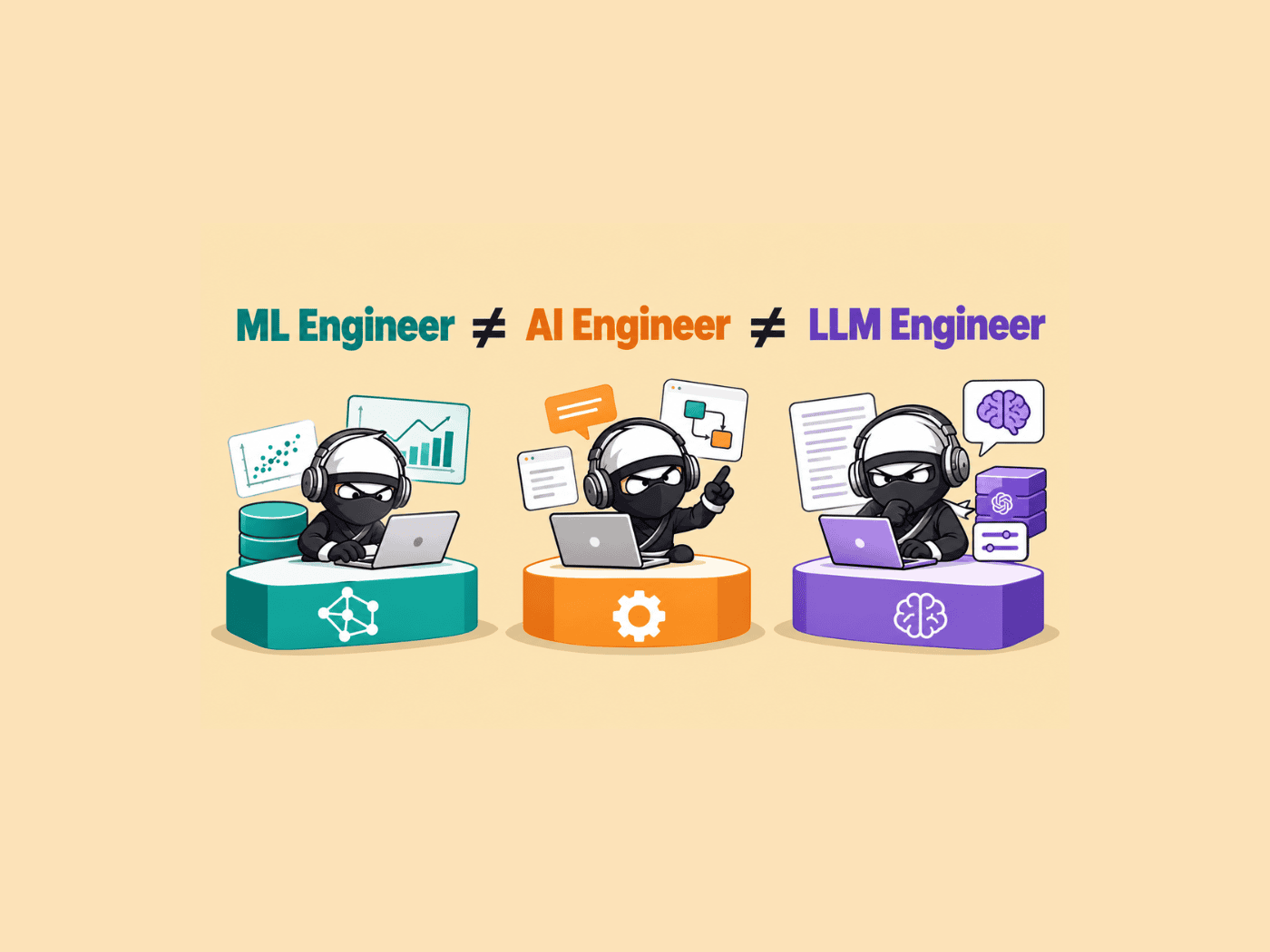
Open three job boards and search “AI.” One company calls the role AI Engineer. Another calls it Applied AI Engineer. A third calls it LLM Engineer. The listed responsibilities look almost identical: Python, an API key for a language model, some mention of retrieval, a line about “production reliability.”
Look closer, and the specifics move too. One posting wants LangChain experience. Another wants fine-tuning experience with LoRA. A third wants someone who can call an API and write clean evaluation code. Same title, three different jobs.
This matters because career decisions follow the title on the posting instead of the description underneath it. Someone chasing AI Engineer roles because the title tops the growth charts might end up in work that looks nothing like what they pictured. Someone who assumes Machine Learning Engineer means training models all day is in for a similar surprise.
We’ve reviewed enough of these postings, and talked to enough candidates confused by them, to know what actually distinguishes the three roles: the list of things you’d be asked to build, own, and keep running six months from now. This article compares outputs: what a machine learning engineer ships, what an AI Engineer ships, and what an LLM Engineer ships that differs from both.
The Three Roles, Defined by What They Build
A machine learning engineer builds and trains a model from data. A data scientist explores that data and prototypes an approach; the machine learning engineer takes the validated approach and turns it into something that runs reliably in production, at scale, on new data it hasn’t seen before.
An AI Engineer starts one step later. The model already exists, usually a large model someone else trained and exposed through an API. The AI Engineer’s job is to connect that model to a real product: a support tool, an internal search feature, an agent that completes a multi-step task.
An LLM Engineer is a narrower version of the AI Engineer role, focused on one category of AI rather than AI broadly (computer vision and recommendation systems are AI too, just not language models). The added responsibility is fine-tuning: adjusting a pretrained model’s own weights for a specific use case.
Here’s what the daily work behind each of those three definitions actually looks like.
The Machine Learning Engineer
A machine learning engineer’s core loop looks the same across most companies: collect and clean data, choose an algorithm, train it, validate it against metrics like RMSE or a confusion matrix, deploy it, then monitor and retrain it as new data arrives.
The tools are Python, PyTorch or TensorFlow, scikit-learn, and a feature store like Amazon SageMaker or Databricks. The output is usually something specific: a recommendation system, a fraud detection model, a demand forecast, a fraud score attached to every transaction.
Most of the actual time goes into data, not algorithms. Bad grain, leaked labels, or a poorly designed feature window will break a model long before the choice of algorithm does. Our own breakdown of what a machine learning engineer does goes into this in more detail, including why the role sits closer to applied data science and software engineering than to pure research.
The AI Engineer
An AI Engineer’s day splits roughly like this: a large chunk on prompt design, retrieval, and connecting to a language model; a smaller chunk on evaluation and monitoring for hallucinations or quality drops; some standard backend work, APIs and databases; and the rest on prototyping and writing things down for other teams.
The tools are Python or TypeScript, LangChain, LangGraph, or LlamaIndex for orchestration, and a vector database for retrieval like Pinecone or Qdrant. Nobody here is training a model from scratch. It’s a common misunderstanding between expectation and reality in the field: people take the job expecting to train models, then end up spending most of their time fixing data pipelines and rewriting prompts.
That’s the honest version of the job. The work starts after a model is trained and validated, and it ends when that model reliably serves real users instead of one impressive demo.
The LLM Engineer
An LLM Engineer does most of what an AI Engineer does, plus one thing most AI Engineers don’t touch: fine-tuning. Using techniques like LoRA or QLoRA, they adjust a pretrained model’s weights on a domain-specific dataset, usually because a general-purpose model doesn’t perform well enough on a narrow, specialized task.
Good LLM Engineers spend more effort ruling out fine-tuning than doing it. Better retrieval, a longer prompt, or a different base model often solves the same problem for less money and no ongoing maintenance burden. They try those first and reach for fine-tuning only after ruling out everything else.
Machine Learning Engineer, AI Engineer, and LLM Engineer Compared
Why the Titles Don’t Match the Work
The confusion has a simple cause.
Machine learning engineering split off from data science once deploying a model became a job in itself.
Then generative AI created an entirely new category — the AI Engineer — that barely existed before 2022. The industry hasn’t agreed on names yet, so the same job gets posted under half a dozen different titles: AI Engineer, GenAI Engineer, Applied AI Engineer, Prompt Engineer, RAG Engineer.
That naming gap shows up in pay too. Two postings with nearly identical responsibilities can carry meaningfully different salary bands depending only on which title the company chose, not on what the person will actually do.
Company size changes what a title covers as well. At a small startup, one person might do all three jobs under any one of these labels: train the model, build the retrieval pipeline, ship the feature. At a larger company, these responsibilities split into separate teams, sometimes five or more categories: applied AI product engineers, machine learning engineers focused on model quality, AI research engineers, AI infrastructure engineers, and forward-deployed engineers who implement AI systems inside customer environments. Our career path guide for AI engineers walks through how this split plays out as a company grows.
The practical takeaway: read the actual bullet points in a posting before applying. What will you build in the first 90 days? What do you own after that? Those two questions tell you more than the job title ever will.
How To Prepare, No Matter Which Title You’re Chasing
Regardless of which of these three titles ends up on your offer letter, the interview bar for all of them leans heavily on the same foundation: SQL, data shaping, and the ability to reason clearly about a problem before writing any code.
Our guide to machine learning engineer interview questions covers what companies like Meta, Uber, and Google actually ask: coding questions built around recommendation systems, time-series forecasting, and text processing, alongside theoretical questions on model evaluation and communication.
We’ve also written about how to pass data interviews for machine learning engineer roles, and the central point there applies just as much to AI Engineer and LLM Engineer interviews: most of the job is defining the problem correctly, avoiding data leakage, and picking signals that make sense — not memorizing an algorithm.
Wrapping Up
AI hiring titles are inconsistent right now, and they’ll probably stay that way for a while. A machine learning engineer trains and ships a model. An AI Engineer builds the product around a model someone else trained. An LLM Engineer does that same work with a narrower focus: fine-tuning and running large language models specifically.
Interview prep barely changes by title. A strong SQL foundation, clear problem framing, and the ability to explain tradeoffs carry weight in a machine learning engineer interview, an AI Engineer interview, and an LLM Engineer interview alike. Companies rename these roles faster than they rewrite their evaluation criteria, so remember that the next time a recruiter reaches out with a title you don’t recognize.
Before you choose a direction or apply to a role, read the actual list of things you’d build, own, and maintain a year from now — not the two or three words printed above it. That list is the most accurate job description you’ll find, regardless of what the posting calls it.
Nate Rosidi is a data scientist and in product strategy. He’s also an adjunct professor teaching analytics, and is the founder of StrataScratch, a platform helping data scientists prepare for their interviews with real interview questions from top companies. Nate writes on the latest trends in the career market, gives interview advice, shares data science projects, and covers everything SQL.
