

Welcome to HackerNoon Meet the Programmer series. Answer your own meet the programmer interview here.
What’s your current role and what do you like about it?
I work as an Assistant Vice President and Principal Machine Learning Engineer at U.S. Bank. My role focuses on designing enterprise AI systems, generative-AI platforms, agentic workflows, APIs, cloud architecture, cybersecurity, and responsible-AI controls. I particularly enjoy transforming emerging AI capabilities into reliable solutions that can operate securely and responsibly in complex enterprise environments.
How did you get into Programming?
I became interested in programming while studying computer applications. I was fascinated by the idea that a carefully written set of instructions could automate work, solve business problems, and serve thousands of people consistently. After earning my Master of Computer Applications degree, I began working in software engineering and gradually moved into architecture, cloud platforms, machine learning, and enterprise AI.
How did you get into writing about Programming?
I began writing because I wanted to document lessons learned while solving real engineering problems. Enterprise systems often involve architecture, security, governance, scalability, and organizational considerations that are not fully captured in product documentation. Writing allows me to organize these lessons, share practical frameworks, and help other engineers avoid common implementation mistakes.
What’s your earliest memory of you learning to code?
One of my earliest memories is writing small programs to understand variables, conditions, loops, and data structures. Seeing the computer follow my logic—and discovering how one incorrect condition could change the entire result—was both challenging and exciting. Those early exercises taught me that programming is not simply writing syntax; it is learning how to think precisely.
When Elon Musk achieves his dream of getting us to Mars, what technology do you think would be important on Mars and why?
Reliable autonomous systems would be essential because communication delays would prevent people on Mars from depending continuously on Earth. AI-enabled systems would need to monitor habitats, manage energy and water, diagnose equipment failures, support healthcare, and coordinate robots. These systems must be explainable, fault-tolerant, secure, and capable of safe human override because errors could have life-threatening consequences.
What’s a programming language that you would build EVERYTHING and ANYTHING in and why?
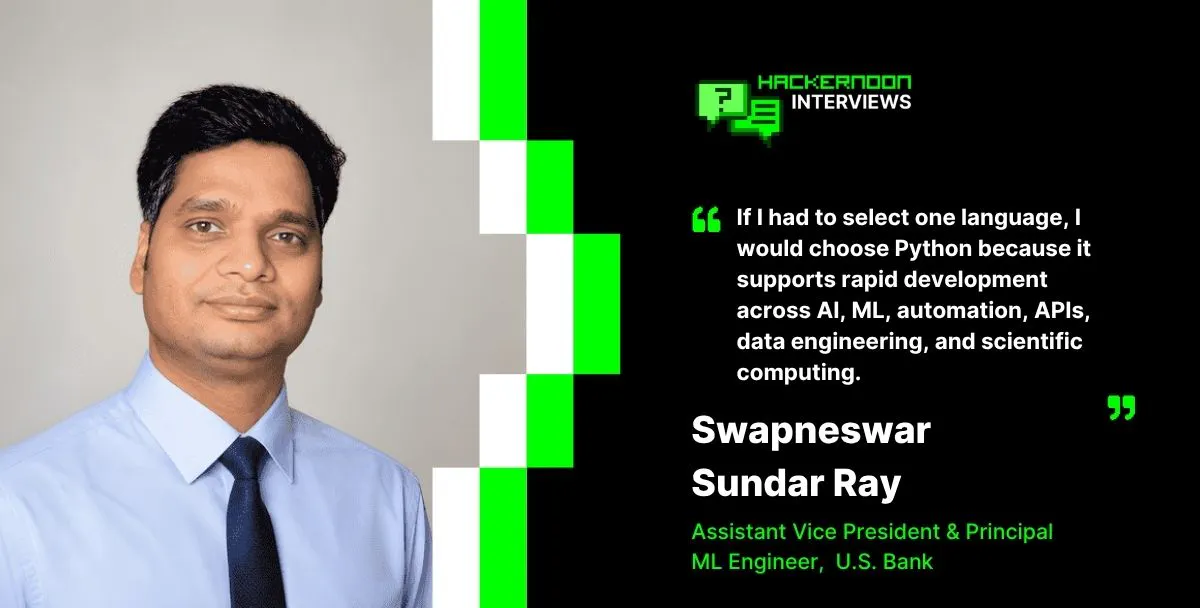
If I had to select one language, I would choose Python because it supports rapid development across AI, machine learning, automation, APIs, data engineering, and scientific computing. Its extensive ecosystem makes it exceptionally versatile. However, I believe language selection should ultimately depend on the problem—Java, JavaScript, TypeScript, and other languages may be better choices for particular performance, platform, or enterprise requirements.
What’s something you think Software developers do not do enough of?
Developers do not always spend enough time understanding the actual user problem before writing code. A technically elegant system can still fail if it does not address the workflow, constraints, risks, and expectations of its users. Developers should also invest more effort in observability, security, documentation, failure handling, and responsible design rather than treating them as tasks to complete after development.
What is your least favorite thing about programming?
My least favorite part is dealing with failures that are intermittent, environment-specific, and difficult to reproduce. These issues can involve several layers, including application code, dependencies, containers, networks, storage, cloud infrastructure, and access policies. At the same time, investigating such failures often produces the most valuable engineering lessons and encourages better monitoring and system design.
What’s a technology you’re currently learning or excited to learn?
I am especially interested in agentic AI systems that can reason, use tools, invoke APIs, and complete multi-step workflows. I am exploring how these systems can be governed through authorization, human oversight, observability, evaluation, audit trails, and runtime guardrails. The important challenge is no longer just making AI more capable; it is ensuring that autonomous systems remain secure, accountable, and aligned with organizational policies.
What’s your favorite Programming story of all-time on HackerNoon?
I do not have only one favorite HackerNoon story. I especially appreciate articles in which engineers explain how they built a real system, encountered unexpected failures, investigated the root cause, and improved the architecture. These practical accounts are valuable because they present engineering as an iterative discipline rather than a collection of perfect solutions.
Time travel 10 years into the past or 10 years into the future? What does technology look like? Give reasons for your answer.
I would travel 10 years into the future. I expect AI to evolve from a tool people consult into a network of specialized assistants that participate in everyday business processes. Software development may become increasingly intent-driven, but human expertise will remain essential for architecture, verification, security, ethics, and accountability. The most successful organizations will not necessarily deploy the most AI; they will be the ones that govern it most effectively.
