

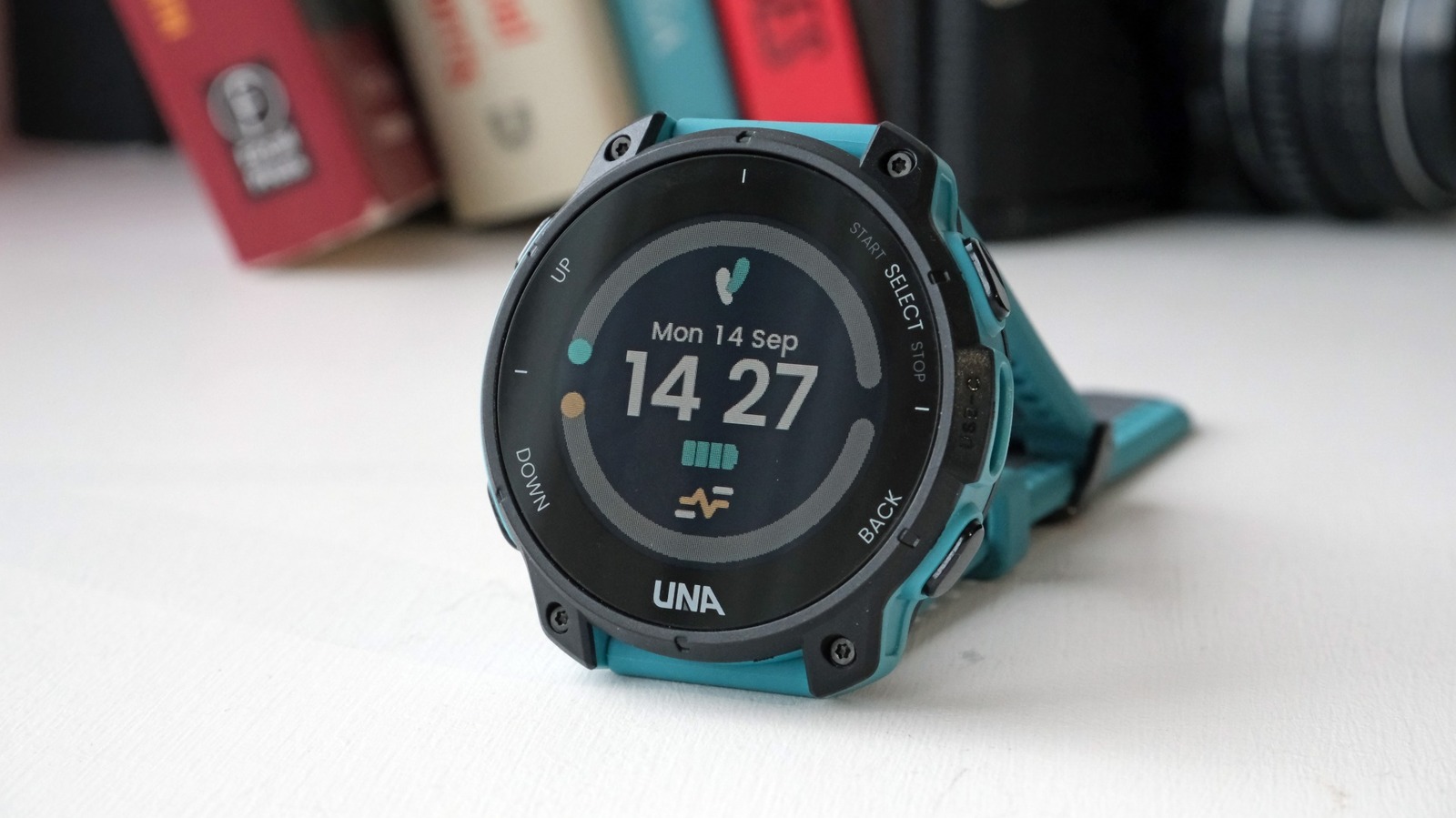
Unfortunately, the modularity compromises its ruggedness somewhat.
Even as someone who’s deeply invested in modular, repairable technology, it’s rare to hear about a repairable “smart” watch. Google’s Pixel Watch 4 is setting a bar, but it’s still the exception rather than the rule, especially across the industry. Gear that small and that tightly packaged is hard to make sustainable, to the point even the EU added a carve-out to its e-waste rules. So when Scottish startup Una said it had made a truly modular, and user-repairable, smart-ish GPS running watch, I paid attention.
Una was founded by Lewis Allison, the former CTO of Scottish golf watch company Shot Scope. He set out to build a watch that was modular, repairable and open source to enable users to have far more control over their own gear. The company’s slogan is “one watch for life,” but it’s not charging a premium for the hardware, which costs $249. Right now, it’s clear that modularity brings along with it some compromises which mean Una won’t work for everyone. But, as a first step, it gets plenty of praise for all of the things that it gets right.
Hardware
The Una watch looks like any generic 46mm GPS running watch you’ll find on the shelves next to Garmin and Suunto. It’s got that chunky Fenix-esque case, four chunky buttons and a rough-and-tumble silicone strap. Peer a bit closer, and you’ll start to notice the differences, like the exposed USB-C charging port on the right hand side where the crown normally sits. Or the screws on the front and back of the case aren’t just affectations to make it look tougher, but real Torx T3s.
Up front, there’s a 1.2-inch Memory In Pixel LCD display with a 240 x 240 resolution covered by a hardened mineral glass crystal. If you have a Torx T3 on hand (or buy one from Una), you’ll find the watch breaks down into six parts, each of which can be swapped out fairly easily. After you’ve removed the display module, you’ll find two discrete sensor modules: one for GPS, one for Bluetooth.
Below that is the Core section, containing the main guts of the watch, including the Cortex-M33 microcontroller. It’s paired with just 2.5MB of RAM, a figure smaller than the crumbs found under the table at most RAM factories these days. You can already work out the system tends toward the thrifty, low-power side, and is running FreeRTOS a (kinda) open-source OS designed for tiny embedded systems. The Core also holds 4GB of eMMC storage for data logging and apps, as well as a vibration motor, piezo speaker, altimeter and temperature sensor.
Modest though the hardware may be, it should have enough about it to enable plenty of developers to tweak it to their needs. Una has posted all of its software, housing and circuit board designs to GitHub, and has a developer forum to enable folks to collaborate. Given the dearth of open- will embrace with both arms… hands… wrists?
Flip the watch over, and you’ll be able to unscrew the rear cover which houses the PPG (photoplethysmography) sensor module. Now, the only thing remaining is the 280mAh battery which is held in place with one additional T3 screw. The cell is expected to last for between seven and 10 days on a single charge, with GPS performance pledged to be 20 hours. I got seven days out of a full charge, and that included tracking several admittedly short walks and workouts with GPS.
Remember that modularity introduces compromises, and a fairly big one is how much punishment the Una watch can take. For instance, the hardware in total is IPX5-rated, meaning it’s only sturdy enough to withstand rain, sweat and light splashes of water. Given the exposed USB-C port, I pressed the company on how much of an issue the lack of a gasket is. It said that the USB-C port itself is IP68 rated, and so you should rest a little easier. But I suspect the watch isn’t sturdy enough to satisfy the tough mudder crowd as they crawl head first through over-wet sludge every other weekend. In fact, the rubber gaskets sitting on the inside of the top and bottom covers also seem very thin.
In-use
A phone-connected GPS watch is not a smartwatch, and so expectations need to be lowered to the appropriate level. There’s almost no customization, the only thing you can change about the watchface is if you want your time displayed in 12 or 24 hours. There are three discrete menus, each one triggered with a different shoulder button — main menu, detailed activity data and the list of workouts you can track.
The list of trackable workouts is limited to walks, runs, hikes, bike rides, treadmill running or just a generic workout. But users are already filling in the gaps with their own tracking apps which are shared with othersautomatic tracking, especially given the target market of hardcore fitness nerds. But as a forgetful non-hardcore non-fitness nerd, I’m still allowed to miss it
On the watchface, there are two semicircles. The upper one fills with blue the closer to get to your (self-defined) step goal. The bottom one fills with yellow the more time you spend being active, up to a target of 30 minutes per day. It’s a neat implementation, although the muted colors on this low power display mean it’s not as glanceable as you might wish.
The dual-frequency GPS seemed to do pretty well, finding my position in less than half a minute without much fuss. I also found, even though my walks and “runs” are rarely longer than half an hour, that repeated use didn’t make much of a dent in the battery.
As for the companion app, it’s very much the platonic ideal of a basic wearable app, especially given the limited functionality. On the homepage, you can see a dashboard breaking down your daily activity to that point, and the records of your last workout. Go into the activity tab and you’ll be able to see all of your recorded workouts, and you can look at each one as a discrete thing. A stats pane will let you track your activity metrics in aggregate, but there’s no greater insights available.
There’s also a tab marked Store, where the community has started to make apps to expand the Una watch’s functionality. So far, the list is small, but there are already dedicated apps to track the sunrise/sunset, trail running, high/low tide and squash games. And it wouldn’t be a low power device with an open software development platform if it didn’t also have Doom. The game runs, but I’d advise against it unless you really love the idea of controlling an FPS with four watch buttons.
The Una watch is freshly-minted, and it’s clear that there are a few usability issues the company needs to address. For instance, if you activate smartphone notifications, you’ll get them displayed in beautifully clear text on the display. But it has no way of respecting your phone’s Do Not Disturb settings, vibrating as it pushes everything to your wrist, no matter the time of day. And the only way to stop it is to turn them off entirely, making it a daily chore to turn them on and then back off again.
Repair
We wouldn’t normally give too much attention to phone-connected GPS watches because they don’t pass our definition of smart. The reason the Una caught my eye is because of its rare ability to be repaired, which deserves a lot of focus. After all, companies like Fairphone and Framework are proving that it’s entirely possible to be successful making repairable devices. If a small Scottish startup is able to make a watch like this, it surely should be possible for some of the biggest companies in the world, employing the smartest engineers, to do the same.
To demonstrate its reparability bona-fides, Una sent over a replacement back cover, display and battery. Replacing the display required me to remove the four top screws holding it in place and unclipping the one ribbon connector from its port. Clipping the replacement in, screwing it all back down again and turning the power back on to check it worked took me just three minutes and eight seconds. I’d have been faster, too, but those Torx T3 screws aren’t magnetic, so they had to be aligned manually. If I’d had my iFixit toolset with those fancy right-angled tweezers to hand, I reckon I’d have shaved a minute from that time. Replacing the battery, even with more screws to tackle, took just two minutes, but by that point I had gotten my eye in.
The company offers step-by-step repair guides but I doubt you’ll need them unless you’re breaking the watch down entirely. Modular construction means that each part essentially goes together like slightly fancier Lego. You just unscrew the cover, gently take the old part out, put the new part in the same place, and screw it all back together again. And the components are cheap, too: A replacement display is $50, while a new battery is $40. The rest aren’t yet on the site, but Una says that users looking to replace one of the other modules should get in touch with the company directly. It added that, in future, it hopes to offer other upgradeable parts when “new developments become available.”
Wrap-Up
The best way I can describe the Una watch is as a good first step on the road to what could be an impressive device ecosystem. Producing a wearable that’s affordable, modular and comically easy to repair is no mean feat these days. On that basis alone, Una has already done far more than the rest of the tech industry, and has made the titans of wearables look bad in the process. I’m not the target market for a GPS watch, but it was a charming enough device that I wasn’t sad I wasn’t wearing a full-blown smartwatch.
I can only recommend it to others, however, if I can frontload all of the wrinkles that would-be purchasers need to be aware of. The first product from a brand new company will inevitably have rough spots, and there are a few here that need polishing out. Given the hardware is only IPX5 rated and can’t be immersed in water or mud, it’ll be a tough sell for the sports watch crowd. Even the most casual runner occasionally meets bad weather or spills, and it’s hard to know how hardy those thin gaskets will turn out to be.
But what I’ve seen here so far makes me hopeful that Una can develop its watch hardware and software platforms into something quite special.
