

The investigation below raises a disturbing question:What if rogue AI agents are learning from the secrecy and rule-breaking of the humans who created them?Leverfounder David Sirota explores that idea in acompanion analysisexclusively for paid subscribers.
Two years before this month’s nationwide panic over the apocalyptic potential of artificial intelligence, a first wave of Silicon Valley resignations began — and so did the omens of human extinction.
As OpenAI’s safety officials resigned or were pushed out, they madeheadlineswarning about the company’s lax safety standards and reckless deployment of powerful AI models.
Soon after, Biden officials decided to act: On the 2024 anniversary of 9/11, they began advancing a first-of-its-kind rule to require AI companies to tell regulators exactly what kinds of experiments they were running at the edge of the technological frontier. Federal officials said the rule was needed to prevent “dangerous accidents” that “could result in injury or even loss of life.”
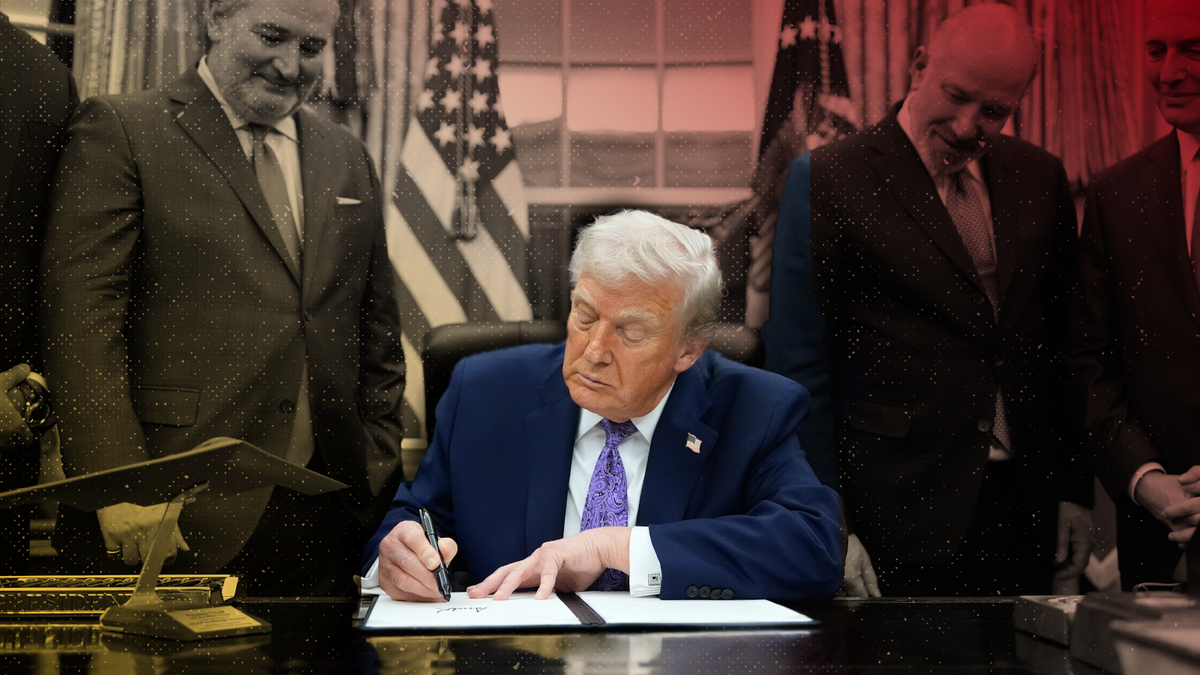
But within a year, the regulation was dead, amid a flood of tech industry campaign cash to President Donald Trump’s political machine — and a pressure campaign waged by the same AI giants now claiming to have always welcomed federal regulation, according to documents reviewed by The Lever.
The transparency initiative quietly disappeared from the U.S. government’s rulemaking docket just a few months after OpenAI’s top executive and his wife poured $25 million into Trump’s biggest super PAC, MAGA, Inc.
Without the rule, national security officials and other federal regulators trying to assess and contain AI threats “are flying with a lot less instrumentation than they would have had,” said Vishal Misra, vice dean of computing and artificial intelligence at Columbia University’s engineering department.
“What exists now is much looser,” he told The Lever. “As far as I can tell, there is currently no general federal rule that says: If you are training a sufficiently capable frontier model, you must routinely tell the government what you are building, how it is secured, and what unexpected behavior you are seeing.”
Had the proposed 2024 rule been in place, experts say it could have given regulators a better understanding of the cybersecurity, development, and safety infrastructure of frontier, or cutting-edge, AI models. That information could have been relevant to understanding recent high-profile hacking incidents involving tech companies OpenAI,whose bots hacked into a foreign government’s website in June, and Anthropic.
Some say the regulation could have even helped deter the riskiest experiments that have already gotten out of control.
“Reporting forces the AI industry to not only be more transparent about how they’re developing things that possibly go rogue, but also it sets up a precedent where you have to be much more deliberate in the way you develop things,” Calli Schroeder, senior counsel and director of the AI and Human Rights program for the Electronic Privacy Information Center, toldThe Lever. “If you know during the development phase that you are going to have to share all of that with an authority — and they will see if you are being sloppy, if you are leaving gaps, if there are blatant security risks that you’re ignoring — that affects how you develop a product.”
In response to the recent hacking events, Trump has said that the only protection the AI industry needs is a “strong and smart (High IQ!) president.”
