

Schnell said he used artificial intelligence for “making writing processes more efficient,” but that AI was not a “substitute” for his own “intellectual judgment or authorship.”
An investigation by The Dartmouth of academic articles and opinion pieces published by Provost Santiago Schnell in 2026 found a median “AI-written” text percentage of 96% using artificial intelligence detector Pangram.
Pangram — which was found to have a “near-zero error rate” by an October 2025 University of Chicago audit — uses a large language model neural network which is trained to recognize differences between separate datasets of human-written documents and AI-generated content, according to the company’s website.
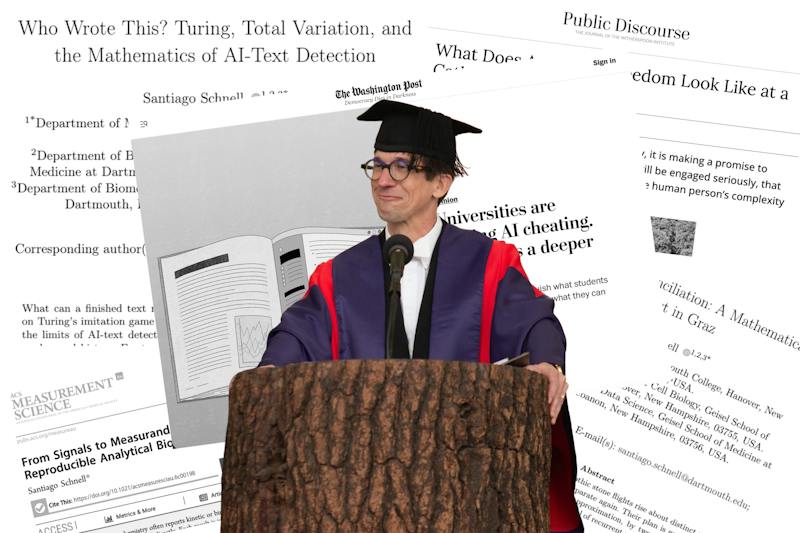
On Aug. 26, a Semafor investigation using Pangram to determine whether recent guest columns in major newspapers were written using artificial intelligence identified a column by Schnell as “100% AI-written.” Schnell’s column in The Washington Post — titled “Universities are fighting AI cheating. But there’s a deeper problem.” — argued that “a degree should distinguish what students can do independently from what they can accomplish with AI.”
The Dartmouth subsequently reviewed publications written by Schnell before and after the November 2022 public release of ChatGPT. Pangram 4.0, the latest publicly available version of the AI detector, labeled all of Schnell’s written works prior to 2022 as “100% human-written,” while a test of nine of his works published this year returned a median “AI-written” percentage of 96%. Between 2019 and 2026, Schnell did not publish any academic works or op-eds for which he was the sole author credited, according to his online curriculum vitae.
Pangram 4.0 assesses whether a work is AI-written by separating the submitted text into smaller segments, which are then identified as “human,” “AI-assisted” or “AI-generated,” according to a Pangram technical report.
“If you get a 30% score on a 10-page paper, it likely means that roughly three pages worth of text display the patterns that are typical of [a large language model],” according to a blog post on Pangram’s website by Pangram Labs head of growth Alex Roitman.
In an email statement to The Dartmouth on Sept. 18, Schnell wrote that he uses artificial intelligence for “language refinement, copyediting, improving clarity and organization and making writing processes more efficient,” but “review[s] the final text and take[s] responsibility for its content.”
“I develop ideas and arguments, conduct the research, evaluate the evidence and sources, determine the structure, prepare drafts and decide what appears in the final text,” Schnell wrote. “I regard these technologies as assistive tools. They do not identify the problem, design the research project, guarantee the validity of research results, interpretations, citations, conclusions or substitute for my research, intellectual judgment or authorship.”
Schnell’s Sept. 18 email statement to The Dartmouth was itself “100% AI-written,” according to a Pangram test.
In a follow-up statement about the composition of the email, Schnell wrote that he “developed the substance and wrote a draft” of the email, then “used an Al tool to assist with language and clarity, taking on several suggestions (including reworded sentences), before reading it through, making minor changes and sending it to you with my signature.”
“I am fully responsible for any text under my signature,” Schnell added.
Schnell previously wrote in an email statement on Sept. 10 that the “characterization of my Washington Post essay as ‘100% AI-written’ is not accurate.”
“I wrote the essay based on my own thinking and used ChatGPT to help refine a few arguments and check for grammatical errors,” he explained. “The piece then went through multiple rounds of edits with The Washington Post. I reviewed and approved the final piece and take responsibility for every argument and statement in it.”
A spokesperson for The Washington Post told Semafor that its policies require guest writers to confirm their submissions are “not created or manipulated with artificial intelligence or editing software.” The Washington Post did not respond to repeated requests for comment.
Economic professor Paul Novosad — who said he has experimented with using Pangram to test “hundreds” of de-identified student assignments from before November 2022 and found “zero false positives” — told The Dartmouth that the “notion that correcting grammatical errors … will trigger false positives is just false.”
“People who want to understate [their AI use] commonly say ‘I only used it to correct my grammar,’” Novosad said. “If correcting grammar literally means correcting grammatical errors in the most direct way, that will not trigger false positives.”
Schnell wrote in his Sept. 10 statement to The Dartmouth that AI detectors are “known to be unreliable.”
“There’s evidence that they’re biased against nonnative English speakers, such as myself,” Schnell wrote.
A July 2023 Stanford University study found that common AI detectors “consistently misclassify nonnative English writing samples as AI-generated.” Pangram — which was not tested in the Stanford study — claimed that its software is “sufficiently accurate on nonnative English speakers” in an April 2025 media release.
An Aug. 26 preprint study from the University of Notre Dame, whichhas not yet been peer reviewed, found that AI detectors, including a previous version of the tool called Pangram 3.2, “cannot distinguish AI editing from full LLM drafts.” Pangram 4.0, the model used in The Dartmouth’s and Semafor’s analyses, mistakes “AI polish” for “AI-written” text 0.009% of the time, compared with 0.18% in Pangram 3.2, according to a July 2026 Pangram media release.
Pangram self-reports a false positive rate of 0.01%. A September 2025 working paper from the National Bureau of Economic Research reported that Pangram’s false positive rate is “essentially zero across all thresholds,” in line with the “near-zero error rate” found by the UChicago audit.
The Dartmouth reviewed five academic publications written by Schnell prior to the November 2022 public release of ChatGPT, the first widely available LLM, and ran them through Pangram. The works — including journal articles from 2012, 2014, 2015, 2018 and 2019 — all came back as “100% human-written.”
In addition to his Washington Post column, Schnell solely authored eight publications after 2022. The Dartmouth tested all nine. Pangram tests on three articles published in the National Catholic Register this year — a film review and two op-eds arguing that AI cannot replace human “judgement” and “responsibility” in the domains of Catholicism and academia — returned “75%,” “96%” and “100% AI-written” respectively. An op-ed about Catholic universities published in Public Discourse in March was “99% AI-written,” according to Pangram.
“Who Wrote This? Turing, Total Variation and the Mathematics of AI-Text Detection,” an academic article published on Sept. 12, came back as “99% AI-written.” That article and “From Signals to Measurands: A Measurement-Science Roadmap for Reproducible Analytical Biochemistry” were Schnell’s only works reviewed by The Dartmouth in which Schnell acknowledged AI’s role in the writing process, but they explicitly do not credit AI as a co-author.
“From Signals to Measurands” — for which Schnell used ChatGPT for “language refinement” and “review of Python code,” according to the Acknowledgments section — was “92% AI-written,” Pangram found.
“I chose the problem, journal, audience and eventual direction of the argument,” Schnell wrote in the “Who Wrote This?” article. “I decided which examples and results should remain central, including the decision to retain the Liang study while confronting it with important counterevidence. I checked the cited literature, rejected or corrected claims that I judged inaccurate, corrected mathematical and conceptual errors and reorganized the argument.”
In the “Who Wrote This?” article, Schnell also included a diagram of the “provenance record” which reflects his process of human-AI interaction to produce a full manuscript. Schnell’s diagram does not illustrate a step in which a human directly contributed to writing the article.

An academic article published in 2026, “The Stairs of Reconciliation: A Mathematical Tourist in Graz,” was “78% AI-written,” “Reaction Acceleration: Reviving the Second Derivative in Chemical Kinetics” tested as “71% AI-written.”
Schnell declined to provide The Dartmouth with AI logs to verify his writing and editing process.
In a Sept. 20 statement to The Dartmouth responding to a request for comment on why he did not disclose any potential use of AI in published works other than “Who Wrote This?,” Schnell wrote that if AI has a “critical role in the scientific process, it will be acknowledged in the manuscript.”
“If a professional editor, ghostwriter or software editor (machine learning or AI-based) is used, they will not be acknowledged in the publication,” he wrote. “This is the rule of thumb for scientists or academics who are not writers or native English speakers.”
Schnell is not the only person to be accused of using AI in a national publication. During the investigation that originally uncovered Schnell’s AI use, Semafor magazine technology editor Reed Albergotti ran over 300 guest opinion columns published between July 27 and Aug. 25 in The Wall Street Journal, The New York Times and The Washington Post through Pangram. Albergotti found a “small” but “significant” number of columns that Pangram flagged as “AI-written.” The Wall Street Journal had the greatest number, at five of its 92 guest columns during that time.
Albergotti said in an interview with The Dartmouth that his experiment was not meant to “shame anybody” but to assess how “common” AI writing is in widely read opinion sections.
“One of [the flagged authors] happened to be the provost of Dartmouth,” Albergotti said. “I totally believe that he put work into this, but it is interesting that it shows up as AI writing.”
Albergotti added that while he finds it “ironic” that Schnell may have used AI to write an op-ed about AI in higher education, he found the article to be “well thought-out.”
“It doesn’t seem like AI slop to me,” Albergotti said. “It seems like a pretty thoughtful piece.”
Schnell wrote in his Sept. 18 statement that “an AI detector’s classification is not a determination of authorship.”
“The relevant question is how a work was produced and what role a tool played in that process,” he added.
The National Catholic Register and Public Discourse did not respond to requests for comment. Pangram did not respond to a request for comment.
In using Pangram to analyze Schnell’s texts, The Dartmouth aimed to input as much prose published solely under Schnell’s name as possible. If dates were mentioned within the text, The Dartmouth did not remove them. The Dartmouth input into Pangram raw text, titles, headings, formulas, figure captions, table captions, keywords, acknowledgements and equations, but did not include publisher notes, footnotes, figures, tables, boxes, page numbers, references, authorship or affiliations. See Pangram’s full test reports here.
Max Hubbard ’29, Jackson Hyde ’28 and Iris WeaverBell ’28 contributed to reporting.
Correction Appended (Sept. 21, 4:28 p.m.): A previous version of this article erroneously referred to “Who Wrote This?” as the “only one” of Schnell’s works reviewed by The Dartmouth in which Schnell acknowledges AI’s role in the writing process. In fact, Schnell also acknowledged the use of AI for “language refinement” and “review of Python code” in writing “From Signals to Measurands.” The article has been corrected.
Alex Klee ’29 is a reporter from Woodbridge, Conn. He plans to major in economics and minor in math. He enjoys live music, skating and climbing.
Isabela Pierry ’29 is a reporter from New York and is majoring in comparative literature and government.
