

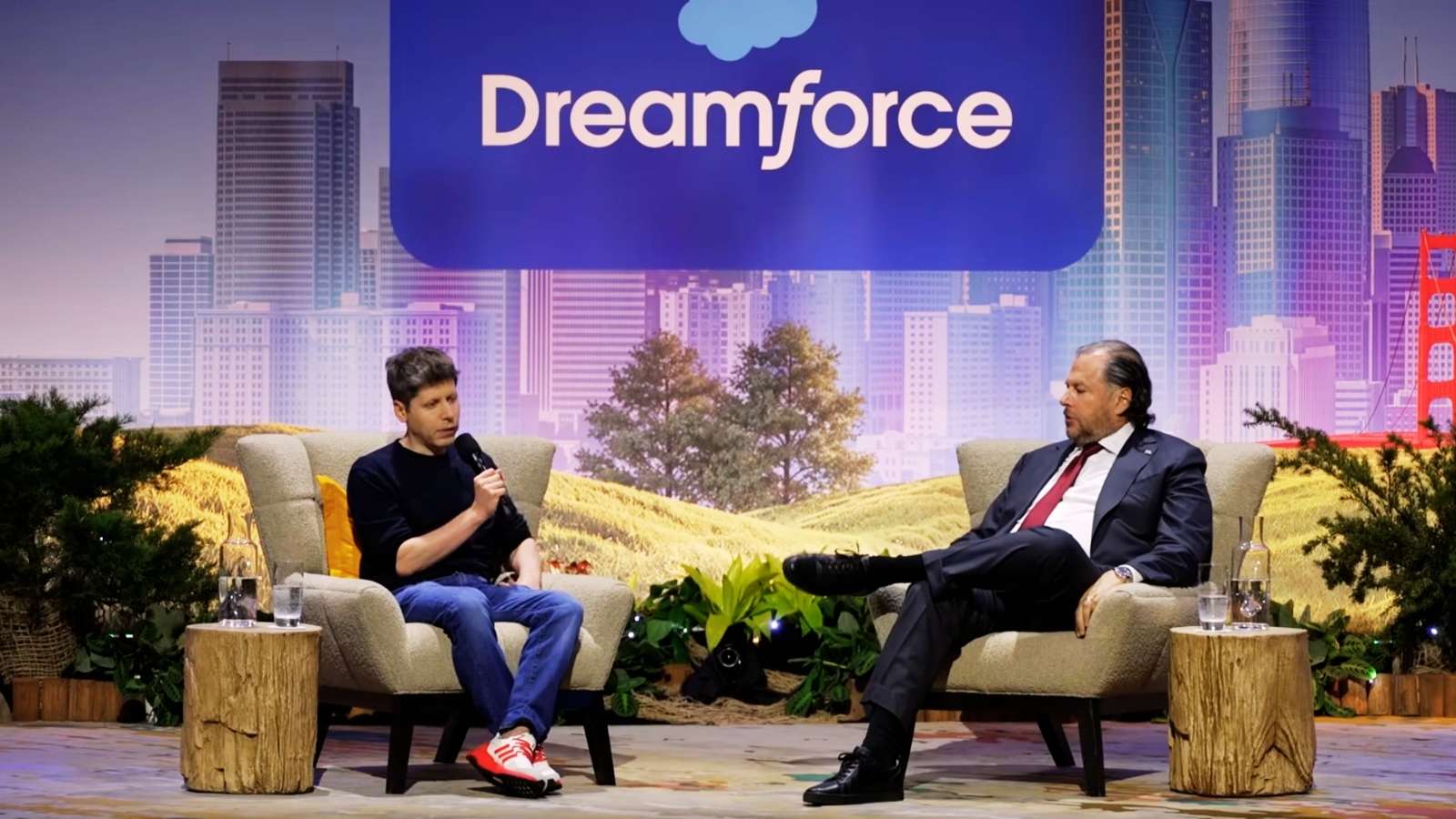
At Dreamforce 2026, Salesforce and OpenAI set out a future of increasingly capable AI agents, dynamic interfaces, and automated enterprise work. But better models will not repair fragmented customer data, unclear service policies, or broken handoffs. For CX leaders, that gap is where the real work begins.
Salesforce’s Dreamforce keynote was full of big claims about what AI can now do: reason through complex work, write software, generate interfaces on demand, and operate more continuously across the enterprise.
Sam Altman, CEO of OpenAI, argued that the technology is moving at extraordinary speed. Marc Benioff’s response was to position Salesforce as the layer that gives those models enterprise context: customer data, workflows, permissions, security controls, and approved actions.
Taken together, their message was clear. AI is becoming more capable. But customer experience will not improve automatically because the model behind it has improved.
That distinction is easy to lose in a keynote full of demonstrations.
As CX Today reported from Dreamforce, Salesforce is trying to make CRM less of a destination and more of a governed layer beneath interfaces such as Claude, Slack, and other AI experiences. The company’s wider agentic CX vision adds prebuilt agents, voice, reasoning models, governance tools, and a new operating model around that foundation.
But a more capable model may summarize a case more accurately, recognize a pattern across customer interactions, or propose the right next step. It may even generate a tailored interface that brings together account history, order data, knowledge, and service metrics. None of that resolves a customer’s problem if the data is incomplete, the entitlement rules are unclear, the relevant workflow is disconnected, or nobody has decided when the AI should stop and involve a person.
“The world has a lot of inertia. The way people do their work has a lot of inertia.”
That may have been the most useful reality check of the day.
Better Models Do Not Equal Better Operations
The enterprise AI market has often treated model progress as if it will solve the operational problems that have held customer service back for years.
It will not.
Customer operations remain complicated because customers do not live inside a single system. A service issue may involve a CRM record, an order platform, a billing system, a knowledge base, a contract, a loyalty account, a delivery provider, a contact center, and a policy that has changed since the last interaction.
The AI may be able to retrieve information from each of those places. But someone still needs to determine which system is authoritative, what data is current, which policy applies, what action is permitted, and who becomes accountable when the answer is wrong.
This is the operational challenge behind Salesforce’s AIforce strategy. The company wants its CRM platform to become the governed layer beneath interfaces such as Claude and Slack, with agents able to retrieve context and take approved action without requiring employees to work through a traditional Salesforce screen.
That could be useful. It could also expose the weaknesses organizations have tolerated for years.
A fragmented customer operation does not become joined up because an AI interface can query it more elegantly. In some cases, AI may simply make the gaps more visible—faster.
The Difference Between a Helpful Answer and a Resolution
Salesforce’s argument is that models alone cannot run the enterprise. It is right to make that distinction.
A customer asks why their order has not arrived. An AI model can produce a fluent response. But resolution may require the agent to check order status, verify the customer’s entitlement, identify a service exception, determine whether compensation is authorized, update the case, arrange a replacement, and notify the customer of what will happen next.
Each step depends on more than model intelligence.
It depends on accurate and accessible data. It depends on business rules that are clear enough to automate. It depends on permissions that prevent an agent from taking an unauthorized action. And it depends on a route to a capable human when the issue falls outside those boundaries.
That is why the most important CX question is not whether an AI agent can contain a contact. It is whether it can help resolve the underlying problem without creating a repeat contact, a complaint, an avoidable escalation, or a loss of trust.
Salesforce’s Dreamforce announcements—from Casey and Fin to Agentforce Voice, Koa, the AI Harness, and the AI Control Plane—are all meant to move AI from answering questions toward completing work. Our analysis of the eight key announcements examines what CX leaders should test before treating that transition as proven.
Dynamic Interfaces Will Not Remove the Need for Judgment
One of the more striking themes of the keynote was the move toward dynamic interfaces. Benioff and Altman described a future in which an AI can understand an employee’s request, determine what information they are allowed to see, and generate an interface around the work they need to do.
For a service employee, that could mean a live workspace assembled around a customer issue rather than a fixed desktop spread across multiple applications.
There is real potential in that. Better context, presented at the right moment, could reduce effort for employees and customers alike.
But dynamic interfaces also raise new questions. If an AI-generated service view combines data from several systems, can the employee see where each data point came from? Can they tell whether it is fresh, complete, or disputed? Do they understand which information led the AI to recommend an action?
Speed is useful. Explainability is essential.
The danger is that a more elegant interface makes an uncertain decision look more certain than it is.
CX Leaders Need to Close the Operational Gap
The pace of AI innovation will continue. Salesforce, OpenAI, NVIDIA, Anthropic, and others are all pushing enterprises toward agents that can take on more work across more systems.
But most customer operations cannot be transformed at keynote speed.
Organizations need time to connect data, clarify policy, update workflows, train employees, test agents, establish approval thresholds, and redesign escalation paths. They need measures that show whether customers are genuinely receiving better outcomes—not just whether fewer interactions reach a human.
The practical response is not to wait for the technology to settle. It is to start with the journeys where the operational foundation is strongest and the customer problem is clearest.
That could mean a repeatable returns process, an account update, a straightforward entitlement check, a delivery exception, or a high-volume internal service workflow. The goal should be to prove that an agent can improve resolution within defined boundaries, then expand from there.
Final Thoughts for CX Leaders
AI may be moving quickly. Customer trust is built more slowly.
The enterprises that succeed will not necessarily be those that deploy the most agents first. They will be those that do the less glamorous work of making their data, decisions, workflows, permissions, and human handoffs ready for the agents they want to deploy.
Dreamforce has set out a compelling picture of what could be possible: CRM context available in any interface, AI agents that can take action, and customer operations that become more proactive and personalized. But CX leaders should resist measuring progress through the number of AI capabilities switched on.
- Which customer problems are we actually trying to resolve?
- Is the data behind those journeys reliable, current, permissioned, and explainable?
- What can an agent do independently, and where must a person remain accountable?
- Can a customer understand, challenge, and recover from an automated decision?
- Are we improving resolution and trust—or simply accelerating a broken process?
The answers will determine whether AIforce and the wider agentic enterprise become a meaningful step forward for customer experience, or a faster route to the same old operational problems.
For the broader Dreamforce picture, read Salesforce Takes CRM Out of Salesforce at Dreamforce and Salesforce’s Agentic CX Vision: 8 Dreamforce Announcements CX Leaders Need to Act On.
