

HTC can’t win on price, and can’t win on the arguments.
Meta makes so much money that it can burn billions upon billions of dollars to go after any product category it wants. The company sought to dominate the camera-equipped smart glasses world and it’s hard to argue that it isn’t succeeding. But it’s only by throwing moneyat the problem that Meta has succeeded so far, since it still can’t explain why anyone needs a pair. There’s almost nothing camera glasses can do you can’t do faster and better with a phone, but you don’t need to make that argument if your gear is cheap and you’ve got Kylie Jenner vibes to coast upon.
HTC, the former phone giant toiling away in obscurity, is the latest to try and go toe-to-toe with Meta. It launched the Vive Eagle a year ago in Taiwan, and now it’s finally brought the device to the West. Sadly, HTC has neither the money nor the cultural clout to rely upon, and so the Eagle needs to do two things. First, it needs to make a compelling argument as to why we need these things in the first place. Second, it needs to offer a sufficiently excellent hardware and software experience that it blows Meta’s offering out of the water. It’s not enough to do one or the other, it has to do both.
Hardware
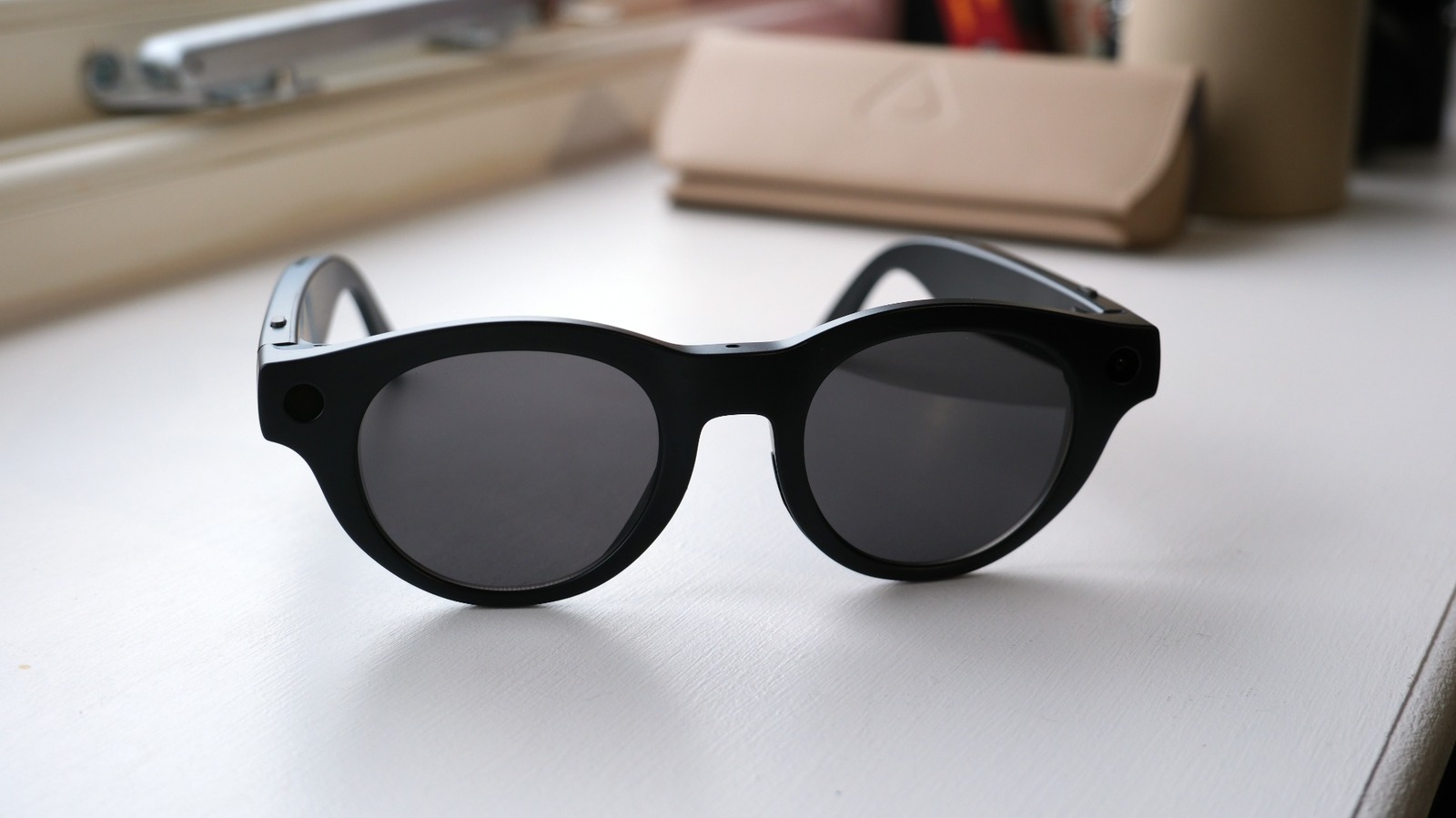
HTC’s Vive Eagle is a pair of smart glasses aping the template laid down by Ray-Ban back in 2021. It’s a Wayfarer-style frame with either Panto (round) or Square lens options hewn in either black or tinted translucent plastic. On either side of the two glasses lenses, embedded in the hinges, are two round cut-outs: one for the camera and the other for a white LED and the sensor that surrounds it. The LED is there to warn those around you that you’re recording.
I’m testing the basic Panto model with non-prescription sunglass lenses, which is available for $499 in the US. They weigh around 49 grams (1.7 ounces), with the light weight meaning you’ll never feel too confident about their ability to take a beating in the rough and tumble world. They’re on the larger end of the spectrum, where even on my face I feel like Anna Wintour grimacing through a particularly lackluster summer showcase. The Vive Eagle ships with a Vive-branded faux-leather case which looks like the sort of accessory you could snag from any optical retail store.
Internally, it’s the same product that arrived in Taiwan last year, with a Snapdragon AR1 Gen 1 SoC, 4GB RAM and 32GB storage. The 235mAh battery will last for 4.5 hours playing music, three hours for calls and can sit in standby mode for 36 hours at a time. HTC hasn’t given specifics about the stereo speakers embedded in the arms beyond saying they’re “bass enhanced.” There’s a four-microphone array — one directional in the nose bridge and three omnidirectional. Rounding out the spec list is Bluetooth 5.3 and Wi-Fi 6E, which you’ll use to transfer data from the glasses and to your phone.
As for the camera embedded in the left hinge, it’s a 12-megapixel ultra-wide sensor capable of shooting 3,024 x 4,032 stills and 1,512 x 2,016 vertical video. If you love documenting your own feats of derring and do, you can shoot slow motion vertical video at 120 frames per second at the greatly reduced resolution of 960 x 1,280. There’s a maximum upper limit of 10 minutes for every video clip, and HTC says that 32GB storage can hold up 3,000 photos, or up to 50 videos.
The Eagle has two buttons, one on the left arm which acts as an on/off switch and triggers the AI. The one on the right is the camera control. There’s a touchpad running down the right side which lets you scroll and tap to answer calls, control media playback and cycle through AI responses. Given the amount of smart glasses which don’t include enough physical controls, the variety here is worthy of praise.
As for charging, the Vive Eagle has two exposed pins on its left arm for its proprietary magnetic connector. HTC is aware that smart glasses are no good to you if they’re trapped in a charging cradle, so the 1.2 meter USB-C cable is long enough for you to walk around with your glasses on and a power bank in your pocket. But HTC is also selling Power Boost, a tiny 120mAh battery pack light enough to clip to the side of your glasses. It’s small enough that you’ll barely notice it, and it gives you at least half a battery’s worth of charge while on the go.
Audio and AI
You’ll be interacting with your glasses via your voice far more than you will your hands using “Hey Vive” as your wakeword. You can trigger pictures and video shooting, ask the AI questions and get it to examine things via the camera. The speakers have been tuned for speech, great for the AI, calls and podcasts, but less so for music. The highs are tinny and the bass is either nonexistent or painfully crunchy, so HTC’s promised bass enhancement clearly isn’t enough. So while it’s better than some glasses, don’t throw out your earbuds. Especially since the speakers’ open design means it’s possible for whoever’s sitting next to you to hear every word of what you’re listening to, music, podcast, or phone call.
As for using the AI, I’ve still yet to find a scenario in which asking any chatbot is actually faster and more efficient than doing it myself. HTC says that it’s possible to open a book and ask your glasses to read to you, but I couldn’t. I opened a novel on my shelf, asked the system to read to me, and every time, it would get a few words in and then stop, saying the text violated its content guidelines. When I asked what guidelines it had violated, it said it was mistaken, and could read the whole thing to me. So I prompted it to do so, but then it told me again that it was going to violate its content guidelines. Sadly, it seems that any text which contains profanity you’ll just have to read yourself.
Other results were similarly hit and miss: It wisely advised me not to eat the fungus I found while walking. But when I looked up a Spanish language menu and asked it for help, it first told me I was looking at a menu on a computer screen. Once I’d burned up another prompt, it gave me the gist of the menu, but didn’t actually work through each option in turn. If I’d actually been in a Spanish restaurant, I would’ve had to use Google Lens on my phone anyway. In fact, there are no use cases where I’d want to use the Vive Eagle’s AI where I know I wouldn’t find it faster to just type something into my phone instead.
Camera
I feel similarly about the forward-facing cameras embedded in any pair of smart glasses like the Vive Eagle. They’re a solution in search of a problem, and an ill-defined one at that, making the images which come out the other side pretty flat and nondescript. As there’s no attempt at even faking depth of field, there’s little chance for you to place your subject. That’s fine for a picture destined for Snapchat or Instagram Stories, but not for anything more serious or meaningful. Looking through the pictures I took on a morning stroll, they resemble cameraphone shots from five or more years ago.

Moving photos and videos off the glasses and onto your phone is frustrating, but HTC says it’s a deliberate choice. As part of its pledge to protect user privacy, images and videos won’t just sync to your phone in the background or when you open the Vive app. Instead, you’ll need to go to the Gallery pane in the app, connect to the glasses’ own Wi-Fi network, and then import the pictures over. Once you’ve done that, you then have to select which photos you’d like to save in your smartphone’s own gallery.
Privacy
In the year since HTC launched the Vive Eagle, the conversation around glasses with cameras has shifted. They’re increasingly called “pervert glasses” and subject to an ever-growing number of bans. This started with public buildings, which already outlawed recording equipment, insisting these glasses would not be exempt. But now, the prohibition is spreading, to the point that even the US Immigration and Customs Enforcement Agency has forbidden them. Given ICE’s documented use of surveillance technology, it’s a sign public opinion is not pro-glasses.
Consequently, HTC has shifted its pitch to talk about how the Vive Eagle respects your privacy more than Meta and its various subsidiaries. HTC says it’s complying with international standards 27001 for Information Security and 27701 for Privacy Information Management. AI requests for both Gemini and OpenAI are “de-identified” before being shared to prevent either company from profiling users. Of course, all of this is based on the false premise that a pair of camera-equipped smart glasses can ever respect people’s privacy. If you’re not respecting the privacy of those around you while wearing them, why should you expect your own privacy to be respected?
HTC says its recording warning light cannot be breached in the same way that Meta’s has been. The camera will not record when the glasses are not worn on the face, and if the LED light is obscured, the recording will stop. HTC alluded to additional system and hardware features designed to prevent hackers from jailbreaking the camera, which it declined to discuss further. And the recording will instantly stop if a third party says “stop recording” in earshot of the glasses. HTC is confident there is no way for a person to record anything without the LED light being visible at all times.
Unfortunately for HTC, I was able to make a crude workaround for this in about three minutes.
I cut up the black cardboard sleeve which held the Vive Eagle’s charging cable, fashioning it into a hook for the right arm. A little piece sat a few millimeters in front of the LED. My guess was that the LED has a light sensor which triggers a shutdown if it falls below a certain threshold. As my piece of card only obscures it from view, and there’s still plenty of room for daylight to pour in, the sensor can still see light. It’s not a perfect system and only works at a distance (it’s really obvious up close) but if you were motivated and had a 3D printer, you could easily make a sensor cover that was far less obvious and equally as effective.
Price and the competition
Let’s address the elephant in the room: HTC is not the company it once was, or even the company it became after it fell into the doldrums. A business that once went toe-to-toe with Samsung and Apple pulled in revenues of just $19 million in the second quarter of 2026. Even worse, it actually posted a loss of $8.8 million, and that was considered good news. Bear that in mind when you learn the Vive Eagle will cost $499 in the US, before the additional cost of prescription or transition lenses.
Meta, meanwhile, makes enough money to take advantage of economies of scale and/or can just subsidise its hardware. Consequently, you can pick up the latest Meta Glasses for $299, with prescription lenses an additional $100. Meta Glasses have a single 12-megapixel camera, a rated battery life of eight hours and open-ear speakers. You can communicate with Meta’s in-house AI, harness live translation, take photos and video, answer calls and listen to music. Plus, there’s a charging case which contains up to 40 hours of additional charge thanks to its built-in battery. Obviously, there are plenty of downsides that come with the cheaper price, including the inherent issues (privacy and otherwise) of any Meta product.
Wrap-up
The HTC Vive Eagle is a functional alternative to Meta’s camera-equipped smart glasses that at least gestures toward user privacy. They are perfectly fine to wear, and the control scheme has been thought out well enough that they solve a few key usability issues. But in the same way HTC (and Meta) hasn’t made a compelling argument for why you need a pair, I’m struggling to see a point.
The AI isn’t elegant or useful enough to compel me to use it, and the speakers are just fine in a pinch. As for the camera, it’s fine for low-effort snaps but hardly good enough to capture memories you’ll want to cherish for a lifetime. I’m not going to complain about the price given the state of the world right now, but it’s not a plus. And if you’re the sort of person who would wear glasses like these, it’s hard to rationalize the premium on moral grounds.
I’m sorry to say, but the HTC Vive Eagle did nothing to win over this AI camera glasses skeptic.
