

We’ve got fitness trackers, smartwatches, and smart rings that can precisely log our sleep, workouts, stress, and more with minimal user legwork, but one holistic tracking pain point that persists is food logging.
Sure, lots of companion apps, including Garmin Connect and the Oura app, let you manually log your calorie and nutritional intake, but what if there was an easier way?
The Odyss N1 AI necklace is aiming to be the missing link. Still a concept, I had the chance to demo the Odyss N1 at IFA 2026 in Berlin, and even though I’m slightly skeptical of its capabilities, I’m seriously intrigued by what it potentially offers.
Odyss N1 AI necklace: design
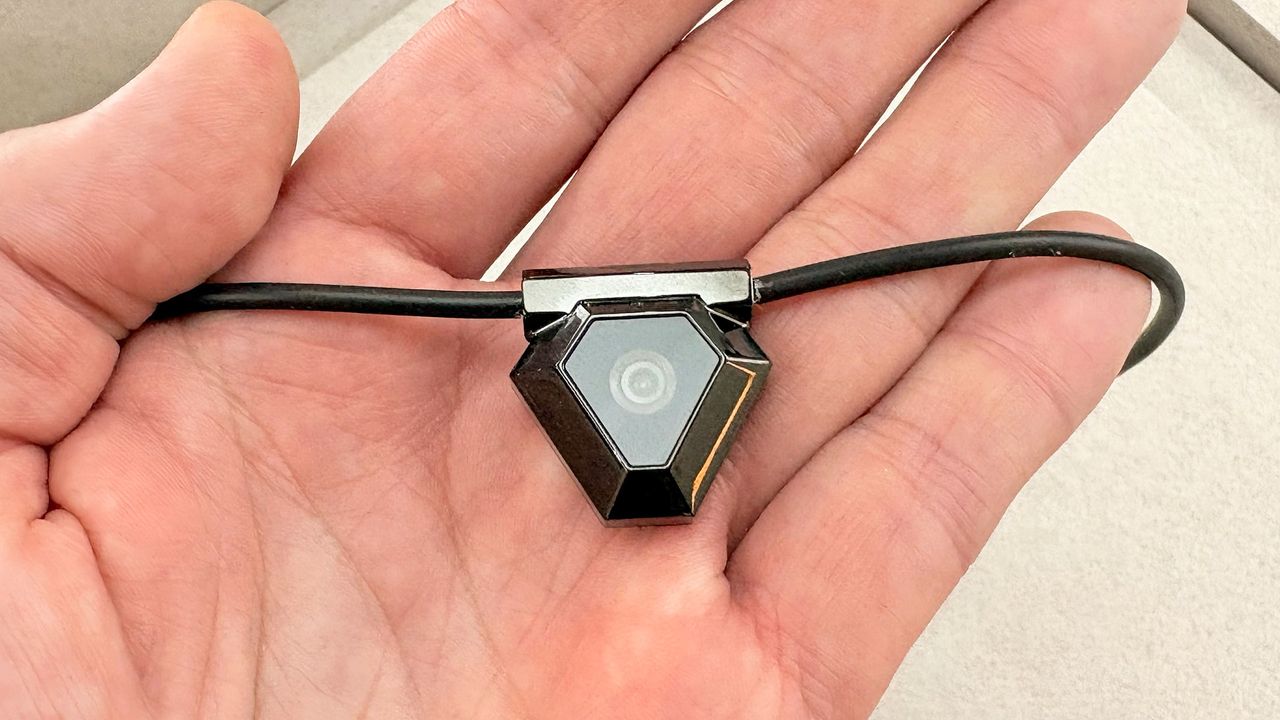
The Odyss N1 consists of a small, triangular metal pendant with a built-in camera and accelerometer used to track what you eat, when you eat, and how much you eat.
The necklace itself is actually a cable that connects the pendant to a battery module that sits at the back of your neck. This power module also boasts haptic feedback for notifications.
The pendant is constructed of metal and available in three colors: black, silver, and gold. It’s also remarkably high-quality and jewelry-like.
A single physical button adorns the top of the pendant. Pressing it turns off all the food logging features. Another privacy feature: the Odyss N1 doesn’t save any raw imaging data, ever.
Odyss N1 AI necklace: how it works
The Odyss N1 feeds visual and motion data into an AI-powered algorithm, which also takes into account prior contextual data to try to accurately predict what exactly you’re eating, including details on how it was cooked. Users can, of course, edit the details logged at any time. Better yet, the Odyss N1 learns from your edits.
The more you wear the Odyss N1 and/or update the logged info, the smarter it gets. I’m told that users will need to wear it for at least two weeks to fully calibrate the device for accuracy, but after that, it should be good to go.
What happens to all that logged food data? The companion app uses it to track your overall nutritional trends and even make recommendations to help you improve your diet.
In addition to nutrition, the app generates diet analysis reports focused on three key metrics: quality, energy, and rhythm.
While the Odyss N1 is still just a concept, the plan is to make its food logging data accessible to other popular holistic tracking apps. Likewise, the Odyss app is designed to import and analyze health data from other wearable tech and factor it into your nutritional recommendations and insights.
Odyss N1 AI necklace: Outlook
The Odyss N1 is more than a cool idea. It’s a potentially groundbreaking piece of wearable tech that truly attempts to solve a problem. Assuming it plays nicely with other popular health apps, isn’t too pricey, and actually works as intended, I could definitely see the Odyss N1 catching on.
On the other hand, one downside of the design is that you pretty much need to wear it all the time for the food tracking feature to work effectively. Moreover, battery life appears to be limited to a day or two at best, requiring users to frequently take it off for a recharge.
What are your thoughts on the Odyss N1 AI smart necklace? Is it something you’d consider wearing? Also, how much do you think it should sell for? Let me know in the comments below.
- Forget Whoop — 3 major differences between the subscription-free Luna Band and Garmin Cirqa
- I just went hands-on with the new Circular Ring 3 — and it beats the Oura Ring 5 in 3 big ways
- Garmin launches nutrition tracking — but you’ll have to subscribe to Connect+ to get it
