

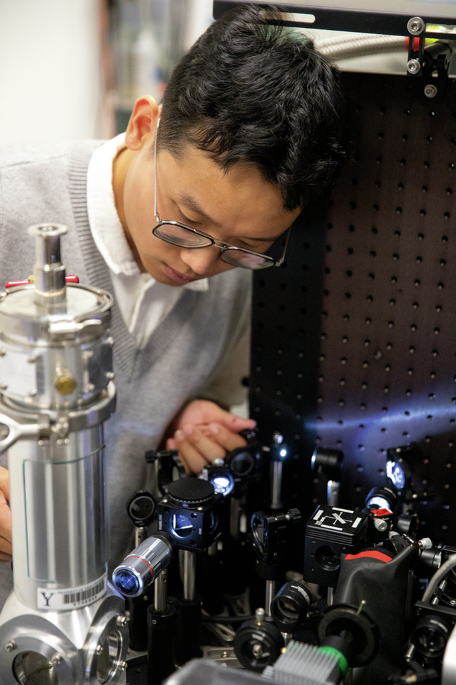
Metal halide perovskites (MHPs) are a versatile class of materials for photovoltaics, light-emitting diodes, photodetectors and spintronic devices. Their composition, structure and dimensionality can be fine-tuned to produce materials with desirable electronic and optical properties for high-performance devices. However, the intrinsically poor thermal conductivity of MHPs makes thermal management a persistent challenge. The resulting heat accumulation and elevated device operating temperatures can accelerate thermal degradation, thereby reducing device efficiency and operational lifetime. Reliable measurements of thermal transport in these materials and devices are therefore essential for guiding materials design and improving device stability.
In VPVP, a mid-infrared pump pulse creates heat within the material by resonantly exciting vibrational modes of the organic constituents (for example, C–H or N–H stretching mode). The resulting temperature evolution is tracked by a time-delayed visible probe, whose reflectance or transmittance changes linearly with lattice temperature. Two complementary implementations have been established: VPVP spectroscopy, which captures heat dissipation dynamics after pump heating; and VPVP microscopy, which adopts wide-field imaging and a monochromatic probe, enabling non-contact spatiotemporal thermal imaging and thermal-conductivity mapping.
This is a preview of subscription content, access
Access options
- Purchase on SpringerLink
- Instant access to the full article PDF.
Prices may be subject to local taxes which are calculated during checkout
Subjects
Authors and Affiliations
Ethics declarations
Competing interests
The author declares no competing interests.
Rights and permissions
About this article
Cite this article
Chen, D. Probing thermal transport in hybrid metal halide perovskites.
Nat. Rev. Clean <a href="https://myappsplus.com/why-older-tech-is-sometimes-safer-from-hackers/” title=”Why older tech is sometimes safer from hackers”>Technol. (2026). https://doi.org/10.1038/s44359-026-00209-7
-
Version of record:24 August 2026
-
DOI
:https://doi.org/10.1038/s44359-026-00209-7
