

Accelerating development for massive Git repositories
NOV. 17, 2026
The Android ABFS Team
Android’s source code is big – the Android 17 open source release has 1,084Git repositories, 1.62 million files, and takes 300 GB for a built workspace. Additionally, in a typical Android source tree with hardware vendor code and first-party applications, the size increases by 2-3x.
Traditionally, it took over 30 minutes to fetch Android Open Source Project (AOSP) source code and well over an hour to build on even highly capable developer workstations. As software development evolved over the last 2 years, modern coding harnesses and LLMs have accelerated the development of many projects. These tools are used today for Android operating system development, but the long sync and build times make them less efficient. Both human developers and agents need quick setup, parallel workspaces, and fast build-and-test iteration times.
We built Another Build File Service (ABFS) to address these bottlenecks. ABFS is a full suite of software across a Linux kernel filesystem module, user-space daemons, and server-side infrastructure. ABFS uses content-addressability across the entire stack to lazy-load and cacheild results
Today, we are excited to announce that ABFS is open
- Reduced checkout times from ~36 minutes to under 8 seconds.
- Reduced full build times from ~80 minutes to just over 2 minutes.
- Enabled parallel agentic workflows across multiple workspaces and agent orchestrators.
- Shared cache reuses up to 100% of build actions across continuous integration (CI) and developer workspaces.
ABFS already powers parallel workflows for developers and agents in Android, but it is designed to scale to other massive Git-based projects.
Case Study: Android
In the Android build system, developers define build rules in Blueprint files (Android.bp), Soong compiles them into Ninja files, and Ninja executes the final build graph (see the Android build overview). Similar to the Make build tool, Ninja is timestamp-based. If a build step’s input file is newer than the existing output file, Ninja rebuilds the output file.
Code Size
Analyzing the <a href="https://android.googlesource.com/” rel=”nofollow noopener” target=”_blank”>AOSP code for Android 17 shows the sheer disk footprint and file count involved in a single checkout and build.
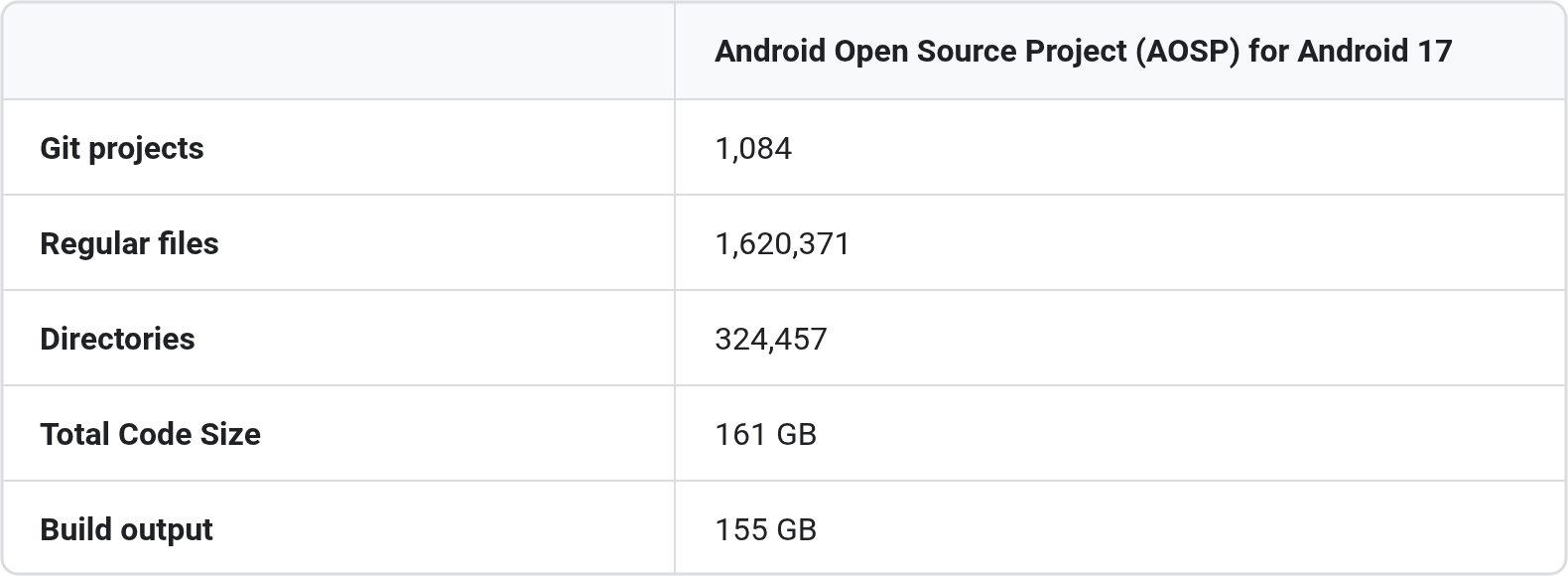
Table of Android Open scale for Android 17: 1,084 Git projects, 1,620,371 regular files, 324,457 directories, 161 GB total code size, and 155 GB build output
In a typical Android tree that includes hardware-specific repositories, board support packages, first-party applications, form-factor-specific code, etc., the code size is 2–3 times the size of AOSP (over 3,000 Git repositories), compounded across multiple active SKU and legacy maintenance branches.
Build Cacheability
Building the Cuttlefish emulator target executes a build graph with 192,249 Ninja actions. While local incremental builds are fast once a tree is already built, every new workspace, branch switch, or ephemeral agent session starts cold.
Even though typical developer changes touch only 1-10 different Git projects, someone building locally without any remote execution might waste up to 80 minutes on a 64-core machine repeating work their CI system already built. Even if a developer edits a core library like system/libbase, 97% of the build graph is identical to the CI build.
Unspecified Dependencies
Sharing cached build outputs across CI and local machines is also tricky in a codebase of Android’s age and rate of change. Build rules occasionally introduce hidden dependencies (such as passing an undeclared schema file inside raw compiler flags), over-declared inputs, or undeclared outputs. In timestamp-based builds, hidden dependencies silently produce stale incremental artifacts, forcing developers to wipe output directories and run clean builds.
Solution: ABFS
ABFS makes building Android fast by replacing massive localSFS). ABFS streams files on demand only when a build actually touches them and utilizes shared build caching to help eliminate redundant downloads and compilation
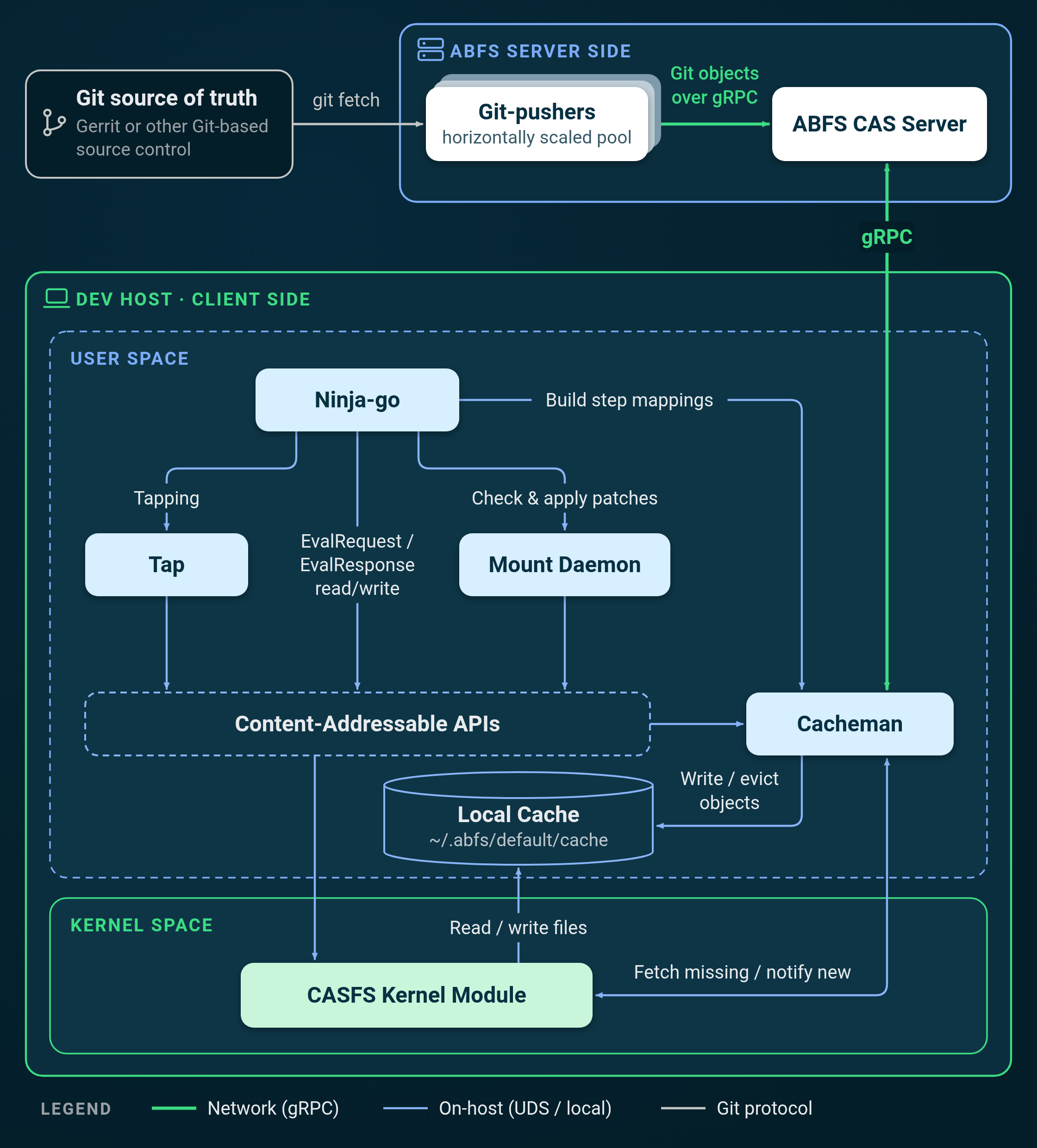
Architecture diagram showing client-side components (Ninja-go, Tap, Mount Daemon, Cacheman, Local Cache, and the CASFS Kernel Module) and server-side components (ABFS CAS Server and Git-pushers connected to a Git
On the server side, Git-pushers continuously ingest new Git objects from Gerrit or other Git hosts into a horizontally scalable gRPC ABFS Content-Addressable Storage (CAS) Server that indexes Git content, workspace snapshots, and build step results. On the developer host, a local Least Recently Used (LRU) Cacheman daemon, Mount Daemon, and Tap utility connect user-space build tools to the kernel filesystem so checkouts and builds stream only what they need. See the full ABFS architecture on GitHub.
Filesystem
At the core of the client is a virtual filesystem called Content-Addressable Storage Filesystem (CASFS), a Linux kernel module that exposes Git SHA content hashestes its metadata immediately and downloads file bytes
$ touch hello
$ abfs hash --set cc628ccd10742baea8241c5924df992b5c019f71 hello   # metadata only
$ ls -l hello      # name and size are available; content is not downloaded yet
-rw-r----- 1 user primarygroup 6 Nov  3 00:11 hello
$ cat hello        # content is lazy-loaded on first read
world
Initial checkouts download only lightweight directory metadata prepopulated with Git hashes. CASFS uses Git’s object model natively, allowing standard git and repo operations to work transparently.
Correct two-phase build caching
CASFS can also tap build processes. Tapping records every file actually read, written, or deleted into lists called patches, which are stored alongside cached build outputs. Ninja-go replaces timestamp checks with two-phase content-addressable caching:
- Phase 1 – Declared key lookup: Ninja-go hashes a step’s command, environment, and declared input hashes to fetch candidate results from prior CI or developer builds.
- Phase 2 – Read-patch verification: Before accepting and applying a candidate result, ABFS verifies the candidate’s recorded read patch against the current CASFS state. In the common case, this read patch will match the filesystem state and then the write patch is applied.
If even a hidden dependency has a different hash on disk, ABFS rejects the stale candidate and reruns the step with tapping enabled. This preserves clean-build correctness even when the build graph is incomplete.
Ninja-go accelerates Ninja-based builds like Android and Chrome; other build systems can integrate with ABFS’s caching APIs using the same model (see the two-phase caching walkthrough on GitHub).
Synchronized workspaces
Each mounted checkout attaches to a persistent workspace that eagerly syncs modified files, git state, and repo state through Cacheman to the ABFS CAS Server—keeping mounts synchronized across sessions or across multiple developer hosts.
Results
The benchmarks below show the mean time of 3 Android runs on a GCE n2d-standard-64 VM with 64 vCPUs and 256 GB of RAM. The ABFS remote server was running in the same cloud network as the client.
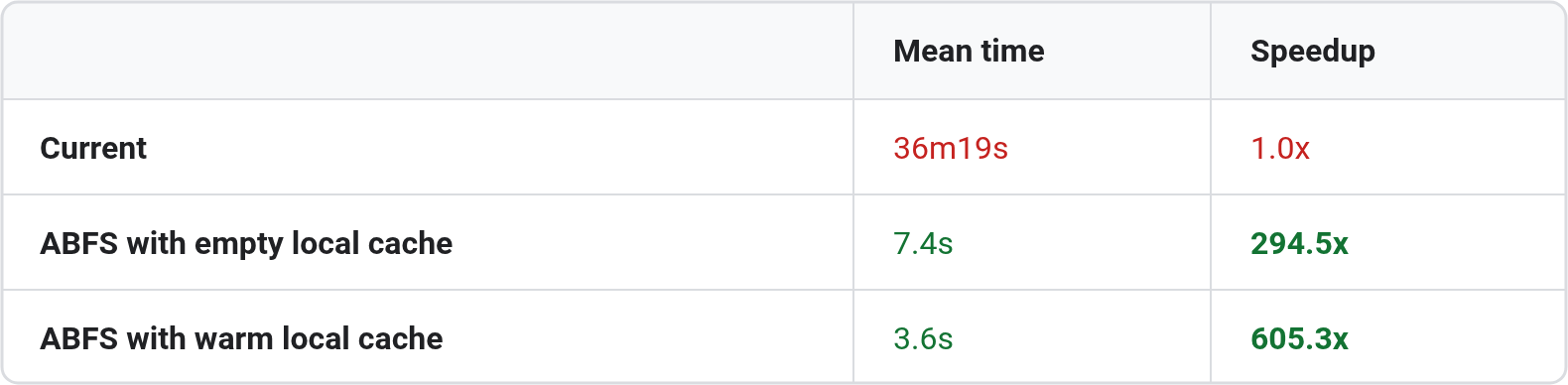
Note: The “Current” flow used repo init –partial-clone and repo sync -j8 as documented in official Android documentation (higher -j values hit Gerrit rate-limiting on android.googlesource.com).
Build
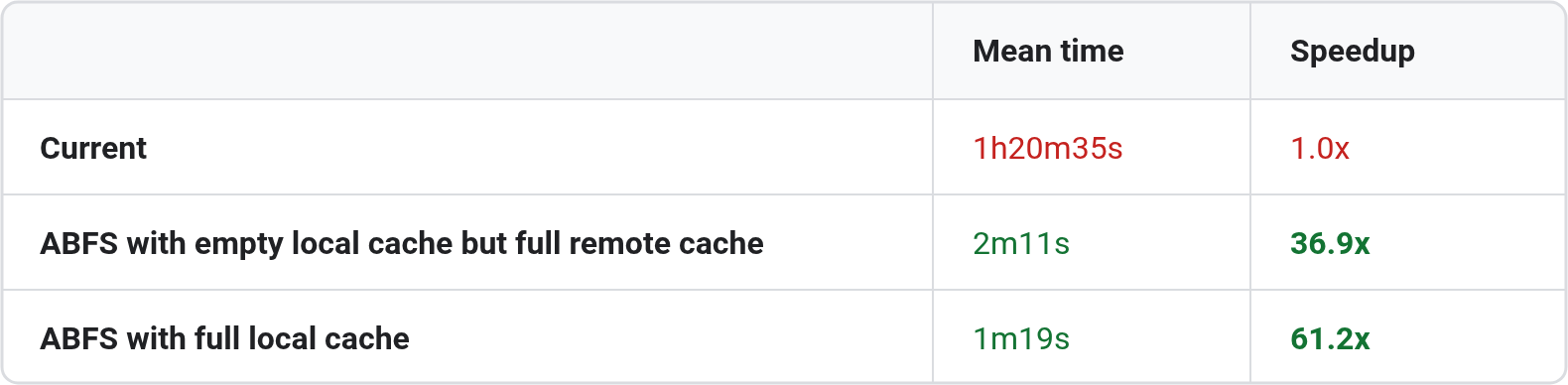
Note: All of these builds used lunch aosp_cf_x86_64_only_phone-aosp_current-userdebug and m droid to build.
Checkout and build demo
<a href="https://www.youtube.com/watch?v=YfXxfH337m8″ rel=”nofollow noopener” target=”_blank”>Link to Youtube Video
(visible only when JS is disabled)
Unlocking agent development
Because ABFS does lazy loading and local cache deduplication, developers and their agents can now mount multiple concurrent Android workspaces on a single machine, benefit from a shared local build cache, and achieve massive scale in development time.
# Mount 5 distinct Android release branches side-by-side in under 8 seconds each
$ abfs mount -b android-latest-release   /ws/a17
$ abfs mount -b android16-qpr2-release   /ws/a16qpr2
$ abfs mount -b android16-release        /ws/a16
$ abfs mount -b android15-release        /ws/a15
$ abfs mount -b android14-release        /ws/a14
An agent can check out a full Android tree in under 10 seconds and perform a full buildin under 10 minutes. Agent swarms are empowered to iterate, review, and test in parallel, which can lead to higher quality solutions and speed.
In the demo below, an agent makes a system/libbase fix on the latest AOSP release, then 4 parallel agents simultaneously backport, build, and test the fix across 4 more AOSP releases on a single VM.
Agent development demo
Note: AOSP releases before Android 17 require some patching to work with ABFS.
Extending beyond Google and Android
We released ABFS as openscale Git-based project to benefit from what we have learned and be able to scale
While Android’s Soong/Ninja pipeline was the first acceleration target, ABFS was built to be extensible to other build systems. Content-addressable build systems like Bazel map naturally onto CASFS and there is already a proof-of-concept integration with Bazel. Chromium, the Android Common Kernel, and other Google projects are exploring ABFS compatibility.
Explore ABFS, CASFS, and Ninja-go on GitHub, and reach out to us at abfs@google.com.
For help with the Google Cloud server-side, infrastructure-as-code, and CASFS for Cloud Workstations and Kubernetes, please reach out to abfs-gcp@google.com.
Acknowledgements
We’d like to extend a special thanks to our significant contributors for their work on this project:
Haamed Gheibi, Erik Sanders, Rob Seymour, Taylor Santiago, Andrew Hsieh, Eric Taseski, Kiyoung Kim, Hung-Wei Chen, Jose “Pepe” Galmes, Ronald Li, Yu-Che Wang, Roger Ellis, Sandeep Patil, Amith Dsouza and the entire Android Build team
