

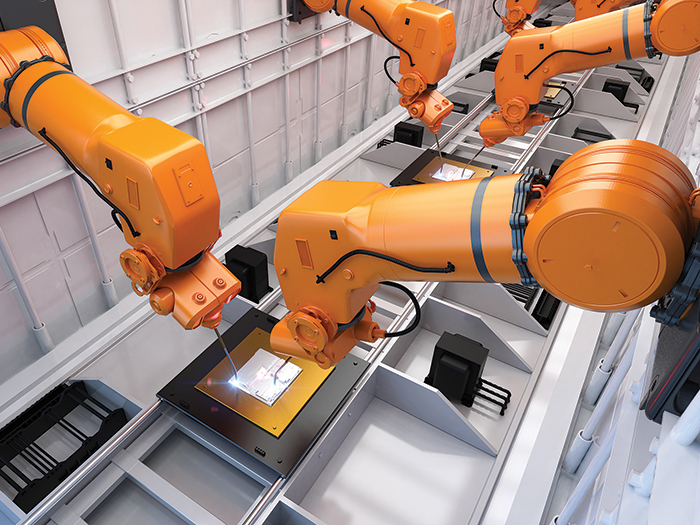
As manufacturers embrace robotics, A.I. and connected systems, insurers are confronting new workplace hazards, cyber threats and coverage gaps that demand a more integrated approach to risk management.
By: Bruce Shutan | November 12, 2026
Topics:Cyber Risks | Emerging Risks | Insurance Industry | Nov./Dec. 2026 Issue
The need to mitigate a growing stack of tech-driven workplace hazards has never been more pronounced. More than a century of automation in manufacturing, integrated layers of computer technology and robotics, combined with increasingly sophisticated cyberattacks that can shut down operations, are complicating efforts to prevent injuries and improve operational efficiency.
Given these challenges, industry experts believe it’s becoming increasingly important to address interconnected risks holistically and identify potential gaps in insurance coverage.
Automation, robotics, A.I. and computer vision are helping manufacturers improve productivity, quality and operational resilience while reducing exposure to injuries manufacturing industry practice leader for The Hartford
Productivity gains stem from the ability to perform tasks with greater speed, consistency and precision than manual processes, he said. For example, robotic welding, machine tending and material handling operations can often run with fewer interruptions, produce more consistent output and reduce rework caused by quality variations.
“From a safety perspective,” Germano explained, “many manufacturers are using robotics to perform jobs that are repetitive, physically demanding or inherently hazardous. These include material handling, palletizing, welding, machine tending and tasks that expose workers to excessive heat, noise or other operational hazards.”
Staying in Their Own Lanes
That trend is showing up in the reporting. “We have been seeing a little bit of a reduced frequency in certain types of workers’ comp claims,” reported TJ Richter, an executive underwriting officer who heads Liberty Mutual Insurance’s manufacturing practice.
However, he cautioned that increased interaction between workers and automated equipment is creating new injury risks. Examples include automated picking equipment backing into workers and automated forklifts running over employees.
“You can make sure that those automated forklift pickers are staying within their own lane. It’s the human element that we’re having trouble controlling right now, where the individual is walking across the floor space now designated for automation,” Richter observed.
With more robotics and automation in the workplace, the focus of underwriting manufacturing risk exposures is now on operational technology (OT), explained Connor Brennan, SVP of cyber and professional liability for Arch Insurance.
TJ Richter, an executive underwriting officer who heads Liberty Mutual Insurance’s manufacturing practice
That category could include robotics-related systems, as well as industrial control systems like a computerized SCADA (Supervisory Control and Data Acquisition) network used to monitor, gather data from, and control physical equipment and infrastructure across long distances.
While autonomous mobile robots (AMRs) in a distribution warehouse can help reduce errors and increase output, they also pose challenges. Their presence introduces a significantly increased risk of hacking events, explained Lindsay Shipper, head of North American commercial property at Beazley.
“What happens if one of those auto pickers is hacked and there’s a fire that starts? What are the safety systems that are in place?” she asked.
Preparing for Cyberattacks
When anticipating an OT system or robotics hack, manufacturers may want to purchase a cyber policy extension to cover physical damage resulting from a malicious cyberattack, which wouldn’t be covered under the property policy, suggested Melissa Carmichael, head of U.S. cyber risk at Beazley.
Jaguar Land Rover may serve as a cautionary tale. An August 2025 cyberattack on the automaker led to a widespread operational shutdown that halted production for five weeks. “The ripple effect of that across the entire supply chain was significant,” she said, noting it was dubbed the largest cyber incident for a British company.
Ripple effects also can be felt across the manufacturing setting if proper protocols aren’t in place. In segmenting OT and IT exposures, Brennan said the aim is to ensure that firewalls and different security protocols such as multi-factor authentication are set up to prevent any lateral movement into OT systems. That’s because when someone clicks on an email with a malicious link within the IT environment, for example, the threat actor can deploy ransomware into operational technology using connections between IT and OT networks.
It’s also important to establish proper segmentation between OT and the internet since many of these systems now communicate with it. While noting the bulk of OT exposure involves business interruption, he said cybersecurity and privacy exposure also come into play with ransomware attacks that exfiltrate sensitive information and shut down facilities.
What scares Richter the most is the potential for property damage at upgraded facilities with additional infrastructure and power sources. He pointed to the risks associated with adding charging infrastructure and lithium-ion batteries without updating existing fire-protection systems.
An example of an expansive thermal runaway risk is 10 forklifts charging for six hours alongside lithium-ion batteries in a facility that relies on a sprinkler system that hasn’t been upgraded to accommodate the new configuration or power sources. Lithium-ion battery fires require large amounts of water to cool the battery cells before they can be extinguished.
“We’ve seen a nasty claim or two because the company wasn’t ready to fully integrate their risk-management philosophy,” he reported.
Richter is more concerned about piecemeal upgrades than full manufacturing factories that are being custom built with automation.
“As we become better at upgrades and more understanding of that risk-management piece,” he said, “we’re going to have a much better opportunity for efficiency, safety and an understanding of how we need to approach it from a fully integrated standpoint.”
Need for Partnership
Carmichael sees a growing need to partner across the entire ecosystem to prepare for cyberattacks — from cybersecurity, risk management and prevention to insurance and incident response. The aim, of course, is to patch any vulnerabilities and get clients back up and running as quickly as possible.
Cyber products have adapted as those exposures increase and evolve. “We’re seeing more claims activity outside of just traditional ransomware,” she reported, adding that policy pricing is starting to stabilize. “We’re seeing data-privacy class actions. We’re seeing copyright infringement. We’re seeing wrongful data collection and a lot of new exposures.”
Beazley recently rolled out two artificial intelligence-enhanced coverages for cyber as one such example. “If an A.I. system starts to hallucinate and needs to be shut down and results in a business-income or business-interruption loss, the policy will respond,” she explained.
A.I. is playing a key role, Brennan believes. Large-language models, for instance, can now automate discovery of both OT and IT critical vulnerabilities at mass scale, assist in phishing or other social engineering-type attacks to obtain credentials, allowing threat actors to penetrate the environment and deploy ransomware.
Closing Coverage Gaps
Many manufacturers miss some of the coverage gaps when viewing property, casualty and cybersecurity programs in silos rather than how they dovetail with each other to protect property, life and cyber infrastructure, Shipper noted. She’s seeing more of a willingness among industry brokers specializing in each of these areas to have roundtable-type discussions that help close coverage gaps on behalf of their clients.
Nevertheless, she’s concerned when a property risk engineer and cyber engineer don’t converse or have the information for how those systems interrelate. Chief among their objectives is determining how a cyberattack impacts property, IT, OT and business interruption.
“It’s another area where, as an industry, we need to come together better and merge some of that pre-loss activity and pre-loss support from clients, particularly those that are on the cutting edge of implementing some of this new technology,” she explained.
Shipper sees significant opportunities for more consistent production schedules and output with robotics and AI utilization within the manufacturing world. “Any increased productivity for a manufacturer is revenue, and it’s impacting their bottom line,” she said, adding it’s also a chance to reduce human error and workplace incidents that could lead to any number of losses.&
Bruce Shutan is a versatile freelance journalist who has written for nearly 140 publications, corporate entities and individuals over four decades. He specializes in writing about employee benefits, self-insurance and captive insurance trends, and also has ghostwritten independently published business books and memoirs.
