

Knowledge workers in capital city centres face the biggest shake-up as AI changes work rather than erasing it
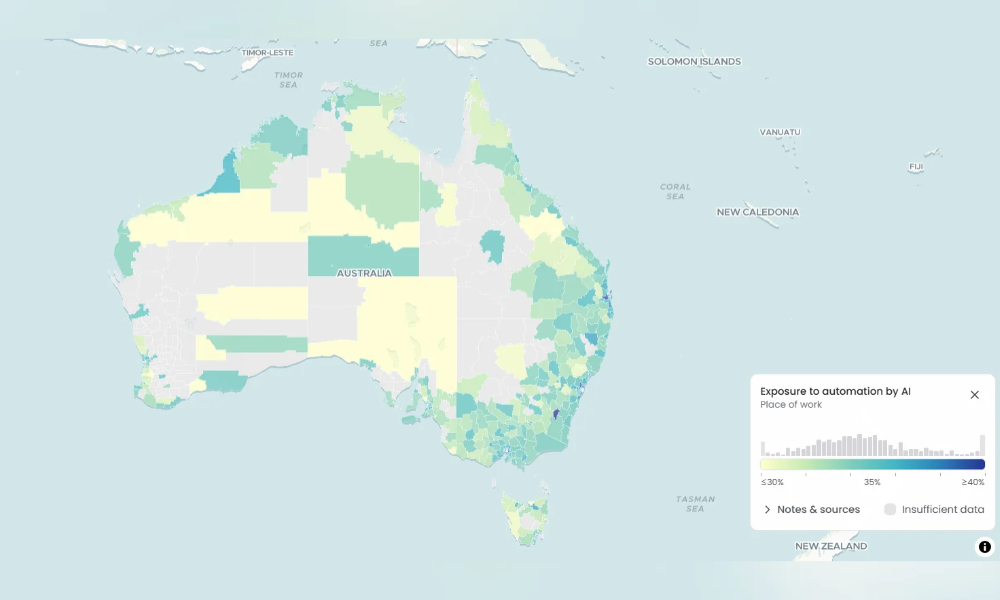
Workers in inner Sydney and Melbourne face the highest exposure to AI-driven job automation in Australia, according to new mapping by SGS Economics and Planning – a reversal of past automation waves that hit regional and outer-suburban Australia hardest.
The research combines Jobs and Skills Australia (JSA) occupation-level AI exposure scores with 2021 Census employment data. It maps exposure across every local government area (LGA) in the country, covering both where people work and where they live.
Exposure measures how much a job’s tasks could change, not whether the job will disappear. Report co-author Alison Holloway, principal and partner at SGS Economics and Planning, said that distinction matters for employers planning their response.
“This analysis is not about replacing jobs. It’s about jobs being disrupted and additional skills and opportunities that that brings,” Holloway told HRD.
Why AI exposure is highest in city centres
The report, co-authored with SGS senior consultant Jayden Perry, found that major urban and city centres have the highest exposure because they hold the densest concentrations of knowledge-economy and information-based jobs. Areas built around work that needs a physical presence are far less exposed, since current AI systems still can’t do most of those tasks.
“AI has been talked about as how is it going to impact different workers. But it will also hit places differently,” Holloway said of the decision to map exposure by location.
No location is untouched, she added. “It did show that all locations will be impacted to some level of degree, that all occupation types will have some level of exposure to AI. But it’s those knowledge jobs that will be more impacted.”
Previous waves of automation targeted hands-on, routine work. “This is a much bigger shift into jobs that are much more in the finance, technology, business services,” Holloway said.
The pace is also different. “Where the big economic structural changes of the past took quite a long time to play out and to see the impacts of those, we’re seeing or anticipating these changes to happen much faster,” she said.
Early signs in the Australian labour market
The broad impact has yet to arrive. The report cites research by the Office of the Chief Economist at the Department of Employment and Workplace Relations. It found no evidence of broad labour market upheaval driven by AI in Australia since ChatGPT launched in November 2022.
However, it did find that occupations more exposed to generative AI automation have grown more slowly than others. That fits with recent data showing AI did not impact job vacancies in August, according to the Australian Bureau of Statistics.
History offers a cautionary tale. Business services now account for almost one-fifth of Australia’s GDP – more than mining, manufacturing and agriculture combined. Yet the productivity dividend from that shift was not shared equally. Many once-secure manufacturing jobs became precarious or disappeared, while housing prices ballooned in inner-city areas suited to advanced business services.
“Some of those big shifts in automation in manufacturing led to a lot of social and income inequalities in our cities,” Holloway said. “If we think about the implications of AI in different workplaces, we need to start thinking carefully about who benefits from those changes and if it’s going to be the community benefits and the workers benefiting from those additional tools, or whether it’s just extracting more value for shareholders or private capital as well.”
The question echoes broader debate over whether AI’s productivity payoff is real but narrow.
What should HR leaders take from the report?
For senior HR leaders steering AI policy, Holloway said workforce capability is the clearest lesson from past transitions.
“What becomes clear when we look at previous big economic shifts is investment in education, training, and skills development at all career and life stages becomes really important,” she said. “We can’t assume that people are just going to pick up these new tools and know how to use them.”
She added that core human skills will remain essential. “What we know as well is that it’s not going to replace a whole lot of skills that are really important in these roles.”
That view aligns with arguments that AI job losses don’t tell the full story for HR leaders.
The report also flags implications for where and how people work, including changing demand for commercial floorspace in CBDs. Holloway said SGS is asking “what does it mean for our city centres and how much commercial floor space will they need?” That question feeds directly into the great office debate and Australia’s different path.
As AI adoption speeds up, Holloway said the focus should be on shared benefit. “As we start to see an increased take-up in these tools, it’s really important to think about how do we make sure that the whole community can benefit from this shift.”
