

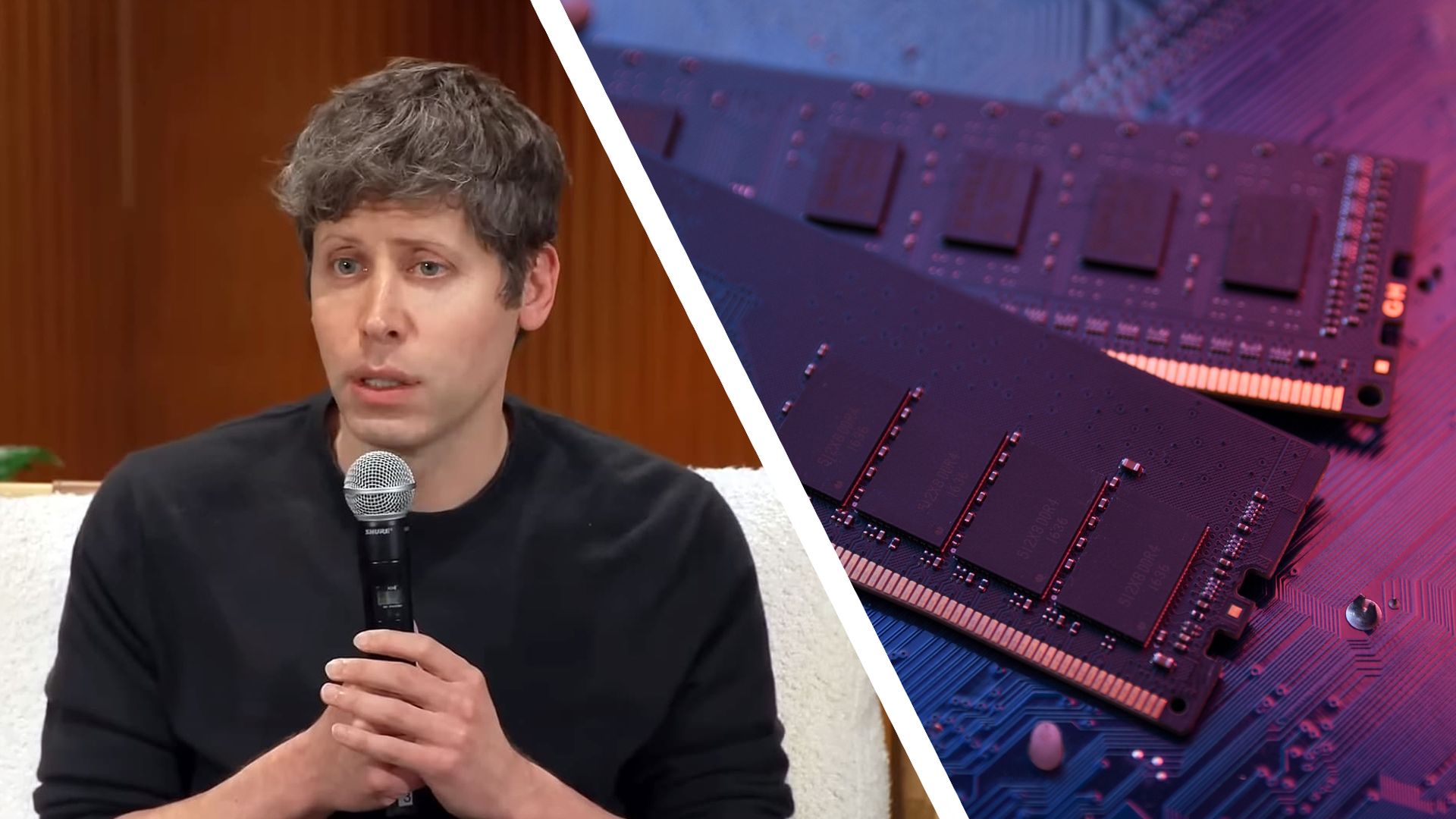
- Sam Altman met about 50 Samsung executives, including its chip chief, then lunched with SK’s Chey
- Samsung billed the visit as an executive AI seminar, and neither company announced a new memory deal
- Samsung’s 2027 HBM is sold out, and SK hynix is booked through 2029, while Microsoft and OpenAI both report demand outrunning capacity
OpenAI CEO Sam Altman recently spent time in a room with around 50 of Samsung’s most senior executives, including the man who runs its chip business.
Officially, the session at Samsung’s Human Resources Development Center in Yongin, just south of Seoul, was a seminar on how AI will reshape management.
Investors on Wall Street and Bloomberg saw it differently, however, with the latter describing it as an effort to deepen cooperation on memory chips and AI infrastructure amid intensifying global shortages.
A training day with a chip chief in the room?
While both narratives can be true at the same time, the timing is arguably intriguing, coming days after Altman complained that the world’s memory supply is badly allocated, and at a moment when nearly every big AI player, OpenAI included, is running into hard limits on how much memory, compute, and money it can get hold of.
The Korea Herald claims the meeting was held under the theme “The Next 10 Years Shaped by AI: The Enterprise’s Choice” and was the second intensive AI training program Samsung has held for its top leadership in 2026. Executives from its electronics, finance, and biotechnology affiliates went through hands-on generative AI training before Altman joined them.
The guest list, though, was interestingly not purely management; SBS reported that attendees included Vice Chairman Jun Young-hyun, who heads Samsung’s Device Solutions chip division, and Song Yong-ho, head of that division’s AI Center. Altman brought four OpenAI executives with him, among them Richard Ho, the company’s vice president of hardware.
Samsung’s statement only stated that the two sides “discussed the direction of AI technology development and its potential applications,” and announced no new memory supply agreement.
Altman’s own message to the room was about using AI rather than buying chips. “It is difficult to secure a sustainable competitive advantage simply by adopting AI,” he said, according to aSeoul Economic Daily report.
He also handed out OpenAI’s $230 Codex Micro, a 13-key keypad built with Work Louder to control the company’s Codex coding agent, with Song among the recipients, marking an unusual gift for a company that makes some of the most advanced memory on the planet.
Samsung was also not Altman’s only stopover: He also had lunch in Seoul with SK Group Chairman Chey Tae-won and senior executives from SK hynix and SK Telecom before leaving the country that afternoon which noted that the details of their discussion were not disclosed
In a nutshell, Sam Altman met both of Korea’s big memory makers within hours of each other, with his hardware chief in tow, and left without announcing anything. A Korea Herald analysis notes that neither side confirmed any discussion of chip pricing or investment commitments. A push for more RAM is a reasonable reading of the weekend but not a forgone conclusion just yet.
What makes that reading plausible is that capacity, rather than demand, has become the binding constraint on AI. Altman said as much on Stripe co-founder John Collison’s Cheeky Pint podcast, released two days before the trip. Alongside his now-notorious claim that it is “quite terrible” for so much of the world’s DRAM to sit in personal computers, he described a “very supply-constrained environment” and predicted that memory makers were each “going to make like $100 billion of free cash flow in a year.”
The suppliers’ own numbers back him up: Samsung said last week that its 2027 HBM supply is already sold out, while SK hynix says its DRAM and HBM output is effectively spoken for through 2029. “Customers are requesting more than twice the volume we can supply,” is what SK hynix’s head of HBM sales and marketing, Kim Ki-tae, told analysts.
The two firms also control most of that supply. TrendForce data gives Samsung 39.4% and SK hynix 24.9% of second-quarter DRAM revenue, roughly 64%, even as Counterpoint Research figures cited by Tom’s Hardware put their share of AI-specific HBM revenue at an even higher 83%.
The squeeze is visible further down the chain, too. Microsoft said last week that demand for its AI infrastructure is outpacing available capacity, and that spending will pick up as delayed third-party capacity comes online. Roughly three-quarters of its $45.2 billion in quarterly capex went to short-lived assets such as GPUs and CPUs, a bill swollen considerably by rising memory and storage costs.
Capacity alone does not fix AI’s problems
AI providers are rationing what they already have: In September, OpenAI paused new sign-ups for its most expensive ChatGPT Pro tier after demand for its Astra model outstripped capacity, Fortune reported, with OpenAI’s Thibault Sottiaux saying the company was “pulling all the levers possible to sustain the demand.”
More recently, Elon Musk said xAI had cut Grok Bot’s usage limits because “the cost of serving Grok Bot was unsustainably high relative to revenue.” That is a cost problem rather than a capacity one on its face, but the two are linked when the memory inside every accelerator is being sold at sellers’ prices.
All of this combined turns securing more memory into as much a financing exercise as a diplomatic one. As we reported in August 2026, Samsung is moving 60 to 70% of its capacity onto five-year supply agreements, with price floors on mainstream products and substantial advance payments required as a contractual term.
OpenAI’s existing paperwork with Korea is also softer than it looked a year ago. In October 2025, Samsung’s letter of intent projected that OpenAI’s memory demand could reach 900,000 DRAM wafers per month, a figure the Korea Herald described as a production target rather than a binding order.
When OpenAI Korea’s chief hinted at deeper chip cooperation in September, an OpenAI spokesperson framed any expansion as happening “in the context of our existing relationship,” pointing back to that same letter.
There is also the question of where all the extra hardware will be housed; Stargate is roughly halfway to its goal of adding 10 GW of US AI compute by 2029, and OpenAI is reportedly considering rebranding its largest data centers as “AI compute campuses” to soften a growing local backlash
Altman is hardly the only customer knocking. AMD CEO Lisa Su made her own trip to Seoul in early October 2026 for back-to-back HBM talks with Samsung and SK hynix leadership, stressing partnerships of three to five years or more, while SK’s Chey has warned that “the current shortage could continue until 2030.”
The real test for Sam Altman’s perceived diplomacy is whether OpenAI can turn its Korean partnerships into firm supply contracts and funded projects. With Samsung’s 2027 HBM already allocated and SK hynix booked through 2029, any new memory OpenAI secures is likely to arrive late, cost more, and come on the suppliers’ terms, a relatively easy conclusion to come to given the lack of leverage in play here.
