

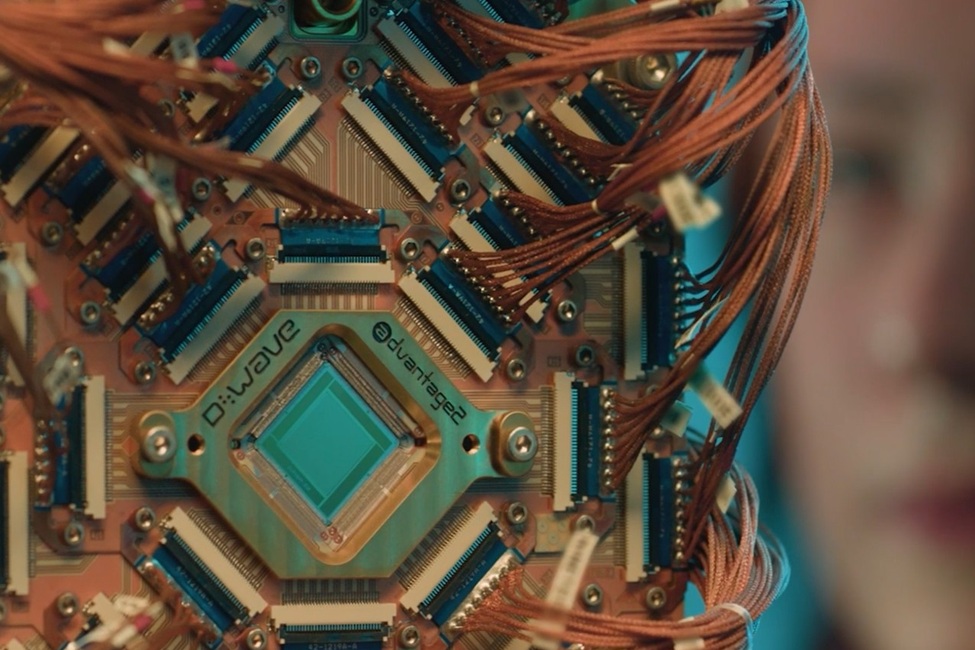
D-Wave’s annealing quantum computers, used in a quantum support vector machine framework, achieved the highest accuracy in the study, reaching 94.31% in simulation and 91.90% on quantum hardware.
Study Snapshot: Developing reliable machine learning models for healthcare can be challenging when only small datasets are available. This challenge motivates research into whether quantum computing approaches can learn useful patterns from limited symptom and risk-factor data.
A research team led by Florida Atlantic University’s College of Engineering and Computer Science evaluated quantum machine learning approaches in simulation and on quantum hardware using symptom and risk-factor datafor lung cancer prediction under limited training data. Published in Discover Quantum Science, a Springer Nature journal, the study compared three classification methods across five computing frameworks.
The best-performing configuration, a quantum support vector machine implemented using D-Wave Quantum Inc. technology, achieved 94.31% accuracy in simulation and 91.90% on D-Wave’s AdvantageTM annealing quantum computers. The results come from an experimental dataset expanded through synthetic data augmentation and represent preliminary research rather than a clinically validated diagnostic tool.
A research team, led by Arslan Munir, Ph.D., professor in Florida Atlantic University’s Department of Electrical Engineering and Computer Science within the College of Engineering and Computer Science, and director of the Intelligent Systems, Computer Architecture, Analytics, and Security Laboratory, evaluated quantum machine learning approaches in simulation and on quantum hardware using symptom and risk-factor datafor lung cancer prediction under limited training data.
The study, published in Discover Quantum Science, a Springer Nature journal, “Inferring lung cancer under limited learning data through gate-based and annealing-based quantum techniques,” provides a common framework for evaluating different quantum machine learning methods under the same data preparation and testing conditions.
“Our goal was to examine how different quantum learning approaches perform when the amount of training data is deliberately constrained,” said Munir. “By evaluating multiple methods within a common experimental framework, we can better understand their capabilities and limitations and identify directions that warrant further investigation.”
The researchers began with a publicly available dataset containing 309 records with information such as smoking history, coughing, wheezing, fatigue and chest pain, along with a lung cancer label. To balance the cancer and non-cancer categories, they used a statistical technique that generates synthetic examples, producing an experimental dataset of 540 samples. These additional samples did not represent newly recruited patients.
An optimization-based feature-selection method narrowed the input variables to 10. The researchers then evaluated three classification methods: quantum support vector machines, quantum k-nearest neighbors and quantum boosting. In each of five evaluation rounds, the models were trained on 108 samples and tested on the remaining 432.
The study examined two major approaches to quantum computing: quantum annealing and gate-based computing. The team evaluated implementations across Qiskit, Cirq, PennyLane, OpenJij and D-Wave, enabling comparisons across several software frameworks and computational approaches.
D-Wave’s annealing quantum computers used in a quantum support vector machine framework achieved the highest reported accuracy in the main evaluation, reaching 94.31% in simulation and 91.90% on quantum hardware. Testing on hardware allowed the researchers to examine how the method performed beyond a simulated environment.
“FAU’s research highlights how D-Wave’s annealing quantum computers can be used to advance AI and machine learning,” said Catherine Potts, Ph.D., manager of technical account management at D-Wave Quantum Inc. “By applying our technology to a challenging healthcare use case, the researchers demonstrate its potential to extract valuable insights in data-constrained environments, opening new possibilities for quantum-powered AI across healthcare and other data-intensive industries.”
The study’s contribution extends beyond its highest accuracy score. By applying a common evaluation framework, the researchers examined how the choice of classification method, selected variables and computing platform affected performance. The findings offer a basis for further research into quantum machine learning for structured healthcare data.
“This study reflects Florida Atlantic’s efforts to connect quantum computing research with meaningful application questions,” said Stella Batalama, Ph.D., dean of FAU’s College of Engineering and Computer Science. “Careful comparisons and testing on quantum hardware help build the evidence needed to assess where these technologies may be useful and what challenges remain.”
The researchers emphasize that the findings are preliminary. The dataset contains symptoms and risk factors rather than medical images, pathology findings, laboratory results or cancer-stage information. The reported accuracy reflects the study’s augmented dataset and evaluation procedure.
Future research will examine larger datasets from multiple institutions and explore combining symptom information with imaging or genomic data. The team also plans to investigate methods that make model predictions easier to interpret.
“These results provide a starting point for further evaluation,” said Munir. “The next step is to determine how well these approaches generalize to independent clinical datasets and whether they can offer useful support within carefully validated healthcare workflows.”
The authors acknowledge FAU and D-Wave for providing access to D-Wave’s quantum computing hardware.
FAU continues to advance its position as Florida’s first quantum university, making strategic investments in research, education and infrastructure to drive innovation in next-generation computing. Through the FAU Center for Quantum Technologies, the university brings together faculty, students and industry partners to advance quantum research and prepare the workforce for the emerging quantum economy. FAU’s investment includes the installation of a D-Wave Advantage2 annealing quantum computer on its Boca Raton campus, giving researchers and students access to leading-edge quantum technology and helping position Florida at the forefront of this rapidly evolving field.
