

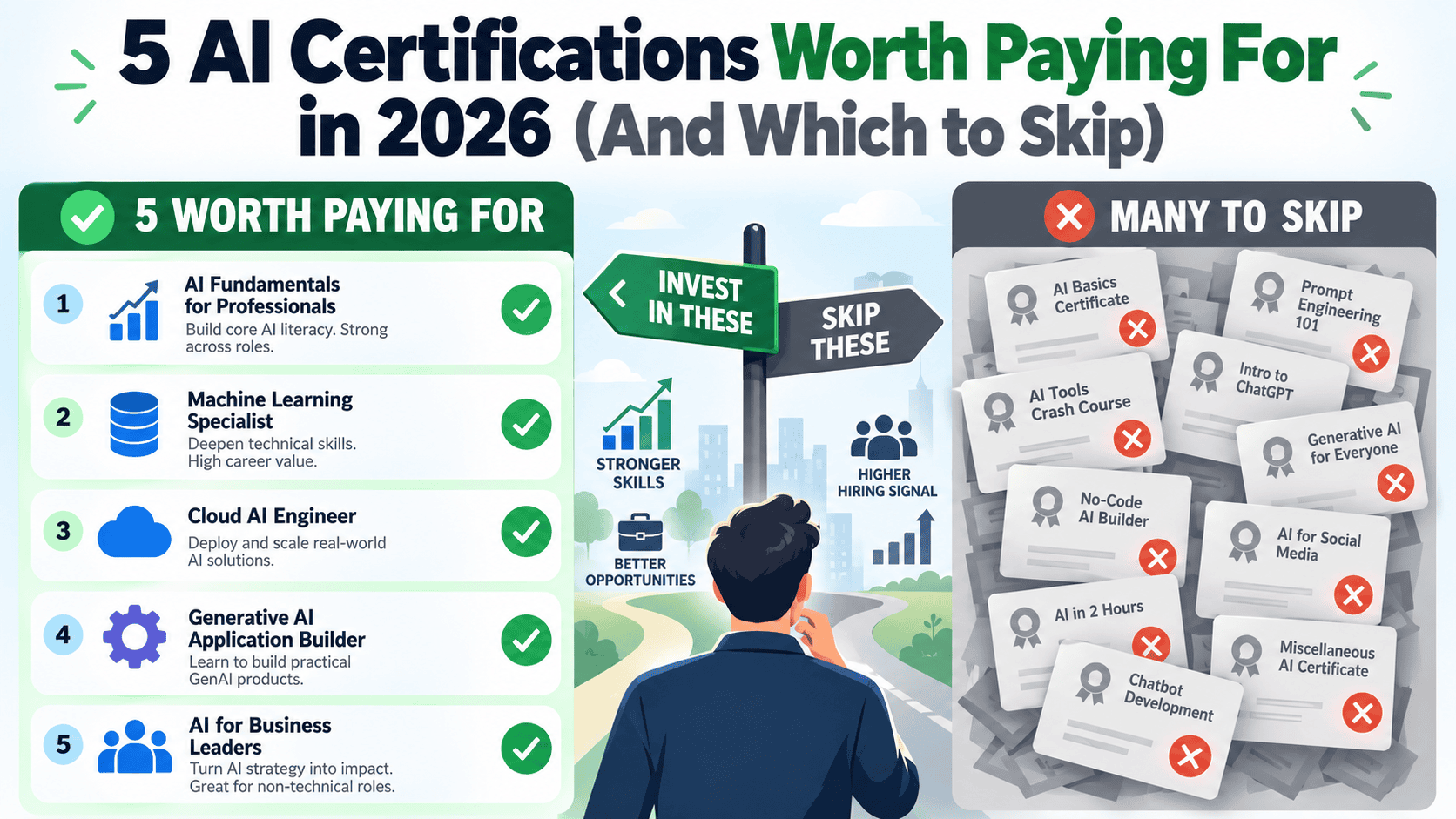
The AI certification market has exploded. By 2026, AI credentials account for nearly 30% of all professional certifications being pursued, a 20x increase from pre-ChatGPT levels, according to labor market research from Revelio Labs. That growth has produced two very different categories: a handful of credentials that employers actively screen for and that correlate with measurable salary premiums, and a large pile of programs that generate revenue for their creators while delivering almost no hiring signal to the people who buy them.
Here’s the uncomfortable reality: most AI certifications aren’t worth it. The candidates who get hired tend to have fewer certifications and more production experience. Five certifications with no portfolio is a red flag to senior hiring managers. One strong cloud certification paired with a GitHub repository of deployed projects is far more convincing.
That said, some credentials do matter, for specific, concrete reasons. The credentialing organization already has employer trust. The exam tests production-relevant skills rather than rote recall. The credential actually shows up in job postings. This guide covers five that check all three boxes, along with an honest look at what to skip and why.
Two things are worth flagging before the list. First, the AWS Certified Machine Learning Specialty (MLS-C01) was permanently retired on March 31, 2026. You’ll still find it recommended across the web on pages that were never updated, but it can no longer be taken. Second, Microsoft’s AI-102 certification (Azure AI Engineer Associate) is being updated as of late 2026. Check Microsoft’s official certification page for current status before scheduling that exam.
The 5 AI Certifications Worth Paying For
1. Google Cloud Professional Machine Learning Engineer
Cost: $200 | Level: Professional | Exam duration: 2 hours | Renewal: Every 2 years
Who it’s for: Experienced machine learning engineers and data scientists who build and deploy production machine learning systems, particularly those working in or targeting Google Cloud environments.
This is the highest-impact cloud machine learning certification available in 2026. Multiple salary analyses report that holders see roughly a 25% salary premium compared to peers without it. That’s the largest differential of any machine learning certification in current data.
The exam covers the full machine learning engineering lifecycle on Google Cloud: designing and building pipelines with Vertex AI, productionizing and monitoring models at scale, and selecting appropriate machine learning approaches for specific business constraints. A significant June 2026 update added generative AI content, including building solutions using Vertex AI Agent Builder and Model Garden. That makes this exam substantially broader than it was two years ago and considerably more relevant to where the hiring market actually is right now.
Google recommends at least three years of industry experience and one year on Google Cloud before sitting the exam. This isn’t a credential to chase right after finishing your first machine learning course. The pass rate is estimated as moderate, and hands-on experience matters far more than memorized definitions.
Why it’s worth it: Employer recognition is strong. The credential shows up in a meaningful share of machine learning engineering job postings, and the June 2026 update aligns the content with current production AI work rather than classical machine learning alone. It also opens paths to related Google credentials, including the newer Cloud GenAI Engineer certification ($200) for those who want to go deeper on generative AI application development.
Best pairing: The Google Cloud Skills Boost GenAI learning path (free, self-paced) before the exam.
Google Cloud Professional Machine Learning Engineer: Registration and Exam Details
2. AWS Certified Machine Learning Engineer – Associate (MLA-C01)
Cost: $150 | Level: Associate | Exam duration: 130 minutes, 65 questions | Important note: MLA-C01 is the current AWS machine learning credential (MLA-C02 is in beta as of 2026)
Who it’s for: Machine learning engineers, data engineers, and applied scientists building production machine learning systems on AWS.
When AWS retired the Machine Learning Specialty (MLS-C01) in March 2026, it replaced it with the AWS Certified Machine Learning Engineer – Associate (MLA-C01). The old Specialty exam was deep but narrow, leaning heavily on classical machine learning algorithms and theoretical foundations. MLA-C01 is broader and more practical, with explicit coverage of generative AI workloads on Amazon Bedrock, MLOps patterns, SageMaker JumpStart, and retrieval-augmented generation pipelines.
The exam covers four domains: data preparation for machine learning (28%), model development (26%), deployment and orchestration of machine learning workflows (22%), and monitoring, maintenance, and security (24%). That emphasis on deployment and monitoring reflects what employers are actually asking for. They want practitioners who can own a model across its full lifecycle, not just build one.
At $150, this is the most accessible cloud machine learning credential across the three major providers. It correlates with a reported ~20% salary premium and appears consistently in job postings for machine learning engineer and MLOps roles at companies running AWS.
A timing note for 2026 readers: AWS has announced that MLA-C01 will be replaced by MLA-C02, which expands to include agentic AI and foundation model workloads. If you’re starting prep in late 2026, check AWS’s official certification page to confirm which version is currently available. The transition is expected to complete around this article’s publication date.
Why it’s worth it: AWS remains the dominant cloud provider in enterprise machine learning deployments. If your current employer runs on AWS, or you’re targeting roles at companies that do, this credential gives you a practical, production-aligned foundation that hiring managers recognize.
Best free prep: The official Machine Learning Engineer learning path on AWS Skill Builder.
3. DeepLearning.AI Deep Learning Specialization (Coursera)
Cost: ~$49–59/month | Level: Intermediate | Duration: 3–5 months | Format: Course completion certificate, not a proctored exam
Who it’s for: Data scientists and machine learning practitioners who want a rigorous, conceptually grounded foundation in deep learning. It’s the most widely respected non-vendor certificate available for that purpose.
It’s worth being precise about what this is and what it isn’t. This is a course completion certificate, not a proctored exam-based credential. It doesn’t carry the same hiring signal as a Google Cloud or AWS certification. Hiring managers at major tech companies won’t be impressed by this certificate on its own.
What it does do: it’s been taken by more than 960,000 students and carries a 4.9/5.0 rating. Andrew Ng is one of the most credible AI educators around, and the DeepLearning.AI Deep Learning Specialization covers neural network fundamentals, convolutional networks, sequence models, and natural language processing. It’s genuinely taught rather than click-through. Employers in the AI and machine learning field recognize the DeepLearning.AI brand, and completing this specialization signals that you’ve done substantive conceptual work, not just watched promotional videos.
The AI Agent Rank editorial team describes it as “a respected baseline,” noting that for enterprise hiring, the IBM AI Engineering Professional Certificate carries the strongest HR brand signal, but for machine learning and data scientist roles, the DeepLearning.AI Deep Learning Specialization still outweighs most alternatives in this price range.
Why it’s worth it: If you’re working toward a cloud certification and need to close gaps in your conceptual foundations first, this is the clearest path. It’s also the most defensible credential at this price point for practitioners who don’t yet have the production experience a professional-level cloud exam requires. Coursera Plus ($399/year) gives access to all DeepLearning.AI specializations, making the cost per credential very low if you’re pursuing multiple programs.
What to do with it: Treat it as preparation and a portfolio signal, not a destination. Pair it with a cloud certification and a deployed project on GitHub.
4. Microsoft Azure Data Scientist Associate (DP-100)
Cost: $165 | Level: Associate | Format: Proctored exam | Renewal: Every year (free renewal assessment)
Who it’s for: Data scientists applying data science and machine learning on Azure, and practitioners targeting enterprise roles at organizations running Microsoft infrastructure.
Azure leads among cloud platforms in enterprise data science job postings. It appeared in 28.5% of postings in the 500-posting analysis from Article 2 in this series, ahead of AWS at 19.7% and Google Cloud Platform (GCP) at 14.2%. That market share directly affects certification value. The Microsoft Azure Data Scientist Associate (DP-100) is most likely to show up in postings from the organizations most likely to be hiring.
The exam tests your ability to implement and run machine learning workloads on Azure Machine Learning, covering experiment design, data preparation, model training and evaluation, deployment, and monitoring. It has a lower barrier to entry than the Google Cloud Professional Machine Learning Engineer exam and is generally the most accessible starting point in cloud AI certification. Unlike the AWS and Google credentials, which lean toward infrastructure-level production engineering, the DP-100 sits closer to the applied data science side. The focus is on building, training, and deploying models on a managed platform rather than architecting the infrastructure underneath.
The annual renewal assessment is free, which matters in a field where the tooling moves fast enough that a two-year-old credential can feel dated.
Why it’s worth it: If you’re a data scientist working in or targeting an enterprise Microsoft environment, this credential maps directly to your actual stack. Financial services, healthcare, and large enterprise IT organizations lean heavily on Azure, making the DP-100 more relevant in those sectors than either the AWS or GCP alternatives.
What to skip within the Azure family: Azure AI Fundamentals (AI-900) is an entry-level credential with minimal hiring signal for practitioners. It’s appropriate for non-technical professionals who need to understand AI concepts for management or business roles, but if you’re a data scientist, go straight to DP-100.
5. Databricks Certified Machine Learning Professional
Cost: $200 | Level: Professional | Exam duration: 120 minutes | Format: Proctored exam
Who it’s for: Data scientists and machine learning engineers whose work centers on the Databricks platform, particularly those processing large-scale data using Apache Spark and MLflow.
Databricks has become a standard part of the enterprise data stack. In the 500-posting analysis, it appeared in 9.3% of data science job postings. That’s a meaningful presence given how specialized the platform is. For practitioners who regularly use Databricks, the Databricks Certified Machine Learning Professional validates skills that are genuinely in demand and that most general machine learning certifications don’t cover.
The exam tests practical, advanced machine learning skills in the Databricks environment: building and tuning machine learning pipelines on Spark, using MLflow for experiment tracking and model management, implementing feature engineering at scale, and deploying models in production. The focus on scale sets this apart from certifications that test conceptual knowledge. The Databricks Professional exam expects real hands-on platform experience, and that’s hard to fake in a timed exam.
The credential carries strong recognition among employers running Databricks-based architectures, which now describes a large share of mid-to-large enterprise data teams. It shows up in a small but consistent portion of senior data scientist and machine learning engineer postings.
Why it’s worth it: If Databricks is part of your current or target stack, this is the most direct signal of platform expertise you can get. For practitioners in healthcare analytics, financial services, and large-scale e-commerce, all heavy Databricks users, it adds real differentiation.
What to do first: The Databricks Certified Associate Developer for Apache Spark (available in Python and Scala variants) is a sensible prerequisite if you’re new to the platform. The Machine Learning Professional exam assumes you’re already comfortable with Spark and the Databricks environment.
What to Skip
The certification market produces far more noise than signal. A few categories are consistently not worth the investment:
Generic “AI for Everyone” certificates from unknown providers. Dozens of organizations launched AI certification programs between 2023 and 2026 with aggressive marketing and minimal substance. Hiring managers in our survey didn’t recognize any bootcamp brand launched after 2024. If you’ve never heard of the issuing organization, chances are the hiring manager hasn’t either.
Prompt engineering certificates. Several companies now sell these at $200 to $500. Skip them. Prompt engineering is a skill, not a credential. It evolves quickly enough that a six-month-old certificate may already be outdated. Demonstrate the skill through a deployed project instead.
University professional certificates with $3,000–5,000 price tags (for most practitioners). Programs like the eCornell Machine Learning Certificate ($3,750) carry brand recognition but rarely appear in job postings as requirements. They might make sense for specific career goals — such as making a case for a leadership transition, accessing an alumni network, or employer-sponsored continuing education. As a hiring signal for technical data science roles, though, they’re significantly overpriced relative to their impact.
The retired AWS Machine Learning Specialty (MLS-C01). As noted in the introduction, it was retired on March 31, 2026. Any guide still recommending it hasn’t been updated. MLA-C01 is the replacement.
Vendor-neutral AI foundations certificates (for experienced practitioners). Credentials like CompTIA AI+ are appropriate for IT professionals transitioning into AI-adjacent roles. For data scientists and machine learning engineers with existing technical depth, they add little differentiation and signal breadth-over-depth positioning that senior roles don’t reward.
Choosing the Right Certification
The most useful question isn’t “which certification is best overall?” It’s “which certification fits my specific situation?” Three questions narrow the field quickly:
What cloud platform does your target employer use? Cloud certifications derive most of their value from platform alignment. Chasing a Google Cloud credential when your target employers are Azure shops significantly reduces the practical return, and vice versa.
Are you on a machine learning engineering or data science track? The Google Cloud Professional Machine Learning Engineer and AWS MLA-C01 are stronger signals for machine learning engineering and MLOps roles. The Azure DP-100 and Databricks Machine Learning Professional sit closer to the applied data science side.
Do you have the production experience the exam requires? Professional-level cloud certifications reward hands-on experience. Going in without it usually means a failed exam and a retake, which costs both time and the exam fee. If your background is primarily academic or notebook-based, the DeepLearning.AI Deep Learning Specialization is a better starting point.
One pattern from the hiring data is worth repeating: 78% of hiring managers say they value portfolio projects more than certifications. Certification complements production experience. It doesn’t substitute for it.
Recommended Resources for Certification Preparation
- Google Cloud Skills Boost: Official Google Cloud learning paths, including free exam prep content. The GenAI learning path is a solid foundation before sitting the Professional Machine Learning Engineer exam.
- AWS Skill Builder: Official AWS learning platform with the Machine Learning Engineer path aligned to MLA-C01. Significant free content is available.
- Microsoft Learn: Free, official prep for the DP-100, organized by exam domain.
- Databricks Academy: Official training for Databricks certifications, including the Machine Learning Professional exam. Free learning paths are offered alongside paid instructor-led options.
- Coursera Plus: At $399/year, it gives access to all DeepLearning.AI specializations and Google’s Coursera-hosted certification prep content.
Final Thoughts
In 2026, a certification’s value depends almost entirely on who issued it and whether it tests production-relevant skills through a rigorous, proctored exam. The five credentials covered here meet both criteria. Everything else in the market deserves scrutiny.
The practitioners who get the most out of certifications treat them as structured learning vehicles, not badges to collect. Pursuing the Google Cloud Professional Machine Learning Engineer exam without real hands-on GCP experience is unlikely to get you a passing score. Working through the prep material with active project work alongside it builds both the knowledge and the portfolio that hiring conversations actually reward.
Certifications are worth pursuing when they close a genuine gap, align with your target stack, and sit alongside evidence of what you can actually build.
Vinod Chugani is an AI and data science educator who bridges the gap between emerging AI technologies and practical application for working professionals. His focus areas include agentic AI, machine learning applications, and automation workflows. Through his work as a technical mentor and instructor, Vinod has supported data professionals through skill development and career transitions. He brings analytical expertise from quantitative finance to his hands-on teaching approach. His content emphasizes actionable strategies and frameworks that professionals can apply immediately.
