

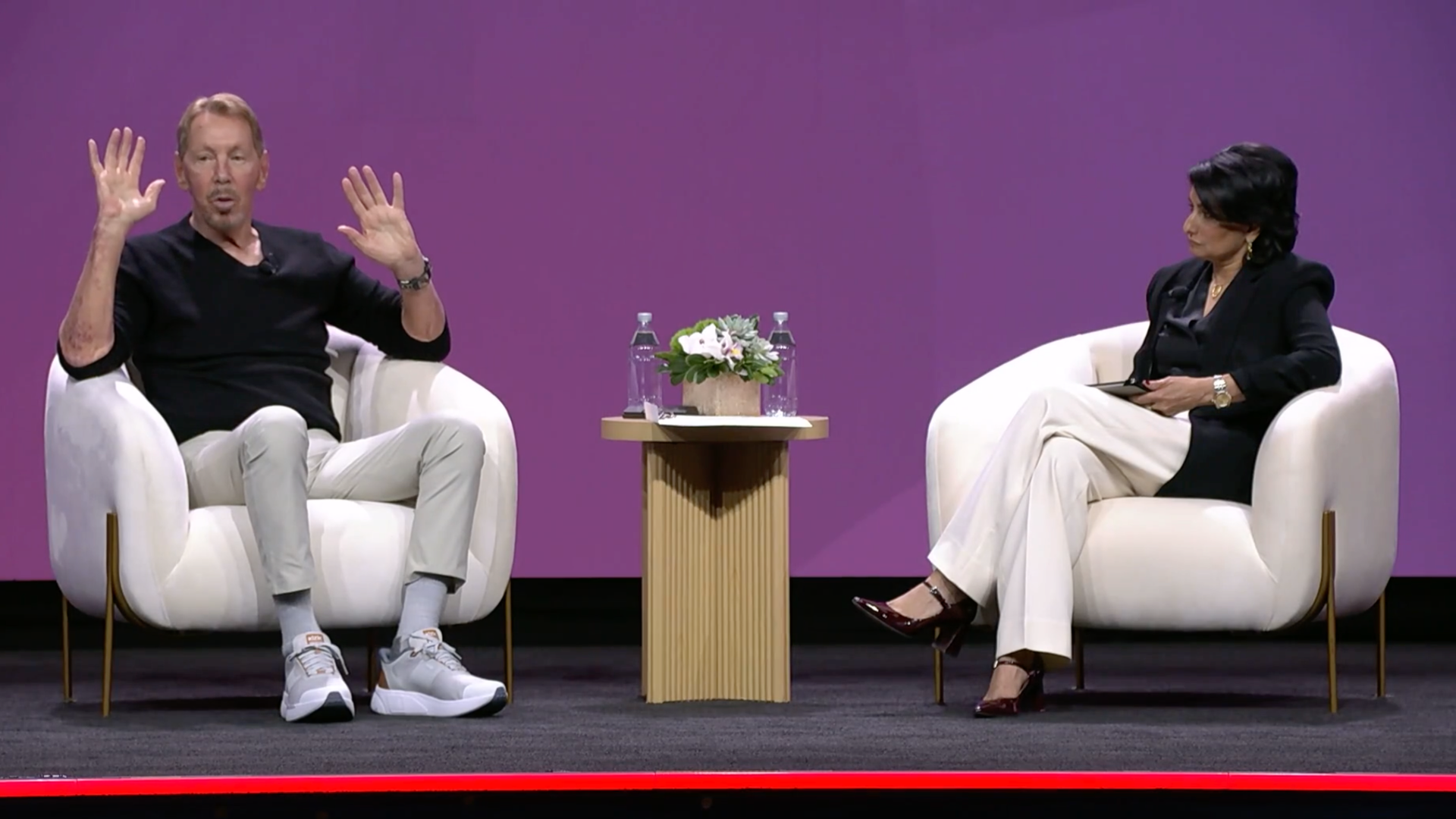
Oracle co-founder Larry Ellison has pushed back at the suggestion that artificial intelligence could end software and SaaS businesses like his, arguing that AI will actually just make enterprise applications even more capable than they ever have been.
Speaking during his keynote at the company’s annual AI World conference, Ellison directly addressed ongoing concerns that businesses could use AI to build their own software – we’ve already seen many popular apps and suites like Adobe’s Creative Cloud be imitated by AI, for example.
“There’s been some talk about there’s going to be a SaaSpocalypse because everyone’s going to use AI to build their own applications,” he said. “I don’t think that’s quite true. I think companies will continue to build applications, but they will be quite different because of AI.”
Future apps will be fully tailored to geographies and industries
Rather than making today’s software redundant, Ellison believes AI will allow developers to make their apps far more comprehensive, capable of handling entire business processes and fine-tuned for every type of sector and business need.
He argued that even the most established enterprise applications today are only so good, automating just a proportion of the processes businesses actually need.
“They may be the best things that are commercially available… [but] they’re not done,” he revealed, acknowledging that many sectors still need to build their own extensions and buy other third-party apps and connectors.
“For the first time… [the] software industry can actually finish the applications if we start doing them industry by industry.”
Oracle’s biggest clear push is in the healthcare sector currently, with Ellison speaking on stage about the notoriously complex and highly regulated nature of this industry – immense challenges for one global software company when navigating endless geographical variabilities is a must.
SaaSpocalypse doesn’t kill off apps – but it certainly shifts the focus from interface to functionality
Ellison also believes that AI could fundamentally change how workers interact with applications, replacing complicated menus, dashboards and multi-step processes with smoother, natural language interaction.
“If you can ask a question describing what you want to see, you should then immediately see it. Any other user interface is nonsense.”
“There should be no training required to use any of these applications,” he added.
While Ellison remains confident about the future of commercial software, that doesn’t necessarily mean businesses will continue to interact with apps in the same way, and it seems that a company as big as Oracle is singing from the same hymn sheet.
In two separate interviews with TechRadar Pro, company execs pointed toward the same trend. Brian Chess, NetSuite’s Chief Operating Officer, implied that the underlying business software could eventually become invisible to users.
Discussing customers who might prefer to access NetSuite through AI assistants like ChatGPT or other platforms like Slack, Chess said “If they never log in, that’s ok with us.” Oracle knows that as long as it can still serve as a company’s system of record, adapting to new ways of access is a must.
But what this means is that, for software vendors, the value of their products will likely come more from the data, logic and processes they manage, rather than the polished interface they’ve been used to building for potentially decades.
Ultimately, earlier SaaSpocalypse concerns remain valid, but it’s not so much about AI wiping software from the world entirely. It just marks the next chapter in software, where interfaces become less critical and functionality becomes the biggest USP.
Shares in Oracle rose around 14% to $144.14 in the couple of days that Oracle AI World took place, likely partly in thanks to Ellison’s thoughts on the future of software as well as the company’s whole suite of product announcements, but share prices are still down markedly on their late 2025 high of $330.34.
