

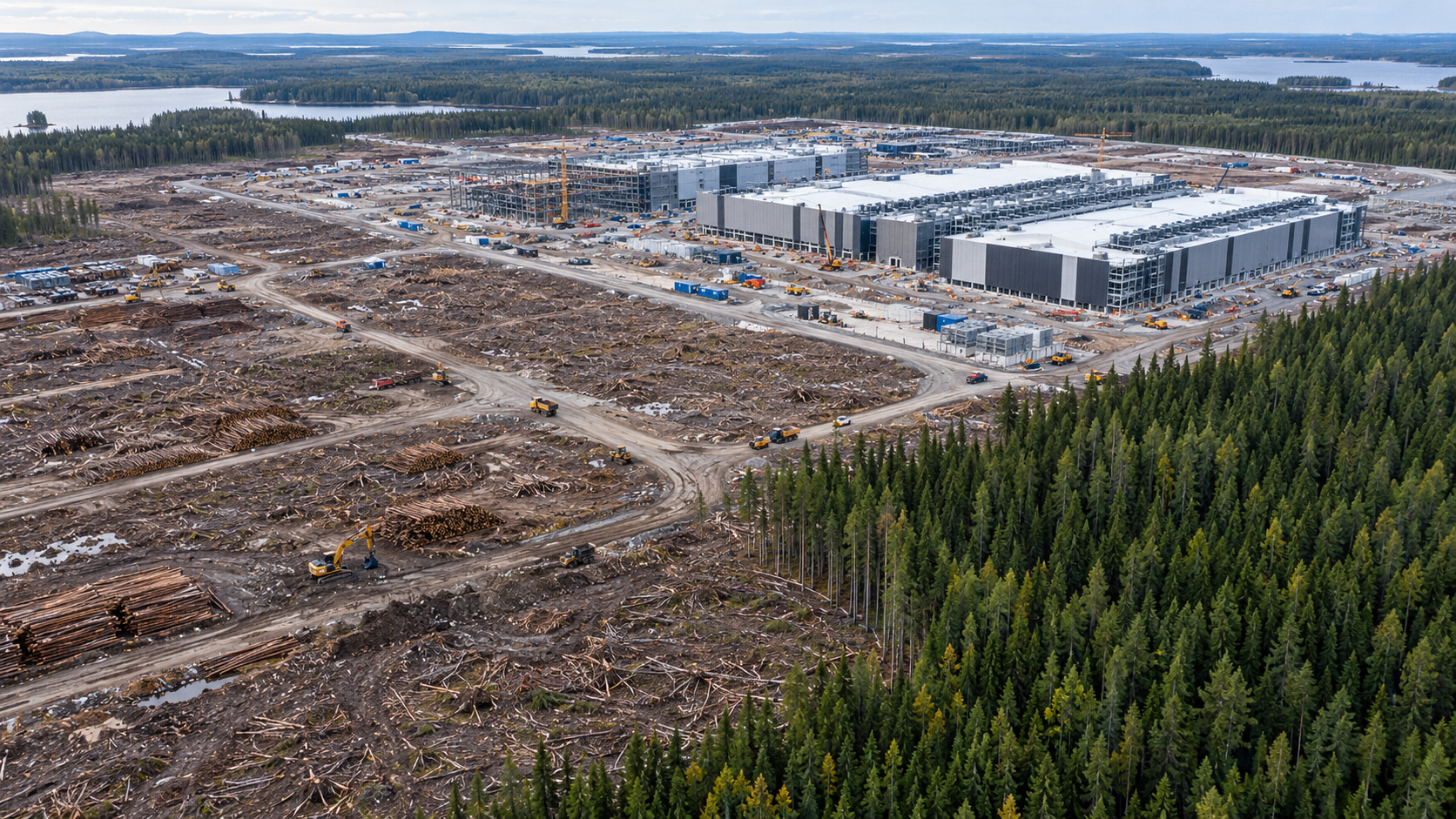
The buildings are windowless, fenced, and often bigger than a shopping mall, and more of them are landing in American communities every month to feed the AI boom. Thecomputing power behind chatbots, image generators, and the AI features now baked into your phone has to live somewhere, and that somewhere is an increasingly hungry network of data centers drawing enormous amounts of electricity from the same grid that powers your home.
Data centers consumed about 4.4% of all U.S. electricity in 2023, up from 58 terawatt-hours in 2014 to 176 terawatt-hours in 2023, and the Department of Energy’s Lawrence Berkeley National Laboratory projects that share could reach between 6.7% and 12% of the country’s total electricity consumption by 2028. When that much new demand shows up near your town, the cost of meeting it rarely stays with the company that created it.
How data centers fuel your electricity bill
The part that should concern homeowners is that a data center doesn’t have to be anywhere near your house to affect your electric bill. You could live miles away from the nearest facility and still end up helping pay for the electricity infrastructure it needs.
Here’s why. When a massive data center connects to the power grid, utilities may need to build new power plants, substations and transmission lines to keep up with demand. Those projects cost billions, and depending on local regulations, some of that expense can be passed along to everyone who pays an electric bill.
As Ari Peskoe, director of Harvard’s Electricity Law Initiative, explained to NPR, those costs can be spread across businesses and households throughout the region. In other words, you don’t have to use AI or live next door to a data center to help cover the costs of powering one.
We’re already seeing what that looks like. PJM Interconnection, which manages the electric grid for 67 million people across 13 states and Washington, D.C., holds auctions to make sure enough power will be available when demand is highest. As demand from data centers has surged, the cost of securing that power has jumped dramatically.
According to Reuters, auction prices rose roughly 1,000% in two years. Prices reached a record $333.44 per megawatt-day in December 2025, although PJM’s July 2026 auction came in slightly lower at $325.
And those higher costs do eventually reach customers. PJM previously estimated that rising capacity costs alone could add between 1.5% and 5% to some household electricity bills. And an analysis from consulting firm ICF warned that residential electricity rates across the region could climb between 30% and 60% by 2030
Perhaps the most striking number comes from PJM’s independent market monitor, which estimated that data center demand contributed $29.4 billion to capacity auction costs across four auctions.
That’s not $29.4 billion added directly to homeowners’ bills, but it shows just how expensive the AI boom is becoming for the electric grid. And the question now is how much of that cost should fall on the companies building these facilities, rather than the households already paying to keep the lights on.
The numbers where data centers cluster
Some parts of the country are feeling the pressure more than others, especially places where data centers are being built close together. Northern Virginia is a prime example. The area is known as “Data Center Alley” because it has the largest concentration of data centers in the world. And with so many facilities drawing power from the same regional grid, keeping up with demand is becoming more expensive.
The effects don’t stop at the Virginia border. In neighboring Maryland, households are estimated to be paying an extra $168 to $216 a year on their electricity bills, primarily because of growing data center demand.
And researchers warn that the problem could get worse. A 2026 study from NC State, Carnegie Mellon and other universities looked at what could happen to electricity prices as data centers and cryptocurrency mining operations continue to grow. By 2030, the researchers projected that wholesale electricity prices could rise between 6% and 29% nationally because of that additional demand, with some regions seeing increases as high as 57%.
Who’s being made to pay, and the fights over it
Voters have noticed. A Consumer Reports survey of more than 2,000 adults released in October 2026 found that 81% of people who had stayed in the same home for at least three years had seen their electricity bills rise, with 28% reporting increases of 20% to 49%, and an overwhelming 84% said they would support their utility creating a separate rate category for large users like data centers. A Gallup survey earlier in the year found that seven in 10 Americans oppose building AI data centers in their area.
States are taking different approaches to keeping data center costs off household electric bills. Ohio approved rules in July 2025 requiring large data centers to pay for most of the electricity capacity they reserve, even if they don’t use it all. They also have to make long-term commitments and face fees if they back out. Virginia has considered a similar approach.
In June 2026, <a href="https://techjournal.org/ai-data-centers-raising-your-electric-bill” rel=”nofollow noopener” target=”_blank”>New Jersey passed a law that requires large data centers to pay for the infrastructure they need instead of passing those costs on to residents. Similarly, Wisconsin regulators ruled that people who already pay electric bills shouldn’t have to help cover the cost of new data centers.
Tech companies are also promising to pay their share. Several have signed a federal pledge to cover their own power needs, and Anthropic, the company behind Claude, has said it will cover any electricity price increases caused by its data centers. But consumer advocates are skeptical. Making a promise is one thing. Making sure companies actually follow through is another.
What to do if a data center is headed your way
If you’re worried about AI data centers driving up your electric bill, you don’t have to wait until the charges show up to speak up. Most major data center projects go through a state’s public utility commission, where regulators decide who pays for the electricity and infrastructure they need. And the public gets a say.
Residents in Wisconsin and Kentucky have already submitted thousands of comments about proposed data center rates. Those comments become part of the official record that regulators consider before making a decision.
If a data center is planned near you, check your state’s utility commission website for an open case. You can submit a written comment or speak at a public hearing to make your concerns heard, including whether the company should cover its own costs rather than pass them along to residents.
Consumer Reports also has an initiative called Power Smarter that helps people understand what’s driving their electricity bills.
AI data centers aren’t going away anytime soon. But who ends up paying for all that power is still being worked out. And in many cases, homeowners can weigh in before the decision is made.
- I tested ChatGPT vs. Grok with 5 questions boomers actually ask — and the winner surprised me
- Microsoft just offered 60,000 workers a way out as AI spending soars — here’s what it could mean for your job
- ChatGPT has a clever new way to fight back against election deepfakes — I tried it and it actually works
