

Valeriia Litvinova Cunningham was pursuing her master’s degree at North Carolina State University as the war escalated in Ukraine.
She helped her parents and her sister Anya start a new life in North Carolina.
“They basically came here with only the clothes on their back,” Cunningham said.
Once reunited, her family hit the gym. It quickly became an escape. “We started strength training together as a way to distract ourselves from what was going on and also do something together as a family,” Cunningham said.
She began posting the family gym sessions on social media. Anya, who has Down Syndrome, quickly became as
“We just saw so much progress in Anya’s confidence, and she started having a sense of belonging in the gym.”
“Our entire life we’ve been told that Anya wouldn’t be able to achieve anything, that she wouldn’t be able to even walk. Now she’s strength training; she’s in the gym with other bodybuilders, with powerlifters, and just out training them,” Cunningham said.
The sisters’ online community grew into workout classes for people with Down Syndrome through GiGi’s Playhouse, a non-profit that provides resources to individuals of all ages with Down Syndrome. They call it Strength Without Labels.
“We’ve really proved, and hopefully continue proving, every day that she’s not defined by her diagnosis,” Cunningham said. “Our participants can see that they belong in a gym with other people. They don’t have to be separated into a separate group. They can work out alongside everybody else, and that’s what’s important.”
As their following grew, so did the skeptics.
“People are accusing Anya [of] not being real, because nowadays, apparently, now we have to fight with artificial intelligence, and that is exactly why people now struggle with distinguishing between what’s real and what’s not.”
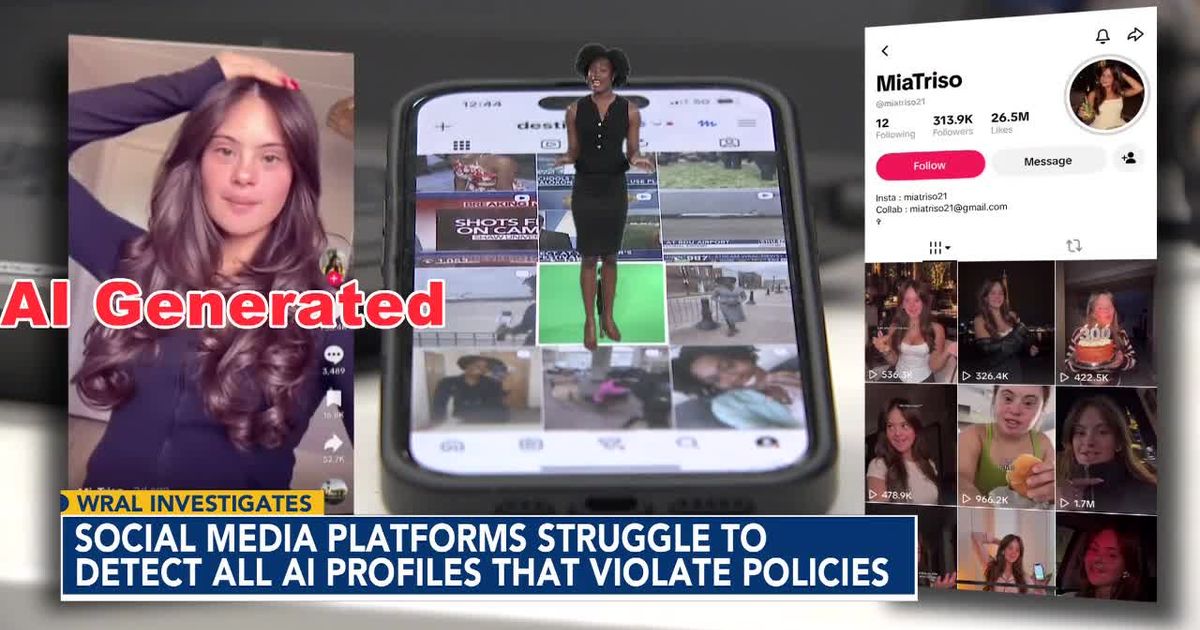
WRAL Investigates met Anya in person during a workout class. However, we also found an account, @MiaTriso21, on both TikTok and Instagram that some people online believe modeled its face after Anya to put on other creators’ bodies.
“To be honest, I cannot even believe that I’m having this conversation right now, especially since…sharing our journey on social media and fighting all these stereotypes. Now I’m fighting against AI-generated content or fabricated content,” Cunningham told WRAL Investigates.
“These accounts borrow a real creator’s body, voice, and audience trust, put an AI face on top and then monetize that trust,” said Laeeq Khan, who is the director of the social media analytics research lab at Ohio University.
Khan says social media platforms tend to rely on victim reporting.
“If somebody hasn’t reported it, it doesn’t get caught,” he said.
Sometimes, reporting it isn’t enough.
“Sometimes, I would get a response saying that something that’s AI-generated is not, so the reports would claim that, ‘We didn’t find this content to be AI-generated,’ and then I have to fight back. I can’t believe that I’m spending so much of my time trying to fight a robot,” Cunningham said.
Both TikTok and Meta require AI-generated content to be labeled and have policies in place to take down videos that violate their respective community guidelines. However, WRAL Investigates found multiple videos still posted without proper labels.
We asked both TikTok and Meta what they’re doing to find [AI-generated] profiles/content that may fall through the cracks.
Meta did not respond to our repeated inquiries.
TikTok said it uses C2PA Content Credentials technology, which tracks the origin and edit history of digital content. The company also said it tests detection systems to target accounts dedicated to posting AI-generated spam.
Since WRAL Investigates started asking questions about @MiaTriso21, the account has been removed from both TikTok and Instagram. However, other versions of the same account are already floating around.
If something looks perfect, Khan warns, be skeptical. And if it looks too good to be true, it probably is.
