



How will we shop in the future as technology evolves?
Shopping is evolving with technology. How can technology evolve in a way that lets humans still be human?
10.26.26
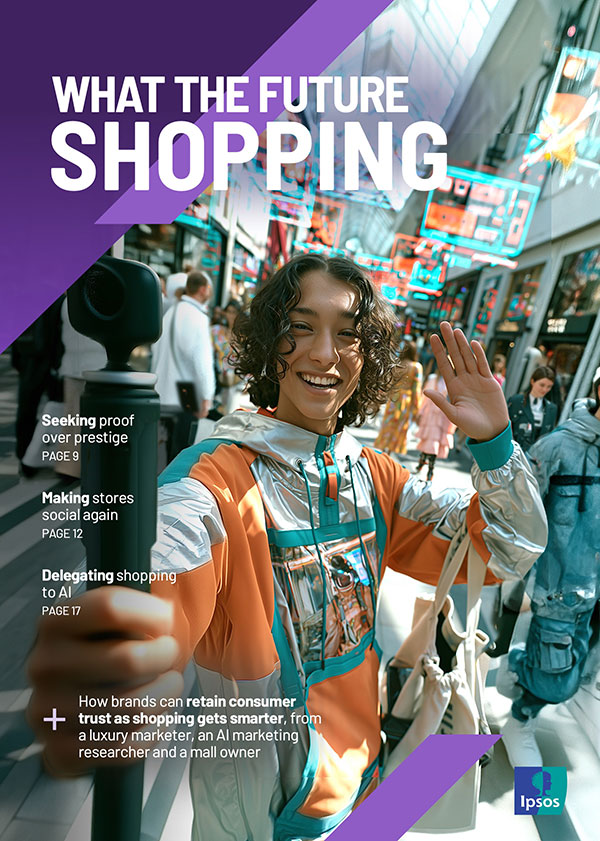
Read the full What the Future: Shopping issue
In 2013, Amazon announced its plans to have drones deliver items right to your doorstep. I had two very different conversations at that time.
One with someone who lived in a very urban area; one who lived much more rurally. They both said, “Man, those are going to get shot out of the sky where I live.” The urban resident was thinking about theft. The rural resident was thinking about property rights.
It reminded me of a story from Wired magazine decades earlier about satellite TV pirates. For those who need a refresher, before the internet, it was prohibitively expensive to get physical cables for TV to rural areas. So people bought huge satellite dishes. The signal was encoded but a sizable percentage of people bought pirate boxes to get around those fees.
Wired ran a story in the 1990s featuring a double-page spread photo of a farmer in his field with rolling Midwest hills in the background. He has a barn on one side and a dish on the other. He’s holding a rifle. The pull quote reads, “If a TV signal comes trespassing onto my property, I should be free to do any damn thing I want with it, and it’s none of the government’s business.”
It’s the same attitude my rural friend felt about drones. It’s the same attitude we see today in discussions of AI data centers, which currently disproportionately impact people in less dense areas. Technology changes. People don’t.
In the shopping world, we see a lot of familiar tensions amplified by prolonged economic stress and rapidly changing technology. There’s the ever-evolving tension between in-person and e-commerce shopping. There’s a further tension between e-commerce led by humans and e-commerce that is either led by AI or in which AI is on both sides of the transaction in true agentic commerce.
Both tensions have distinctly human roots because both discussions benefit from an understanding that shopping is about more than simply procuring. Emotions are central. Shopping is social, frustrating, fulfilling, convenient, time-consuming, an escape, a reason to leave the house, a way to entertain the kids, and is wrapped up in our identity as value seekers (or not), bargain shoppers or “whimsiful splurgers,” fashion focused (or not), healthy eaters (or not), etc.
If nomadic proto-humans hunted and gathered, today we regularly forage through 2.7 grocery stores just to fulfill our daily need to eat, according to the Ipsos Consumer Tracker.
Time is marked by shopping seasons as well as meteorological ones: holidays, back-to-school, spring fashions, etc.
People like shopping. Eight in ten like shopping online. Just as many say they like shopping in stores. That’s mostly consistent across genders. And while yes, half of younger folks say that shopping stresses them out, 37% say they are excited to have help from AI assistants.
Younger people are also most likely to frequent shopping malls, twice as likely even than older Americans. That’s partially because they are hitting the malls not as much to shop as to socialize, people-watch, and just have some place fun to go.
AI can’t replace that for you. However, malls can be places where people and technology come together in new ways.
There’s another issue with AI: We don’t trust it … yet. As we start moving toward agentic commerce, that’s likely to get worse before it gets better. Already, the news is starting to be peppered with anecdotes of agents setting buyer-seller meetings but not informing the seller or posting personal details in work chats. “My bad,” says the AI, “Won’t happen again, promise.”
In terms of fully agentic commerce where agents talk to each other and handle both sides of a transaction, there will likely be complications, too. One experiment showed that agents are programmed to behave logically.
But if one of the agents injects what the researchers called “whimsy,” making illogical claims like, “On Tuesdays I can only pay $1 for that item,” the other agent doesn’t know how to react and defaults to accepting it.
There’s a blueprint in the data about how to solve the issues which we’ll explore in this issue, including the need to keep humans in the loop to build trust, give people places to put checks in place before AI actually acts, be transparent about where goods are made and how they’re priced.
All of this ties back to the emotions in shopping. I have a working theory that there’s something at play I like to call the Human AI Risk Reward Matrix (HARRM). When asked about things people like doing and things people trust AI to do, you see one clear trend.
We’re less likely to use AI on tasks that we view as risky when an AI gets it wrong (think big purchases) or on tasks we personally enjoy doing (such as some shopping tasks). When it comes to the HARRM, we today trust AI much more to help with research than to execute. That’s a big and important trust gap, and one that brands and tech companies will need to close for the tech to change how people do a thing so ingrained in their lives. It’s possible.
It’s interesting that none of the tasks we tested landed in the sweet spot quadrant: Things we don’t want to do but trust AI to do for us. That’s the corner with massive market potential. That said, we certainly moved to trusting e-commerce despite initial misgivings.
Economic pressure changes how we shop
Part of this hesitation is because of the risk of losing money versus the reward of perhaps some added convenience. That risk is especially salient, because money is tight.
When our research shows, give or take, that four out of ten possible customers don’t have any money left over after paying their bills each month to spend on things they want … that’s a problem, and one we’ve been living with for years now. As the cost of something goes up today — that’s gas, but it’s been electricity and meat and overall groceries — something has to come down in a zero-sum budget.
So in just one year since we last asked, we see people shifting things that we used to consider everyday purchases into luxuries or splurges.
As with AI challenges, the challenges for brands and innovators provide a roadmap. Brand reputation for quality leads the way, and then more human concerns about worry of being wasteful or future regret.
To go back to where we started, technology changes, people don’t. The challenge then for those developing the technology as well as those implementing it is this: Can the technology evolve in a way that lets humans still be human?
|
← Read previous |
Read next → |
- Insights to Activate: Economy
- What the Future: Shopping (2024)
- 9 charts that explain the zero-sum human economy
