

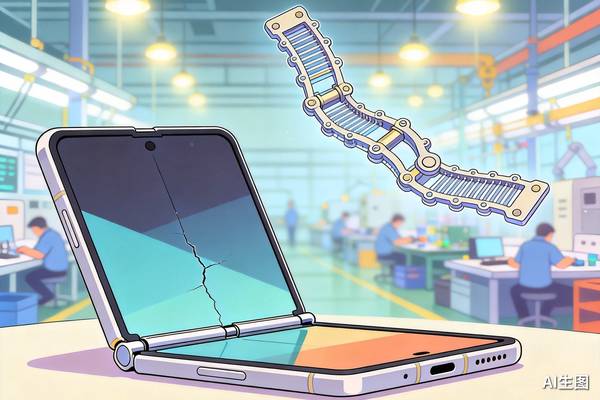
Apple’s efforts to reduce its reliance on Chinese supply chains have led to mass screen cracking issues across its first-generation foldable devices.
iPhone Duo went on sale on October 23, and Apple’s first batch of foldable phones has received concentrated complaints, with multiple users reporting that the inner screen has bright lines or cracks at the hinge.
An overseas user in Australia found a bright line crack in the middle of the screen after less than 20 opening and closing cycles after unboxing; at the business hall of Shanghai IFC Mall, Ms. Zhang purchased the latest iPhone Duo foldable phone, and after just a few opening and closing operations, two obvious cracks appeared on the inner screen. All fault locations are highly consistent — all are at the hinge position.
Preliminary analysis in the industry suggests that this is not a design defect, but an excessively large hinge assembly tolerance.
There is a “keel” structure inside the hinge of a foldable phone, which supports the screen to bend repeatedly. If the keel is misaligned by even 0.1 millimeters, the edge of the keel will press against a single point on the screen during opening and closing operations.
Stress concentrates on this point, which may not cause problems in a short period of time, but after repeated opening and closing, this stress point will gradually damage the screen.
Why is it considered a tolerance issue rather than a design issue? There are two pieces of evidence: the fault locations are extremely uniform, all at the same position on the hinge; the durability test showed no cracks after 11,000 folds, indicating that the design itself is durable enough, or the problem arises from improper assembly during mass production.
Regarding the screen cracking issue of iPhone Duo, Li Nan attributes the cause to the running-in period of the supply chain. He stated that Apple’s designers and engineers used to live and eat on-site at Chinese supply chain facilities in previous years. While industrial design may seem imaginative, when it comes to final mass production implementation, supply chain capability is the unavoidable gravity that governs product outcomes.
He believes he does not believe that cracked screens and bright lines are problems that Chinese supply chains cannot solve. The problem is that Apple has increasingly distanced itself from the Chinese supply chain over the years, and process and quality structural engineers from suppliers on the production line are estimated to no longer have sufficient opportunities for full communication with Apple. The risk was most likely predicted long ago, but was ignored by senior management.
In the past, Apple engineers lived and ate on-site at Chinese supply chain facilities
What Li Nan said may not be unreasonable. The “living and eating together” relationship between Apple and the Chinese supply chain in the past has been documented in specific published reports.
“Weeks before the launch of the first-generation iPhone in 2007, Steve Jobs suddenly decided to revise the screen design. At other companies, this modification would have delayed production by several months at least. But what happened? The Chinese factory woke up 8,000 workers in the middle of the night, gave each of them a biscuit and a cup of tea, and the new production line started running half an hour later.”
This case was recorded in a book written by a former Apple executive. Behind this, Apple’s engineers had already been stationed in the factory for months, debugging together with production line technicians. Designers can make changes on a whim because they know the production line can deliver the results.
In 2018, Isabel Ge Mahe, head of Apple Greater China, visited the iPhone 8 production line at Pegatron Shanghai. Reports at the time stated that when Apple’s new products first went into production, Apple would send more than 100 engineers to be stationed at the Pegatron factory, working together with Pegatron engineers to study various problems encountered in production.
Many of the equipment on the Pegatron production line were designed and developed by Apple, then handed over to local Chinese suppliers for production or jointly developed with local suppliers.
This is not a situation where the client places an order with the contractor. It is two teams of engineers working in the same workshop, facing the same machine, gradually working out the parts that “can be drawn on blueprints but cannot be manufactured on the production line”.
A 2024 report from Xinhua News Agency mentioned that at Lingyi iTech’s Dongguan factory, “Apple engineers have long been present, working closely with the supplier team from the product development stage to jointly overcome technical difficulties”.
This is not a case where finished blueprints are handed over to suppliers. From day one, Apple engineers sit side by side with suppliers. When a designer wants to create a certain structure, the supplier’s engineer can tell him on the same day whether it can be manufactured, what the yield rate will be, and what the cost will be.
With the iPhone Duo, this model has reached a more extreme test case.
Apple COO Sabih Khan said: iPhone Duo is “one of the most challenging products” Apple has ever developed, “many design concepts are very difficult to implement without the manufacturing capabilities of the Chinese supply chain”.
The hinge area is composed of hundreds of precision components. Apple and Foxconn did not purchase off-the-shelf equipment, but jointly developed a micron-level 3D printing automation device from scratch, using confocal laser to scan the microscopic morphology of the hinge layer by layer, and then applying up to 25 layers of customized photosensitive polymer coating to control flatness at the micron level.
The positioning of Foxconn’s Zhengzhou factory is not an “assembly plant”, but a “process test site for joint technical breakthroughs between Apple and Foxconn”.
But the problem is that the process knowledge of foldable screens cannot be executed just by writing it on blueprints and sending it to suppliers. It is accumulated during the trial production stage, beside the production line, through repeated debates and trial and error by the two teams of engineers.
Which tolerances must be tightened, which materials will fatigue after tens of thousands of opening and closing cycles, and at what angle of the hinge the stress will concentrate directly above the screen folding line — these are muscle memories accumulated by Huawei, Samsung and other manufacturers after developing six or seven generations of foldable phones.
The iPhone Duo is Apple’s first-generation foldable phone, with far higher complexity than bar phones, requiring a large number of Apple engineers to be stationed long-term at production lines in Zhengzhou, Shenzhen, and other Chinese supplier facilities.
But the feedback channel for passing the message “this is not right” is narrowing.
According to sources, Foxconn Zhengzhou has specially deployed a team of Apple on-site resident engineers for the iPhone Duo’s hinge, with approximately 30 resident engineers on the production line.
Reports from 2012 and 2017 both mentioned that the number of engineers Apple dispatched to Foxconn was close to 2,000, covering the entire chain of materials, production lines, and quality control.
At that time, Apple did not send people to supervise assembly. Instead, the design end and manufacturing end shared the same physical site, and risk signals did not need to go through layers of reporting, and could be intercepted right beside the production line.
Why the number of Apple engineers stationed at Foxconn has decreased: one possible speculation is that more engineers have been dispatched to India, since India lacks engineers, and Apple’s goal is to raise India’s production capacity to 50% of the global total within two years.
At Tata’s Hosur casing factory, the yield rate has long been stuck at around 50%, while the yield rate at Foxconn Zhengzhou has remained stably above 97% for years.
Indian production lines rely on Chinese engineers to be stationed on site for debugging. As soon as the Chinese team takes a vacation or is recalled, the operating rate of Indian equipment drops. Therefore, Apple’s current priority is to increase the number of Indian engineers and improve the yield rate to promote the expansion of production capacity, which means fewer engineers can be allocated to the Chinese market.
However, the complexity and difficulty of foldable screens precisely require more engineers to solve problems, but the special team for the iPhone Duo’s hinge only focuses on the single component of the hinge.
The problem is that the fault of Apple’s foldable screen does not lie in a single component, but in the deviation in the coordination between the hinge and the screen, UTG glass, and the overall stress of the whole device.
The Australian user heard a clicking sound after less than 20 opening and closing cycles, and the Shanghai user saw a 3cm vertical crack when unfolding the device normally, with faults highly concentrated directly above the hinge — these are issues exposed by assembly tolerance under real opening and closing stress, which is exactly the layer that most requires instant feedback right beside the production line.
The risk was most likely predicted long ago, but was ignored by senior management
Li Nan said: The risk was most likely predicted long ago, but was ignored by senior management.
The underlying meaning is that it is not that no one saw the risk, but the people who saw the risk had their weight in the decision-making chain suppressed by the higher-priority goal of “shifting production capacity to India”.
When the focus of supply chain management shifts from “working with Chinese engineers to grind tolerances down to the micron level” to “pushing India’s production share from 25% to 50%”, those early signals of abnormal hinge noise and concentrated folding line stress may only become a risk item that needs to be “managed” on the report.
Apple’s choice to prioritize yield rate and accept product shortages shows that its quality control standards still exist. But the existence of standards does not mean that the feedback loop that knows how to realize those standards on the production line still exists.
The iPhone Duo is manufactured in China, but Apple’s attention is shifting to India. To raise India’s production capacity to half of the global total within two years, fewer engineers are dispatched to Chinese production lines, less time is spent refining processes with Chinese suppliers, and the chain for feedback from the production line to the decision-making table has become longer.
This reflects that the attention of Apple’s senior management has been drawn away by India, and the group of people who know the production lines best are getting further away from the decision-making table.
The frequency of the “living and eating together” dialogues between Apple and the Chinese supply chain, the density of the two teams squatting in the workshop arguing in front of the same machine, can never go back to the old days. It is only natural that the iPhone Duo has a large-scale screen cracking accident.
Many users have expressed their feelings that this is Apple’s first foldable phone, and they think they
