

OpenAI’s release of over 700 AI-generated mathematical breakthroughs has prompted questions among Dartmouth faculty and students about the validity of the findings, the future of mathematical research and the role of AI in academia.
On Oct. 6, OpenAI released 722 mathematical manuscripts addressing hundreds of research problems, including longstanding conjectures and questions related to several of the seven Millennium Prize Problems — major mathematical challenges established in 2000 that carry a $1 million prize for finding their solution. The released findings, and the unprecedented volume of them, has prompted mixed reactions among the mathematics community, including five current and former Dartmouth faculty members and researchers.
The manuscripts, generated by an unreleased OpenAI model, were organized into 372 groups of related findings and published on GitHub, an online platform where people can publish, share and collaborate on code, research and other project materials. The papers span several mathematical fields, including number theory, geometry and theoretical computer science.
OpenAI previously announced on Sept. 8 that it solved the Navier-Stokes problem, a Millennium Prize Problem that pertains to fluid motion. The Clay Mathematics Institute, which established the prize problems, determined the problem was “apparently” settled but did not announce a prize award, calling its process for evaluating results “deliberately unhurried.”
For mathematics professor Erik van Erp, whose ongoing research overlaps with several of the newly published manuscripts in part, the release raised questions about how quickly artificial intelligence is advancing and whether its findings can be understood and built upon.
“[OpenAI] is moving really fast, way faster than I had expected,” van Erp said.
Van Erp studies pure mathematics, a field concerned primarily with abstract mathematical structures, theories and concepts rather than their immediate practical applications. He explained that AI’s ability to produce answers raises a broader question about what makes that work valuable.
“It’s not usually particularly the solution of the problem that is what is at stake,” van Erp said. “It’s what it takes to solve the problem and what you learn in the process.”
Van Erp said he had spent weeks before the release using ChatGPT 5.6, a publicly available model, to investigate the Baum-Connes conjecture, a 40-year-old hypothesis linking abstract algebra and geometry. OpenAI’s release included three papers presenting counterexamples to the conjecture. In his own investigation, van Erp set up a loop that prompted ChatGPT to search for potential counterexamples for about five minutes each hour, working within his subscription’s usage limits, and periodically checked in on its progress.
“It just runs on its own,” he said. “I had to correct it a few times because it went off on a tangent.”
After reading the introductions of three OpenAI papers relevant to his particular field of study shortly after their release, van Erp decided not to read further into the arguments at all, describing the papers as “impenetrable.”
“AI talks as if I know everything that’s ever been published, which I don’t,” van Erp said. “It’s not going to explain things that are in literature, but I don’t know the whole literature.”
Unless mathematicians “can extract new insights” from OpenAI’s new papers, the release should be considered a “non-event,” he added. “Just answering the questions is not the point.”
For former College President and mathematics professor Phil Hanlon ’77, human involvement is central to what makes discovery meaningful.
“There’s also a kind of emotional thrill that comes with discovery, to think that you and your collaborators are the first people to have ever seen this before,” Hanlon said. “And I would hate to give all that up to artificial intelligence.”

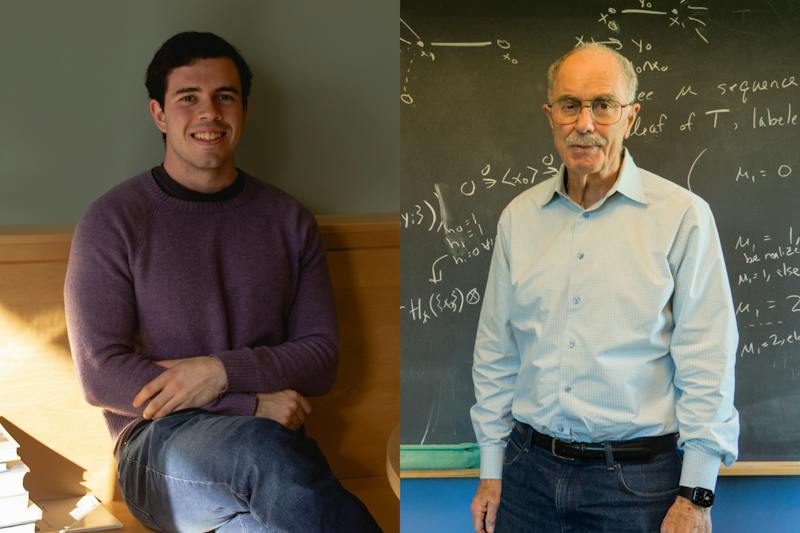
For former College President and mathematics professor Phil Hanlon ’77 pictured in his office on Oct. 15.
Mathematics professor Asher Auel wrote in an email statement to The Dartmouth that manuscript 054, which OpenAI claims disproves Alexander Kuzenetsov’s rationality conjecture in algebraic geometry, could overturn longstanding assumptions in his research community if true. The work, however, is “almost completely unreadable.”
“It is impossible to tell whether it lays out a viable strategy to prove the claimed result,” Auel wrote.
Auel emphasized that very few of the manuscripts have been accepted as true under the mathematics community’s standards so far. Currently, only 300 out of the 719 findings in the repository have been formalized, which means that the proofs have been broken down step by step and entered into the software program Lean which verifies findings. Further scrutiny could reveal important new ideas, errors or plagiarism, Auel wrote.
Undergraduate mathematics researcher Benjamin Singer ’27, who studies arithmetic geometry and recently won the Goldwater Scholarship for his research, said he learned about the release of the manuscripts through a group chat of Dartmouth undergraduate and graduate mathematics students.
“My initial reaction, as one always is when new results come out, is to be skeptical of the methods involved and to want to read the results for myself,” Singer said.

Undergraduate mathematics researcher Benjamin Singer ’27 pictured in Kemeny Hall on Oct. 15.
OpenAI withdrew three manuscripts concerning progress on aspects of the Hodge conjecture, one of the seven Millennium Prize Problems, on Oct. 7. Singer said he was particularly concerned about the errors identified in the papers and argued that OpenAI had “severely downplayed” the errors’ severity in its public response, which attributed the three withdrawals to “a sign error” and listed revisions to 14 others.
“Errors in and of themselves are fine in new research,” Singer said. “But I would say that errors in work that is so publicly hyped the way OpenAI has done and then sort of covered up to the public is very unhealthy.”
Despite his concerns, Singer described the release as containing “a lot of very interesting ideas” overall and called for academic journals and other resources to review new findings.
“We need to do a better job of organizing mathematics as well,” Singer said, referring to the mathematics community as a whole.
AI has also created opportunities within researchers’ existing work, some interviewed people pointed out. Dartmouth postdoctoral applied mathematics researcher Yao Xiao said AI tools are helping her “accelerate the whole process” of research by giving her the background to “make the connection and then make a contribution.”
Xiao said she does not think AI will impact her future or that of pure and applied mathematics “in a bad way.” Any changes to the field will be “good,” because the tools still need mathematicians’ expertise for guidance, she explained.
Singer said he believes AI can make mathematical research more accessible to people without formal training. He said he has received emails from individuals who used AI to investigate questions raised by one of his recent papers about classical number theory. Although he had not finished reviewing the AI-generated explanations and results they sent, “the generated mathematics does look correct,” Singer said.
Auel also emphasized faculty’s responsibility to advise students who are trying to envision a future in mathematics.
“Many, among them some of our students, graduate and undergraduate, are worried that they may not see a place for themselves in the new landscape,” Auel wrote. “They are looking to us for guidance.”
Although van Erp expects to continue his research, he said he has some reservations about entering the field today.
“If I was 25, would I want to be a graduate doing math?” van Erp said. “I’d have to think twice.”
For Singer, who plans to pursue graduate study in mathematics, the immediate concern is about how established researchers’ reactions might affect students entering academia.
“The mindset of the senior mathematicians will impact the early career process for younger mathematicians,” Singer said.
He remains committed to pursuing graduate school despite uncertainty about what an academic career in mathematics might look like after he completes his degree.
“My thought is that I really enjoy doing mathematics,” Singer said. “It’s a really important part of how I see the world. And I’m going to continue to do it.”
OpenAI did not respond to requests for comment.
Haley S. Rodriguez ’29 is a reporter with roots in New York City. She is studying history and biology and enjoys long-distance running, reading and sailing.
