

Leaving water in your irrigation system over winter is a fast way to ruin expensive plumbing. As trapped water freezes, it expands, snapping underground PVC pipes, shattering valve manifolds, and cracking exposed backflow assemblies. Fixing freeze damage in the spring often requires tearing up your lawn and paying hefty repair bills.
Taking a little time in the autumn to properly shut down and drain your sprinklers protects your equipment, saves money, and ensures your system is ready to fire back up smoothly when warmer weather returns.
Why you need to winterize your sprinklers
(Image: © Shutterstock)
Ignoring your sprinkler system in the fall is a gamble your wallet will lose. Water left trapped inside your pipes expands with incredible force when it freezes, turning underground PVC lines into brittle plastic, shattering valve manifolds, and exploding your backflow assembly.
What starts as a minor late-season maintenance chore quickly turns into a nightmare of torn-up lawns, flooded soil beds, and a hefty repair bill. Properly draining and blowing out your water lines in the fall prevents these structural failures and keeps your system functional for the following season.
When to winterize your sprinklers
(Image: © Shutterstock)
Timing is everything when shutting down your irrigation for the year. You should aim to winterize your system in mid-to-late fall, ideally 1 to 2 weeks before your region’s forecasted first hard freeze.
While light ground frosts around 32°F won’t immediately penetrate the soil to damage buried pipes, a hard freeze (defined as temperatures dropping to 28°F or lower for several continuous hours) will quickly freeze water inside shallow lines and exposed backflow preventers.
Another clear signal is your lawn’s growth cycle. Once daily average temperatures consistently drop below 50°F, grass enters dormancy and no longer requires active watering, making it the perfect time to turn off the faucet.
How to winterize your sprinklers
(Image: © Shutterstock)
Start by shutting off the main water valve to your irrigation line, usually located in your basement, crawl space, or an underground box near your meter. Next, turn your sprinkler controller to “Off” or “Rain Mode”so your saved settings stay intact without triggering dry valves.
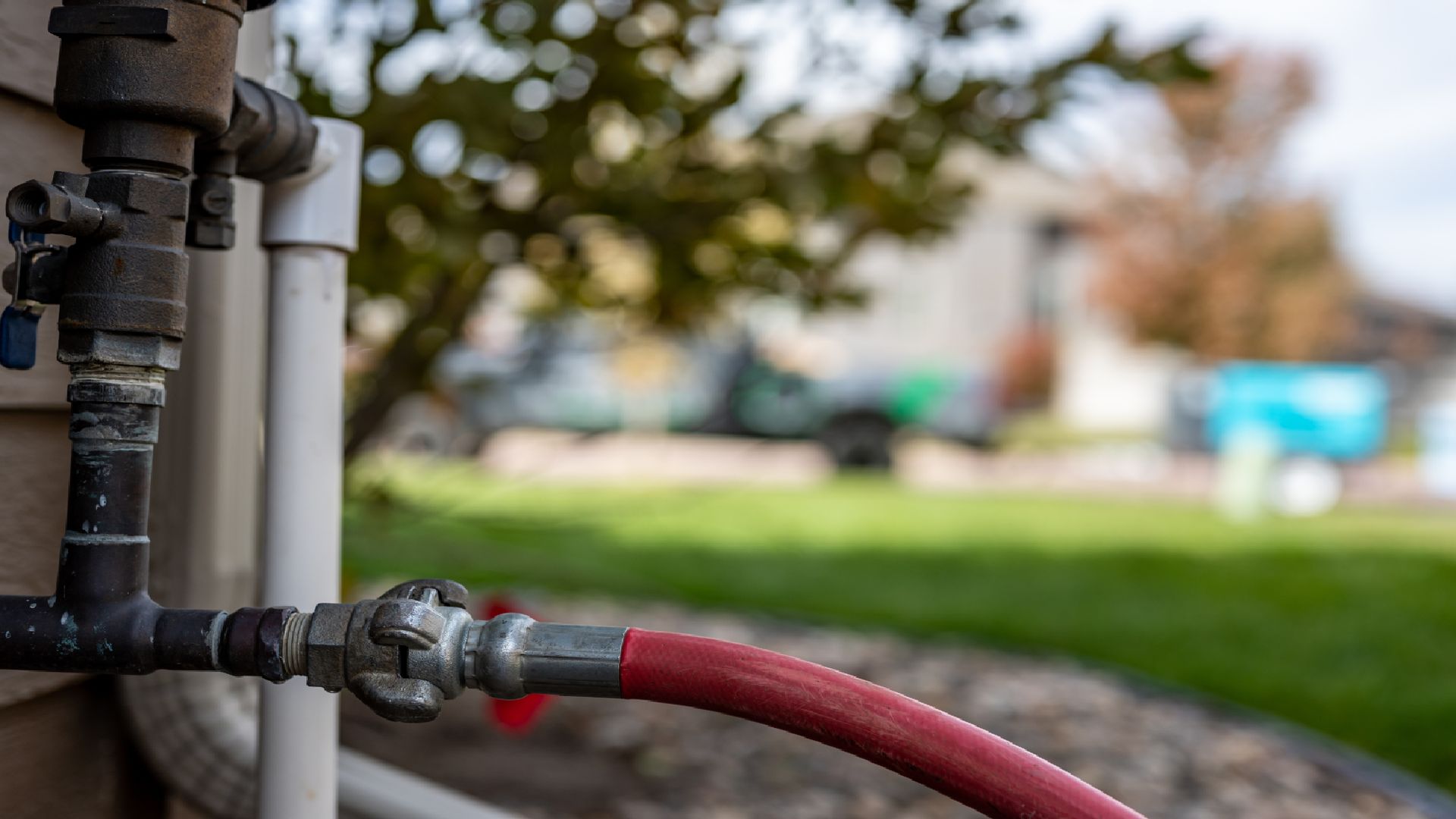
To clear the water, the safest method for freezing climates is a compressed air blowout: attach a compressor to your blowout portdownstream of the backflow preventer, cap the pressure at 50 to 80 PSI maximum to protect your pipes, andrun air through one zone at a time for 1 to 2 minutes until only fine mist emerges.
If your system features manual or automatic drain valves at the lowest points of the piping, open those to let gravity empty the lines.
Finally, protect your above-ground backflow preventer by opening the test cocks, setting the ball valves at a 45-degree angle so water isn’t trapped inside the valve seats, and wrapping the unit in an insulated cover.
- How to prepare your above ground pool for winter in 7 simple steps
- Stop spring lawn weeds before they sprout with a simple fall pre-emergent barrier — applying it now saves you hours of yard work next year
- 3 essential fall jobs to protect young trees before the first cold snap
