

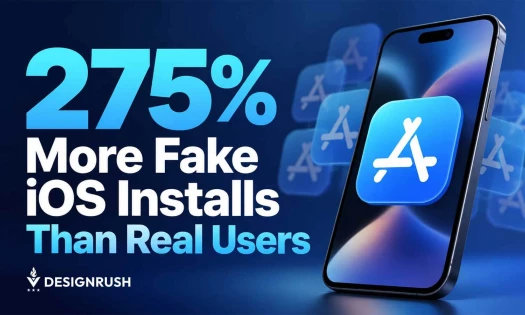
Mobile acquisition dashboards can make a campaign look healthy even when a large share of the users behind the numbers aren’t real.
In Social Media on iOS, Real Users Lift reached 275% in the second quarter of 2025, meaning three out of every four installs were fake for the full quarter
Put another way, advertisers paid for roughly four installs to get one real user.
When install counts, conversion rates, and channel comparisons rely on distorted inputs, a campaign can look stronger without bringing in users who retain, spend, or complete valuable actions.
AppsFlyer’s State of Fraud for Marketers 2026 examined more than 100 billion installs across more than 246,000 apps.
The report says fraud rates remained largely flat in 2025, but fraudulent installs moved across channels, platforms, and verticals.
How Organic Fraud Can Skew Paid Campaign Data
ROCKAPP Head of Sales Rikhard Shmidt has seen the problem appear after a campaign launches, when early conversion figures don’t match the quality of the users coming through.
“Yes, we have seen situations where the initial picture looked much stronger than the traffic quality we observed after launch.”
An agency may see the acquisition metrics without seeing the revenue, retention or other business outcomes that follow an install.
“One challenge for an agency is that it does not always have access to the client’s full conversion funnel or internal unit economics,” Shmidt says.
Pre-launch data may suggest healthy conversion and clean traffic, while behavior after launch raises questions about the acquisition mix.
“There have been cases where the information available before launch suggested healthy conversion and clean traffic, but campaign behavior later raised questions about the existing acquisition mix,” he adds.
The response is to investigate differences across sources.
In some cases, the client found that fraudulent traffic was already present; in others, “our team identified suspicious patterns by comparing performance across different channels.”
But install volume says little about whether those users stay, spend, or complete valuable in-app actions, leaving advertisers with a weak view of the value generated by the campaign.
The less obvious problem sits in the traffic marketers use as a comparison point.
In fact, 52% of all fraudulent installs came from organic channels
Its report describes organic traffic as the baseline marketers use to judge paid campaign performance, meaning fraud in that channel can affect how other traffic sources are judged.
ROCKAPP works with paid acquisition, so it would “be careful about drawing a universal conclusion here.”
Shmidt also points out that organic data can become harder to interpret when several acquisition partners and traffic streams feed the same product.
“Fraudulent traffic can also be directed toward a product outside the paid campaigns managed by its agency, including activity generated by third parties,” he says.
A clean campaign can therefore sit inside a product whose wider acquisition data contains questionable traffic.
“If some of those sources have weaker quality controls, questionable traffic can enter the overall data even when the campaigns managed by another partner remain clean,” Shmidt says.
The report’s Android Gambling figures show that the problem isn’t confined to one iOS social media example.
Real Users Lift reached 175% in the fourth quarter of 2025, meaning advertisers paid for nearly two fake users for every real one
The bigger challenge is separating genuine acquisition performance from fraudulent activity.
Why Install Volume Alone Isn’t Enough
A conversion can tell a marketer that an event happened.
It can’t, on its own, tell them the user will stay, spend money, or produce value.
Shmidt says ROCKAPP looks further down the funnel where the client data allows.
“Retention, LTV and the behaviour around important post-install events usually provide much more context than conversion rate alone.”
The measures depend on the available product and data.
“The more of the downstream funnel we can connect back to the acquisitionwho create real value for the product,” Shmidt says
Install volume still matters, but marketers also need to see whether users retain, generate revenue, and complete valuable post-install actions, along with the acquisition
ROCKAPP hasn’t changed how it defines its own performance.
“At the same time, we separate campaign performance from issues that may exist elsewhere in the product’s acquisition mix,” Shmidt says.
That separation gives marketers a clearer way to read performance.
A channel can deliver the results attributed to it while another traffic
That makes install volume a weak measure on its own.
Retention, LTV, and post-install behavior give marketers a clearer view of user quality, especially when those signals can be traced back to the acquisition source.
