

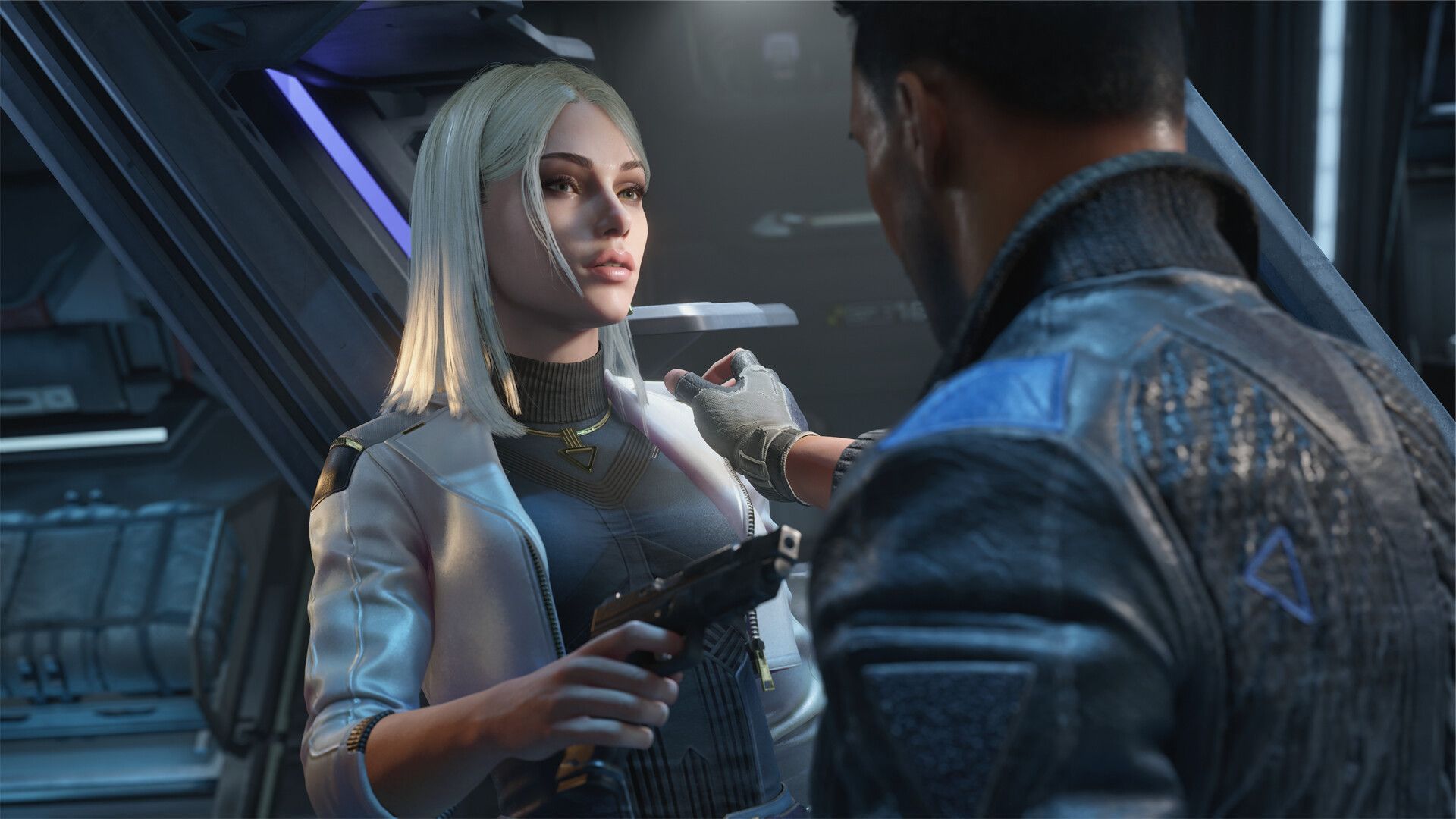
Mass-Effect-a-likes are a lot like interstellar buses: you wait ten years for one to arrive, and then two warp into view at once.
Unveiled at this year’s Summer Game Fest, both The Expanse: Osiris Reborn and Exodus look set to capitalise on the gaping hole left by BioWare’s beloved MIA franchise. Yet where Exodus’ Matthew McConaughey-starring project left Gamescom to rave reviews, in my infinite wisdom, I ventured into the far reaches of the outer rim to investigate the other Mass Effect-inspired epic: a sci-fi action-adventure based on the hit TV show, The Expanse.
With nine books to its name and six seasons of acclaimed television, Osiris Reborn was, I wagered, the candidate most likely to deliver a deep, narrative-led role-playing game (RPG) experience. Yet after an hour and a half spent sneaking across space stations, blasting soldiers, and fleeing stalking mutants, it turns out The Expanse isn’t really a narratively rich Mass Effect revival at all. It’s a so-so sci-fi Gears of War.
“We start the game from the Phoebe incident… It’s set between Season 1 and Season 2 of the TV series… within the first two books,” explains Natalia Turina, lead level designer, as I pick up the controller and take my first steps.
Put into the space boots of the player protagonist and her twin, J, I join the duo as they infiltrate a space station owned by a shady private military corporation, Protogen. After a recent shipjacking by their crew, the duo has snuck deep into enemy territory with one vital task — delete the shipjacking’s virtual evidence from Protogen servers, and get the hell out.
Less normandy, more office bureaucracy
Thanks to its richice-drivenworld. Yet while the fiction of The Expanse promises a glimpse into a complex future, playing Osiris Reborn feels like traveling back into console gaming’s beige-looking past
After slowly inspecting the busy cargo ship undercover, I duck and weave between armed enemy forces without arousing any suspicion, eavesdropping on ship personnel before heading to the ship’s computers.
As I pretend to be shipping a piece of intergalactic cargo and helmet-clad guards stare me down with assault rifles cocked, this should be a masterclass in tension and subterfuge. Instead, as I’m tasked with walking back and forth between computer terminals, I’m not immersed in the universe’s knotty politics — I’m bogged down by the minutiae of intergalactic shipping logistics.
“For choices in an RPG to feel meaningful, you need to believe in this world,” says Turina. “Every space needs to make sense — what is this place, how does it operate? This is why we spend so much time on the environment.”
It’s an answer that makes sense on paper, yet while rich in detail, there’s nothing exciting about the lore nuggets that I uncover. Well, I guess I certainly know how intergalactic shipping containers operate. After some more perfunctory dialogue, my cover is blown. Luckily, just as the alarm sounds and the station is alerted to our presence, I’m saved by an ambush. As a squad of a rival militia faction breaches the airlock, the formerly mundane depot erupts into a hail of gunfire.
A world stuck in the Xbox 360 era
Thankfully, combat fares a bit better than the world-building. Part Gears of War, partBinary Domain, there’s a retro 2010 feel to its firefights — for better and for worse.
Much like Commander Shepherd before me, I sprint between cover, deploy a drone, and blind-fire into a series of heavily armoured mercenaries, swapping between an assault rifle and shotgun. As I toss grenades at advancing militia and shatter glass over crouching enemies, I’m told players are free to change their specialisms on the fly, tweaking their tactical approach as needed
It’s all functional lizard brain stuff, but while enjoyable, I worry that the combat [so far] doesn’t feel dynamic enough to truly elevate it from the Xbox 360 era of cover shooters — let alone compete with modern peers.
Character interactions also struggle to hit the mark. When I encounter a lone marine — his hardened status signalled primarily by relentless swearing — our protagonist and her companion accept him as an ally almost immediately, despite being deep in enemy territory and under fire from multiple forces. It’s a jarring, immersion-breaking moment that once again highlights the quality of BioWare’s dialogue.
For all the granular detail painstakingly poured into Osiris Reborn’s lavishly rendered environments, its characterisation and dialogue currently feel paper-thin.
Running from horror, missing the tension
A late-demo pivot sees me being stalked by a Protogen-developed experimental mutant who broke containment amidst all the gunfire. Whoops. Impervious to bullets, the creature forces me into a frantic sprint down half-lit corridors. Where in Resident Evil or Dead Spacethis would be an exercise in sphincter-clenching terror, blending eerie exploration with a heart-pounding chase sequence, here the pursuit lacks any real tension. From the creature’s unconvincing AI to a complete lack of cinematic flair, I merely felt like I was running from A to B, meekly jogging toward a doorway to trigger the next cutscene.
As shiny as Owlcat’s mix of cover shooter and RPG is, I came away from my hour-and-a-half Osiris Reborn demo feeling fairly underwhelmed. Mass Effect won hearts not just through its worldbuilding, but through the strength of its writing: sharp wit, genuine heart, and moral dilemmas that stayed with you long after the credits rolled. It’s why during its ten-year absence, fans of BioWare’s space opera have been pining for a franchise to fill that galaxy-sized hole. So far, it sadly doesn’t look like Osiris Reborn is up to the task.
While I’m told the full game will feature wider exploration and more side missions and roleplaying, what I saw left me concerned that Osiris Reborn is less a Mass Effect spiritual successor and more a pale imitation.
Owlcat Games may borrow the same core Mass Effect ingredients, it appears to cook them together with none of the same skill or soul; its blend of corridor walks, light puzzles, and chest-high cover shooting feels closer to Kane & Lynch than Knights of the Old Republic.
With the full game not due out until next year, there is, of course, still time to refine the formula. Here’s hoping that the final adventure lives up to the title — expanding itsRPG aspirations be reborn
