

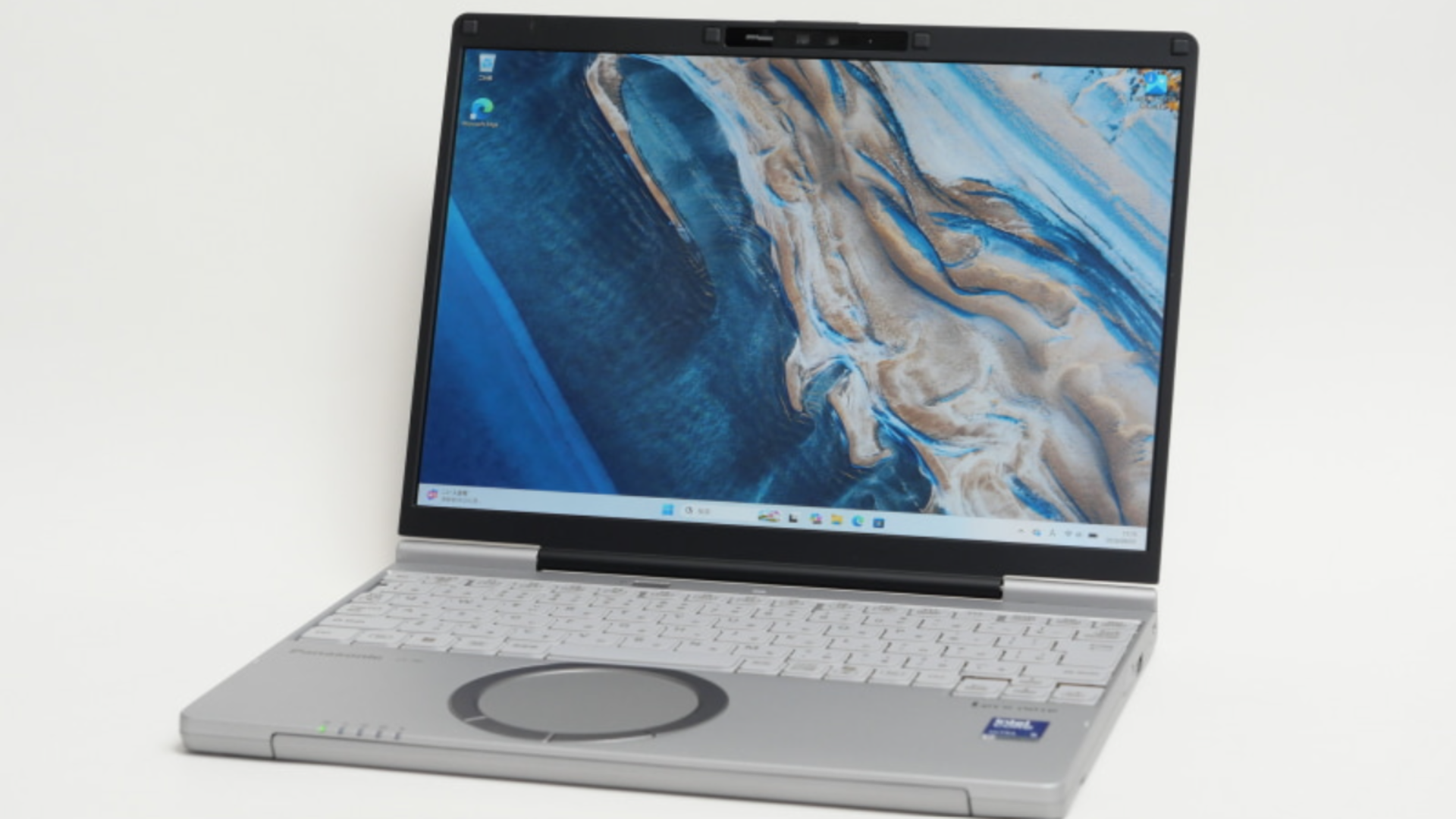
- Panasonic Let’s Note SC7 weighs just 919 grams but passed drop tests from both 76 and 30 cm
- The chassis meets the US military’s MIL-STD-810H toughness standard
- Battery testing returned nearly 23 hours of continuous everyday use
Japanese manufacturers have long built a reputation for producing remarkably light business notebooks, with some models weighing under a kilogram entirely.
Panasonic has now expanded that lightweight lineup with the Let’s Note SC7, a compact notebook weighing just 919 grams total.
The company also carried over its distinct circular wheel pad, letting users scroll by tracing a finger along the pointing device’s outer rim.
Packs a full-day power into a small frame
The SC7 features a 12.4-inch display with a 3:2 aspect ratio, taller than the widescreen format common on most rival <a href="https://myappsplus.com/how-to-properly-clean-your-laptop-fan/” title=”How to properly clean your laptop fan”>laptops today, showing more vertical content at once, improving efficiency when editing spreadsheets, documents, or browsing lengthy web pages daily.
Inside sits an Intel Core Ultra 5 325 processor paired with a 47 TOPS neural processing unit for on-device AI tasks.
The low-end version of this device comes with 16GB of LPDDR5X RAM and 512GB of internal storage – however, users can choose models with 32GB or 64GB of RAM and 1TB or 2TB of internal storage depending on the buyer’s needs.
Let’s Note SC7 ships with Wi-Fi 7, Bluetooth 5.4, two Thunderbolt 4 ports, two USB 3.2 Gen 1 ports, HDMI, and Gigabit Ethernet.
Under the hood, this notebook uses a 56Wh removable battery, which is attached with two screws rather than a latch.
According to Panasonic, this battery lasts roughly 17.7 hours during video playback and 32.4 hours in idle mode under JEITA 3.0 standards, and charging through the bundled 65W USB PD adapter reaches about 46% capacity within 30 minutes.
A magnesium alloy body measuring 273.2 x 208.9 x 19.9 mm combined with internal ribbing keeps the notebook sturdy, though it still appears slim.
Sturdiness, software, and benchmark results that support the design
Panasonic subjected the SC7 to internal drop tests from 76 centimeters and 30 centimeters across 26 separate directions during development.
The chassis also passed a 100 kgf pressure vibration test and met the US Department of Defense’s MIL-STD-810H toughness standard – few compact business notebooks built outside Japan undergo this level of physical stress testing before reaching commercial release.
The built-in NPU meets requirements for Microsoft’s Copilot+ PC program, enabling both cloud-based and local artificial intelligence processing directly on device.
PCMark 10 testing showed the processor performing at full capacity, aided by Panasonic’s proprietary MaxPerformer heat and power tuning system.
On Geekbench 7, the Let’s Note SC7 scored 2354 points on single-core tasks and 10437 points on multi-core benchmarks.
Battery testing under PCMark 10’s Modern Office profile returned roughly 22 hours and 59 minutes of continuous everyday use.
For security, this device includes facial recognition through an infrared camera alongside a fingerprint sensor built into the power button.
It is currently available in gray, black, rose, and deep indigo, but there is no indication that this device will sell outside Japan.
All these capabilities do not come for cheap, as Panasonic lists this device for 298,100 yen, which is about $1,880.
