

- Sep 24, 2026
- Original Content
- 30 Views
48 minutes ago
GenAI Owns the Hype, but Predictive AI Is Thriving
EDITOR’S NOTE: This article is adapted from the new preface to the paperback edition of The AI Playbook: Mastering the Rare Art of Machine Learning Deployment., coming October 27, 2026.
Special offer: Pre-order the paperback now and receivefree, immediate access to the audiobook.
This article was originally published inCDO Magazine.
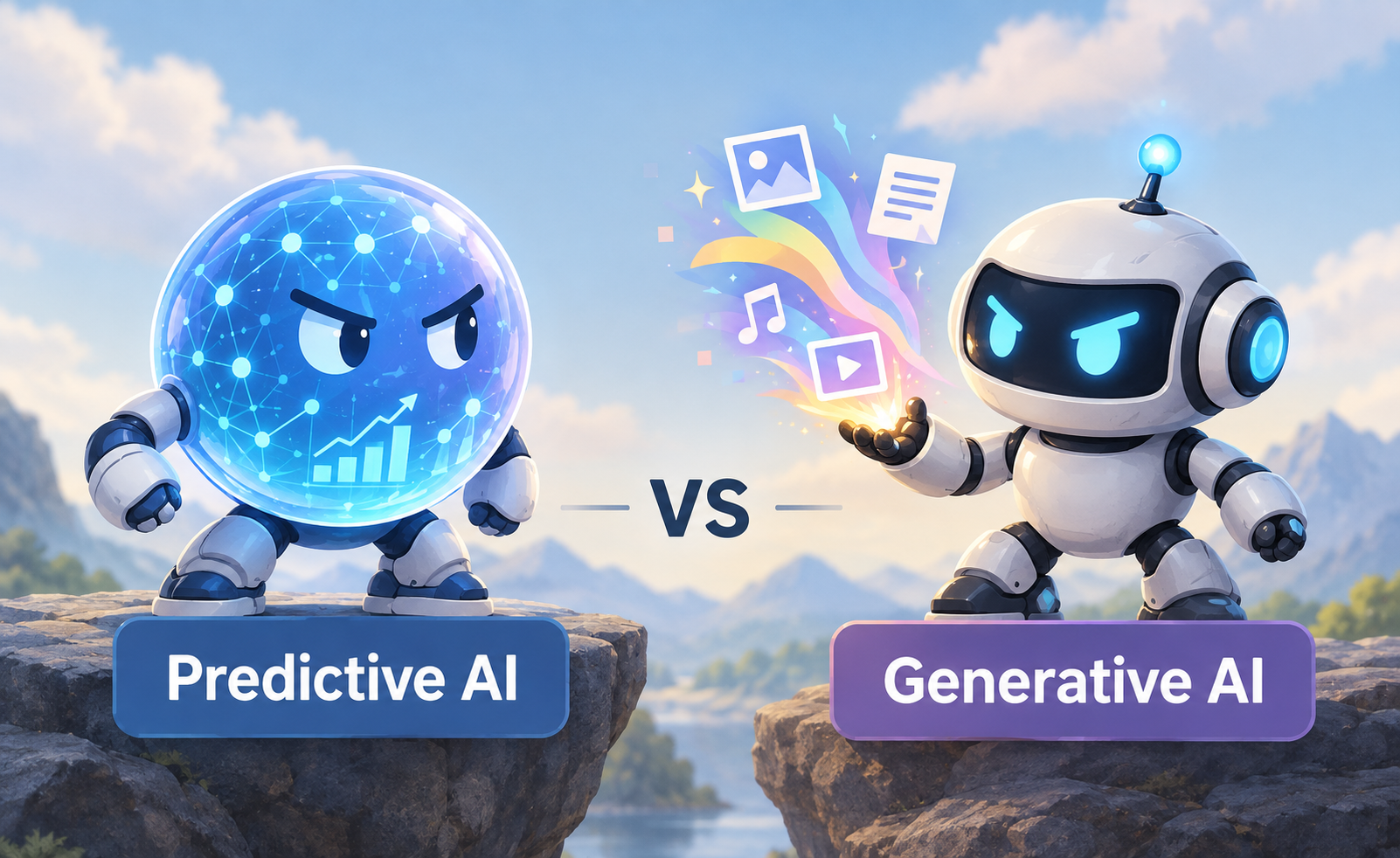
An epic battle has erupted between AI glitz and AI value. Theatricality is challenging utility. It’s chic versus geek.
What started it? In the less than three years since I presented the bizML playbook for running predictive AI projects, a newer kind of AI has taken the world by storm: generative AI, or genAI. It commands center stage in an AI craze that has absolutely exploded in this short time. GenAI offers new capabilities and value, and man is it sexy as hell.
Of course, the sheer usefulness of predictive AI holds a seductive appeal of its own—but is that enough for it to survive? Will its proven serviceability and great untapped potential keep it afloat even as tides turn? Or will genAI’s fashionability crush predictive AI, relegating it to obscurity and extinguishing most of its value across sectors?
In one corner, we have predictive AI, which learns from data to predict the outcome for each customer, patient, machine, or transaction. These predictions target marketing, fraud detection, risk management, maintenance, healthcare, and pretty much any other primary function. It’s the technology you turn to for improving existing large-scale operations.
In the other corner, we have genAI, which generates new content: writing, computer code, graphics, and other media. Amazingly, its output is largely coherent. The content it synthesizes proves valuable, at least as a solid first draft. What’s more, since genAI responds to human-language prompts, it can converse interactively to answer questions, retrieve information, or even deliberate on decisions and logical arguments.
Watching genAI’s rise made me wonder: What would its mammoth hype mean for predictive AI? Were my efforts to improve predictive AI’s already-suffering deployment record for naught?
These Two AIs Should Unite
GenAI and predictive AI ought to live together in harmony. They solve different problems and present distinct value propositions, so they should compete no more than a camera and a telephone. In fact, they work best together: Hybridizing the two—using one to strengthen the other—delivers the greatest value for many projects.
But these two flavors of AI compete indeed—for resources, budgets, and attention. As this competition plays out on an international stage, genAI appears to be destroying predictive AI. Today’s hoopla often ignores genAI’s older sibling. Predictive AI—or predictive analytics, as it was called until recently—is so last decade.
Which is more valuable depends on the organization and project. But here’s my rule of thumb (I hope you’re sitting down, because this sensible assertion feels wildly subversive given today’s genAI frenzy):
Most companies should invest at least as much in predictive AI as in genAI.
GenAI threatens to upend this balance, with its unmissable charm serving as a secret weapon. To many, it appears to be getting us closer to machines that are as smart as humans. It comes across as more humanlike than computers have ever seemed before, so it’s often construed as a step toward the AI of science fiction.
As a result, beyond its enormous media attention, genAI is also attracting far more R&D and venture investment than predictive AI. It has become so dominant in the press that the term “AI,” in its general usage, has come to mean genAI in particular.
But a knockout blow would be no good for anyone. If genAI were to dominate to the point of virtually shutting down predictive AI, flashiness would have defeated merit.
Good News: Insider Trends Bode Well for Predictive AI
“Generative AI is a seductive distraction from the type of AI that is most likely to make your life better, or even save it: predictive AI.”
—Margaret Mitchell, PhD, Chief Ethics Scientist, Hugging Face
Fortunately, there’s a very different story inside the industry. When it comes to the number of enterprise projects in play, predictive AI is holding its own against genAI.
Data scientists at large still widely adopt predictive AI. For one, in my work chairing industry conferences, I don’t see genAI dominating the way it does in the press. Instead, I see a roughly equal division between predictive AI and genAI projects. After extensive calls for speakers that cast a wide net, the submissions reveal an even split. This balanced spread represents a rough gauge of the industry. What’s more, novel predictive AI projects cross my desk as often as ever—for predicting things like electrical grid malfunctions, insurance claim denials, lawsuit settlements, lease terminations, dirty solar panels, no-show dental patients, abandoned shopping carts, successful startups, and willing blood donors.
Back-channel buzz tells the same story. I repeatedly hear that, even as data science teams feel pressure from above to experiment with genAI and work to capture some of its frequently promised stupendous potential, they see predictive AI projects as the ones realizing the most value.
The demand for my book about deploying predictive AI, The AI Playbook, also reflects its enduring importance. Since its 2024 publication, it has received endorsements from Scott Galloway, Charles Duhigg, Mustafa Suleyman, and the CEO of FICO; won multiple awards; become a number-one Amazon category bestseller; been adopted for courses at universities such as Carnegie Mellon, George Mason, New York University, Northeastern, and University of Texas; appeared on several “must-read” lists; led to dozens of keynote addresses; and gained media appearances in the likes of Bloomberg Radio, Fast Company, Harvard Business Review, Los Angeles Times, and over 60 podcasts.
Predictive AI’s Singular Value Keeps It Alive
Amid genAI’s astronomical hype and undeniable allure, why is predictive AI still thriving?
Predictive AI delivers unique, critical value. Its role in this world will endure, because uncertainty is an indelible aspect of life and business. Although genAI is built on leading technology, it does not replace predictive AI. Predictive AI represents a different kind of endeavor: explicitly managing uncertainties across millions of outcomes. It uses machine learning to play a scientific “be wrong less often” numbers game inherent to most large-scale operations. For that undertaking, genAI is not well suited—it’s made with machine learning, not for doing what machine learning does. Although it’s made with machine learning, genAI is not natively capable of performing machine learning algorithms. Instead, it is better to just run such algorithms intentionally, as needed. Moreover, even when you use genAI’s core methods to improve a predictive AI project, it remains a predictive AI project in form and function: It delivers value by systematically playing the odds over many cases. These two types of AI projects are intrinsically destined to remain distinct.
What’s more, genAI’s popularity promises to actually bolster predictive AI’s longevity more than threaten it—because genAI projects need predictive AI. Crucially, predictive AI addresses genAI’s stubborn reliability challenge: GenAI hallucinates and exhibits other unacceptable behaviors that preclude its deployment. This is particularly so for its more ambitious intended uses, such as assuming the role of customer service agent, analyst, educator, or virtual assistant. For genAI to realize a meaningful portion of its bold—often audacious—promise of autonomy, its reliability must improve. Predictive AI can help. It acts as a reliability layer that tames large language models by monitoring their behavior and targeting human attention toward situations most likely to go wrong. I am witnessing the emergence of this kind of hybrid approach: Enterprises are increasingly adopting it and I believe it represents the next killer app for predictive AI. Once it becomes common practice, most genAI projects will also employ predictive AI.
Mastering the Rare Art of Predictive AI Deployment
Predictive AI may be older, but it’s not “old school.” This is the original AI—established enterprise uses of machine learning that have accumulated decades of proven results. It’s destined to live long and prosper.
Yet despite its age, predictive AI still has some desperately needed maturing to do. Even after decades of usage, predictive AI initiatives routinely fail to deploy, never realizing value. Since each project endeavors to change ops based on odds, the organization often faces a new challenge when attempting to sell the project’s culminating launch to business stakeholders. After all, even though predictive AI deployment—that is, systematically acting on probabilities—is not terribly complex, it’s not yet widely understood. If we can address this problem, the realized value stands to multiply many times over. Opportunities abound.
What’s needed? A specialized business practice suitable for wide adoption. In The AI Playbook, I present the gold-standard practice for ushering predictive AI initiatives from conception to deployment, bizML (this article summarizes it). This disciplined approach serves both sides: It empowers business professionals, and it establishes a sorely needed strategic framework for data professionals.
Predictive AI sustains great value alongside its younger sibling, genAI. Find the greatest opportunities for your organization and determine which tech applies. Often, it will be predictive AI—or, increasingly often, a combination of the two. In such cases, follow best practices to defy the odds, avert common pitfalls, and realize the potential value. Happy predicting!
This article is adapted from the new preface to The AI Playbook: Mastering the Rare Art of Machine Learning Deploymentwith permission from the publisher, MIT Press. The complete references/notes supporting the content of this article may be foundhere.
Eric Siegel, Ph.D., is a former Columbia University professor who helps companies deploy machine learning. He is the cofounder and CEO of Gooder AI, the founder of the long-running Machine Learning Week conference series, the instructor of the acclaimed online course “Machine Learning Leadership and Practice – End-to-End Mastery,” executive editor of The Machine Learning Times, and a frequent keynote speaker. He wrote the bestselling Predictive Analytics: The Power to Predict Who Will Click, Buy, Lie, or Die, which has been used in courses at hundreds of universities, as well as The AI Playbook: Mastering the Rare Art of Machine Learning Deployment. Eric’s interdisciplinary work bridges the stubborn technology/business gap. At Columbia, he won the Distinguished Faculty award when teaching the graduate computer science courses in ML and AI. Later, he served as a business school professor at UVA Darden. A Forbes contributor, Eric publishes op-eds on analytics and social justice.
Eric has appeared on Bloomberg TV and Radio, BNN (Canada), Cool Science Radio, Israel National Radio, Motley Fool Radio, National Geographic Breakthrough, NPR Marketplace, Radio National (Australia), and TheStreet. A Forbes contributor, Eric and his books have been featured inAmerican Banker, BBC, Big Think, Built In, Businessweek, CBS MoneyWatch, CDO Magazine, Contagious Magazine, The European Business Review, Fast Company, The Financial Times, Fortune, The Globe & Mail, GQ, Harvard Data Science Review, Harvard Business Review, The Huffington Post, The Los Angeles Times, Luckbox Magazine, MIT Sloan Management Review, The New York Review of Books, The New York Times, Newsweek, Quartz, Salon, The San Francisco Chronicle, Scientific American, The Seattle Post-Intelligencer, Trailblazers with Walter Isaacson, The Wall Street Journal, The Washington Post,WSJ MarketWatch. and ZDNET.
