


Convenience vs. maximum isolation: Here’s how to choose where your verification codes live.
When it comes to keeping your online accounts safe and sound, two-factor authentication (2FA) has been a standard recommendation from security experts worldwide for years. As more and more people adopt 2FA, one question keeps coming up: Should you store your authentication codes inside your password manager or keep them in a dedicated authenticator app?
The idea that your login should rely on two separate factors is a fundamental security principle. Password managers offer one approach, while authenticator apps offer another. Each comes with real trade-offs that aren’t always obvious at first glance. While they’re both designed to protect you, they work in completely different ways.
Two-factor authentication is built on the simple idea that if someone steals your password, they still won’t be able to get into your account without a second piece of proof of your identity. Some apps will send you a text message with a one-time-use code, some will make a number pop on your phone screen, a few will email you a code, while others will ask if you’d rather use a special code generated by an authenticator app.
A password manager, on the other hand, brings both factors into the same vault, trading some of that separation for convenience. Neither approach is wrong, and each reflects a different set of priorities, like how much friction you’re willing to accept, how you manage devices and what you’re most worried about losing access to. Understanding how these tools work, how they differ and what you need is the recipe for finding the right tool that fits your needs.
The pros and cons of storing 2FA in your password manager
Most modern password managers come with multiple tools, including authentication tools. Most popular options, such as 1Password and Bitwarden, can generate and autofill six-digit, time-based one-time password codes right alongside usernames and passwords. There are real advantages to putting all your eggs in one basket.
It’s such an effortless way to autofill all this info without squinting at your phone and typing in a code before it expires. Another advantage comes for users who handle multiple devices, as password managers sync 2FA codes across desktop, browser and mobile apps, so you’re never stuck without access.
Another advantage to using a password manager is that you’re never locked out of your devices if you lose or break your phone. Since all your 2FA seeds are backed up inside your encrypted vault alongside your passwords, they’re all equally safe. If you need to share your account data with family or your team, it’s easier to give access to your password manager since they won’t have access to the authenticator tool on your phone.
It’s not all milk and sugar, because folding 2FA into your password manager comes with downsides too. True 2FA relies on separating the first factor — the password — from the second one — the one-time code. When both live in the same vault, a single master password breach can expose everything at once. Similarly, if you catch a case of malware in the shape of a keylogger or a malicious browser extension, these can all capture your password and 2FA code in the same sweep. Using a separate phone for your authenticator app creates a physical barrier between your password vault and your login codes, which improves safety. Storing both together removes that barrier.
The pros and cons of using a dedicated authenticator app
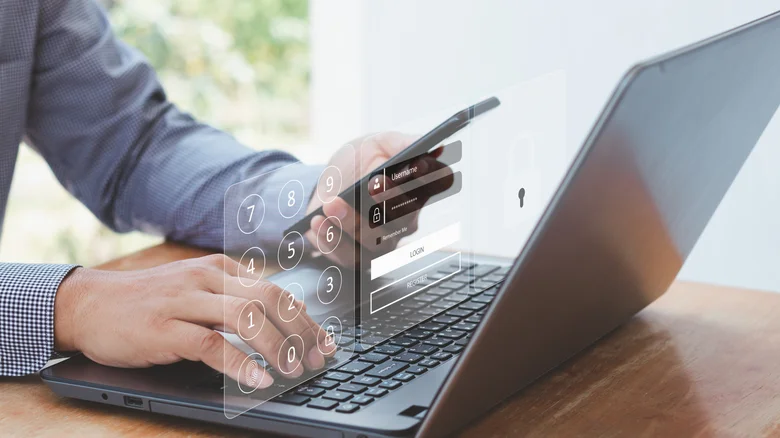
Standalone apps like Google Authenticator take a more isolated approach because they work offline. There’s physical separation, so your second factor actually lives on a different device than your passwords, and there’s a lower chance of having your data stolen.
On the other hand, that isolation comes at a cost, because you’ll still be copying six-digit codes by hand. Also, most authentication apps are mobile-only, so you’re out of luck if your phone isn’t nearby. Unless, that is, you have one of the models that also offer desktop apps or browser extensions, like 2FA or 1Password. There’s also the risk of temporary lockout of your accounts if you lose or break your phone, requiring you to set up a replacement device and restore your cloud backups before accessing your codes again.
The hybrid model brings the best of both worlds
One of the best ways to make your life easier while still keeping everything safe is to mix and match. Most timed one-time password codes can lie safely in a password manager, but a small handful, such as the codes for your main email account and the password manager itself, are better kept on a separate hardware key or an authenticator app. This way, if your vault is ever compromised, your most critical accounts remain out of reach.
The breakdown is to use your password manager’s built-in 2FA for low-risk everyday services, like shopping sites and subscriptions. Use a dedicated authenticator app or hardware key for your email, banking and the password manager itself. In this way, the friction is minimal, and your most essential accounts are safe if your password manager is ever compromised.
Ultimately, neither tool is flawless on its own, and the best choice depends on what you’re protecting and how much back-and-forth between devices you tolerate. For most people, a hybrid approach seems to be the best path forward.
