

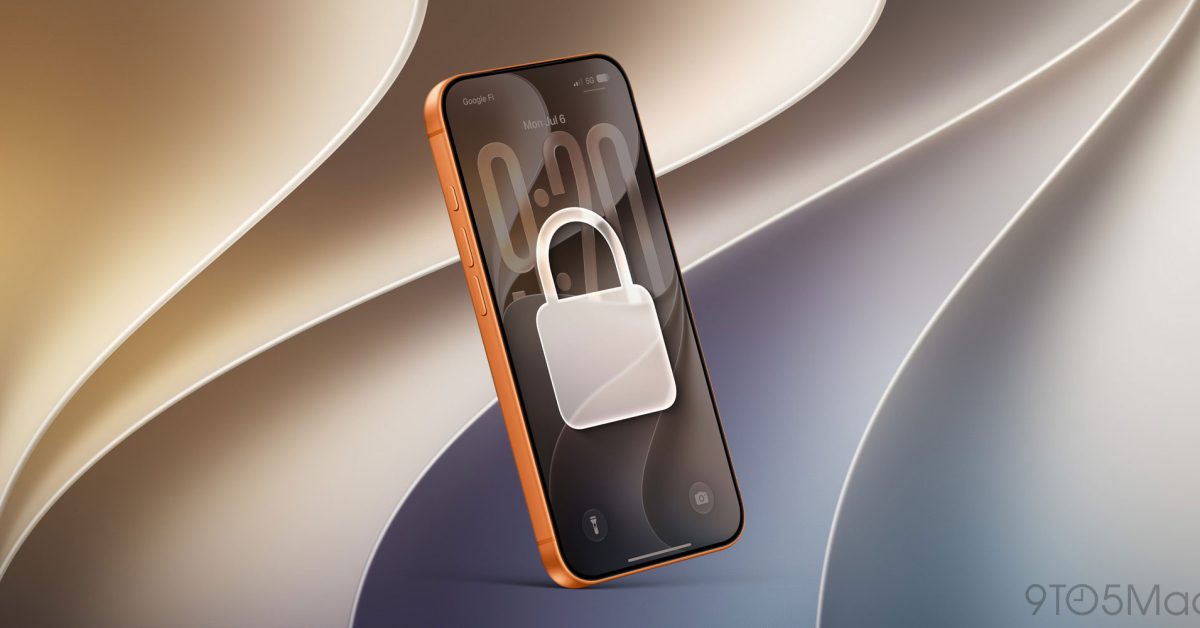
Apple continues to work on a feature that automatically locks an iPhone when it detects that the device has been snatched from its owner’s hand. Here are the details.
Apple still working on iPhone anti-snatching feature
Earlier this year, 9to5Mac first reported that Apple was working on a new iPhone security feature that can automatically lock the device when it detects that it has been snatched from the user’s hand.
While Apple has yet to officially announce the feature, new references included in iOS 27.2 beta 2 show the company is still actively developing it.
According to new code seen today by 9to5Mac, the feature, which is called “AutoLock” internally, can use the following signals to determine whether an iPhone may have been taken from its owner:
- A sharp acceleration consistent with the phone being snatched;
- A paired Apple Watch remaining unreachable for a certain period;
- Loss of connectivity to a paired Apple Watch;
- Prolonged loss of network connectivity;
- The device remaining unlocked beyond a certain interval.
Additionally, new references include safeguards meant to prevent false positives, such as successful biometric authentication, certain foreground app activities that could otherwise be mistaken for signs that the device has been taken, and a backoff mechanism that can temporarily suppress further automatic locks after repeated lock events.
The code also suggests AutoLock uses a voting system in which a potential theft signal can request a lock, while safeguards such as biometrics, familiar locations, or certain app activities can veto it.
These new details add to the references already present in the code, including a location-based safeguard similar to Stolen Device Protection that accounts for whether the iPhone is in a familiar place.
It is worth noting that the feature is still under development and is not currently enabled or available as a user-facing option in iOS 27.2 beta 2. Rather, Apple has enabled the underlying AutoLock service in the background, while keeping the component that actually locks the iPhone disabled, possibly as a way to test the underlying behavior without actually triggering automatic locks.
This means that, for now, the new references only provide a look at Apple’s progress in developing the feature. Whether or when it will ultimately launch remains up to Apple.
Worth checking out on Amazon
You’re reading 9to5Mac — experts who break news about Apple and its surrounding ecosystem, day after day. Be sure to check out our homepage for all the latest news, and follow 9to5Mac on Twitter, Facebook, and LinkedIn to stay in the loop. Don’t know where to start? Check out our exclusive stories, reviews, how-tos, and subscribe to our YouTube channel
