

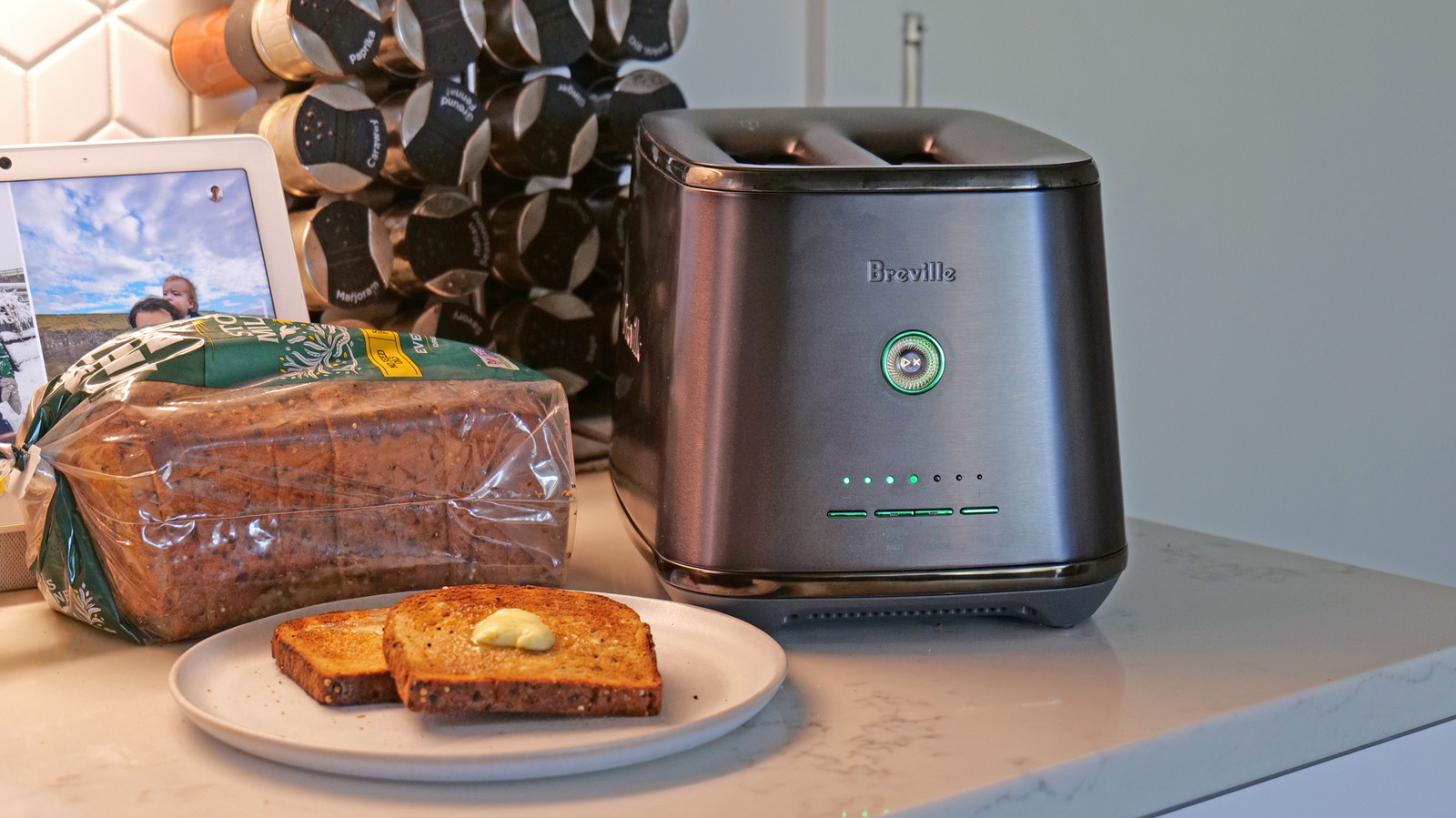
The world’s first toaster that works on color instead of time is great. But is it $300 great?
We may receive a commission on purchases made from links.
The classic pop-up toaster is arguably one of the simplest kitchen appliances you can own. It’s just a box with resistive coils inside, a timer and spring-loaded slots to eject your bread when it’s done. It’s a well-tested formula that has worked for more than 100 years, and as the old adage goes: If it ain’t broke, don’t fix it. But what if there was a world in which the pop-up toaster had never been invented and someone tried to make one with today‘s technology? The result would probably look a lot like Breville’s new $300 Eye Q Toaster, which is the first of its kind to crisp up bread based on color instead of time.
Design
There’s only so much you can do to spruce up a toaster, but Breville still managed to give the Eye Q a decidedly futuristic appearance. It features rounded edges and a minimalist design that seems like it would fit in better on a spaceship than a typical mid-century modern home. On top, there’s a non-stick ceramic coating that does a great job of keeping the toaster clean while also allowing crumbs to neatly fall down into its removable tray. There’s also a handful of rather intuitive buttons for adjusting how light or dark you want your bread to get.
When the light is in the middle, you get a really nice golden brown. If you want a blonder roast you can simply press the minus button on the left, or tap the button on the right for a deeper toast. There’s also a dedicated button for bagels and an “A bit more” button in case your bread needs just a little extra tan. And of course, instead of a spring-loaded lever, there’s a big button in the middle that tells the toaster when it’s time to get to work.
How it works
As soon as you press the start button, the Eye Q uses its built-in motors to clamp down on your bread and slowly lower it inside. The whole process definitely feels more sophisticated than slamming down on some springs, but in practice, it doesn’t really change much. The big difference is what happens when the coils inside heat up.
In a traditional toaster, there’s a timer you can set that tells the toaster how long to cook your bread. When it’s done, you get that classic ding, the toast pops up and you get what you get. The issue is that depending on how hot the coils are and what kind of bread you’re toasting, achieving the perfect golden brown nirvana often feels very hit or miss. And that goes double when you’re using a toaster that you aren’t familiar with.
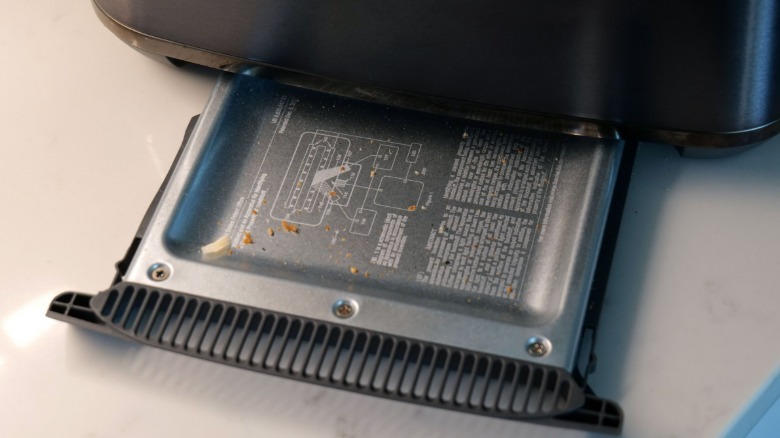
That’s where the Eye Q changes things. Instead of a timer, it has a handful of optical sensors inside that tracks the color of the toast 10 times per second. When it hits your desired shade, alongside a helpful beep, your bread smoothly rises up to let you know that it’s done. No need to guess if a minute, a minute and a half or two minutes is what you need to properly sear the surface of your bread or bagel. Your toast is ready when its color is right, not when it’s been singed for an arbitrary length of time.
The toast test
In order to put the Eye Q through its paces, the first thing I did was buy a fresh loaf of whole wheat and then toasted a slice on each one of Breville’s seven color options. The result was a surprisingly smooth gradient from light to dark that would make the paint section of your local home improvement store proud. The lightest setting was so faint that it was more like merely crisping up the crumb of the bread without really changing its color, while the darkest slice was a deep brown that critically stopped short of being burnt — aside from the very edges of the crust. And in the middle, the Eye Q produced a perfect golden slice of toast that practically anyone would be happy to eat. In fact, the standard middle option was so on point that I just left it there for nearly all of my regular toast needs after that. (Note: In the picture above, the slice in the top left is an untoasted control, followed by seven progressively darker pieces of toast made by the Eye Q.)
If I’m really nitpicking, sometimes you can see the grill lines of the toaster where it holds each slice of bread in place. I also noticed that some pieces of bread looked a bit more splotchy while others featured a more uniform coloring. But those are almost entirely cosmetic differences because after smearing a touch of butter on, the taste of the toast was on point. There’s no need to guess if the bread should cook for 30 or 45 seconds or whatever, the Eye Q can figure things out on its own. Though if you do want a little extra crunch, you can always hit the “A bit more” button like tapping snooze on your alarm clock. You can even toast frozen bread straight out of the fridge without worrying about it coming out overdone.
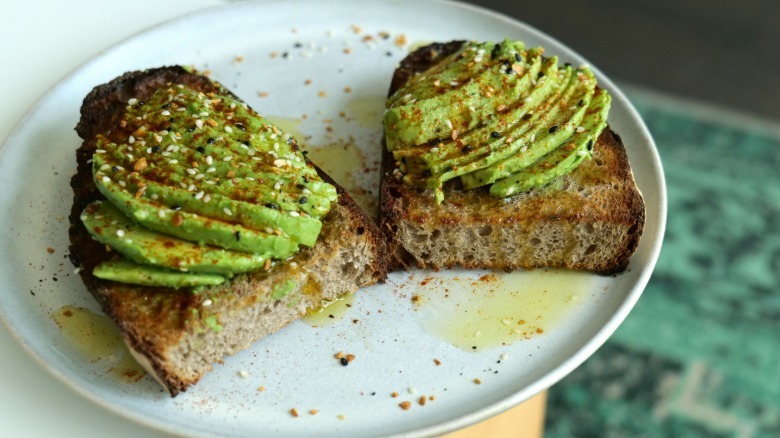
Of course, that’s not all the Eye Q can do. If you press and hold down on the main button, you can trigger its sourdough mode. This gives the toaster a bit more freedom to propagate a maillard reaction into the big nooks and crannies you often get on a fancy leavened loaf. As a card-carrying millennial, naturally I used this function to make some avocado toast. And even though I had selected a massive French miche, the toaster produced a wonderfully crisp and perfectly colored slice that served as a perfect bed for Mexico’s most famous berry. That said, I did have to cut the bread in half lengthwise so that each slice would actually fit inside the toaster.
The Eye Q can also toast bagels, though as someone who lives in the northeast US and has plentiful access to fresh-baked options, I’m of the opinion that a good bagel doesn’t need to be toasted. And in its own way, I feel like Breville agrees. That’s because after I went out to my local shop and brought some home, I found that proper NYC-style bagels are often so thick they don’t really fit in the toaster, even after you slice them in half, without hacking it up or stuffing it into the slot in a way that just doesn’t feel right.
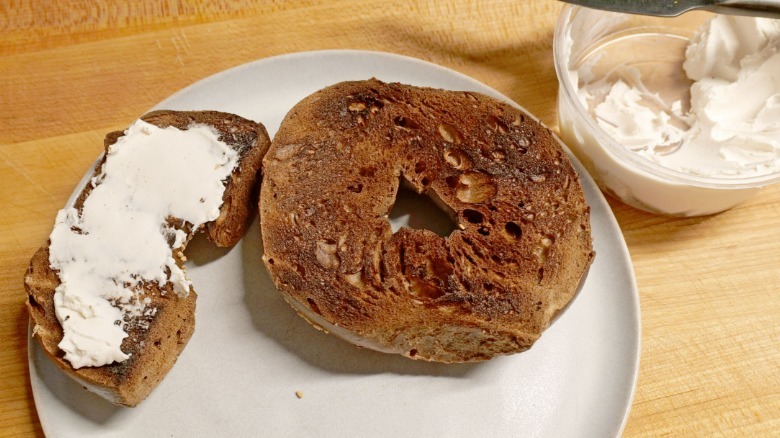
It’s also important to note when toasting bagels, you’re supposed to face the cut sides outwards for the best results. Unfortunately, when I tried that with a lovely Russian rye pumpernickel, it ended up getting a bit burnt. In the Eye Q’s defense, I think that happened because the bagel was simply too big for the space and it ended up too close to the heating elements. So, if you’re the kind of person who buys Lender’s or whatever other sad excuse for a bagel that you find at your local grocery store, go ahead and toast it as the Eye Q can easily handle that too. But for anyone with access to a proper bagel, I think you should just skip the toaster entirely.
Wrap-up
The Eye Q does everything you want a toaster to do, and in almost every circumstance, it does it better than any other toaster I’ve ever used. You don’t need to worry about how long your bread needs to be seared because the toaster already knows and is on alert to make sure it comes out perfect every time. It’s easy to use, easy to clean and it’s available in both two and four slice models depending on your needs. The Eye Q is basically what a toaster would be if it was invented today with focus on modern components and ultimate convenience.
However, the major hurdle with the Eye Q is that the cheapest version starts at $300. That’s a ton of money for a toaster, especially when you consider that you can get a basic one for one-tenth the price. Furthermore, a toaster can really only do one thing, which means it’s going to take up a decent chunk of counter space without bringing much versatility, which can feel like an extra restriction for people with small kitchens. Thankfully, at just under six pounds, it’s light enough to move around when not in use.
I love what the Eye Q can do. But ultimately, its presence in your kitchen will probably depend more on how much disposable income you have as opposed to its ability to crisp up bread better than your average slotted box.
