

Why This Matters to Distributors:United Natural Foods Inc. is moving AI and automation from individual projects into core distribution operations. The food service and grocery distributor has deployed AI-powered supply chain planning across its distribution centers, added automation in Joliet, Illinois, and rolled out lean management at 44 distribution centers as it looks to improve fill rates, inventory management, delivery performance, and productivity.
United Natural Foods Inc. is expanding artificial intelligence, automation, and other technology across its distribution network as the company increases investment in supply chain operations following a return to profitability in fiscal 2026.
The Providence, Rhode Island-based distributor plans to spend about $300 million in fiscal 2027 on capital and cloud implementation projects, including targeted automation, enterprise resource planning deployment, and other technology initiatives.
The spending follows a fiscal year in which UNFI completed the rollout of an AI-powered supply chain and procurement planning platform across its distribution centers, expanded automation at its Joliet, Illinois, distribution center, and deployed lean daily management at 44 distribution centers.
UNFI CEO Sandy Douglas told analysts on the company’s fourth-quarter earnings call that those investments are central to the distributor’s effort to improve its operating performance.
“We also completed the rollout of our AI-powered supply chain and procurement planning platform to all DCs in our network,” Douglas said. The technology is “helping to steadily improve fill rates and inventory management,” he said.
UNFI’s investments come as the company reported lower sales but sharply improved bottom-line results.
Fourth-quarter net sales declined 0.7% to $7.64 billion from $7.70 billion a year earlier. UNFI reported net income of $35 million, compared with a net loss of $87 million in the year-earlier quarter. Because the company moved from a loss to a profit, UNFI reports the year-over-year percentage change in net income as not meaningful.
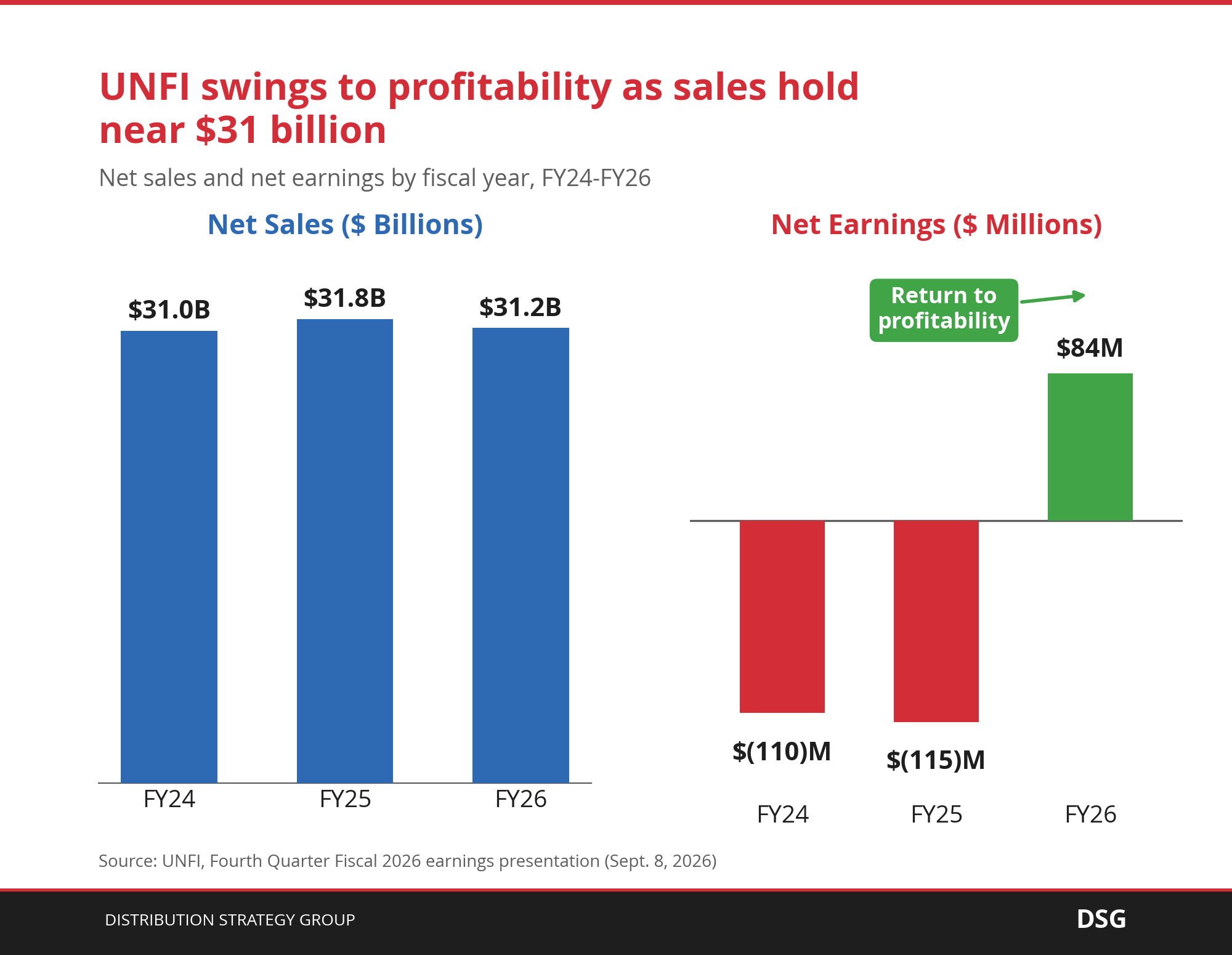
For the full fiscal year ended Aug. 1, net sales declined 2% to $31.15 billion from $31.78 billion. Net income was $84 million, compared with a $118 million net loss in fiscal 2025. Here again, a percentage increase in net income is not meaningful because UNFI moved from a loss to a profit.
The company’s natural products business moved in the opposite direction from overall sales. Fourth-quarter natural products sales increased 6.6% to $4.26 billion, while full-year natural products sales increased 7% to $17.13 billion. Conventional products sales fell 8.6% in the quarter and 11.5% for the year.
UNFI said fourth-quarter sales were affected by planned distribution network changes and the end of temporary project work. Management said underlying wholesale sales grew at a low single-digit rate after accounting for those factors and the comparison with the previous year’s cybersecurity incident.
Douglas said UNFI is concentrating on two areas: adding value for customers and suppliers and making the company more efficient.
“We are improving effectiveness and efficiency across the business through next-generation supply chain, technology and productivity initiatives,” Douglas said. Those initiatives are “steadily improving safety, quality and delivery accuracy for our partners while reducing our operating costs.”
AI moves into inventory and procurement
UNFI’s AI strategy is increasingly focused on operational problems that directly affect product availability and inventory.
The company has implemented RELEX across its distribution system and is using AI to improve purchasing, inventory planning, and fulfillment.
Douglas said fill rates remain one of UNFI’s biggest opportunities for improvement, particularly in natural products, where the number of products, slower-moving items and frequent introductions make inventory management more complicated than in conventional grocery.
“We consider improving it to be at the top of the most important things we can do for our customers,” Douglas said of fill rates.
The objective, he said, is to understand demand, ordering patterns and promotions while working with suppliers to position the right amount of inventory.
UNFI is also using its technology investments to support those decisions.
Douglas said the company is using RELEX “to leverage AI to make sure that we are continuing to order and fulfill in the most technology-supported way.”
“We are making some progress, but we continue to see it as the biggest improvement opportunity we are working on,” he said.
UNFI also added AI-enabled features to its UNFI Insights platform during fiscal 2026. Douglas said the additions are intended “to make it easier for our suppliers to assess store-level performance, improve demand planning and achieve their goals.”
Automation expands in Joliet
Automation is also becoming a larger part of UNFI’s distribution center strategy.
During the fourth quarter, the company consolidated its Racine, Wisconsin, operation into its expanded Joliet distribution center, which UNFI equipped with full-case automation.
President and chief operating officer Matteo Tarditi said the project is part of a broader strategy that combines automation with lean management, technology, and engineering standards.
“Automation is inside a suite of capabilities and functionalities that we have to become more effective and efficient,” Tarditi told analysts.
UNFI is looking for opportunities to modernize its distribution network by moving into larger facilities and adding technology where management believes the investment can support customer growth.
Tarditi compared the Racine-to-Joliet transition with an earlier distribution center consolidation in which UNFI moved operations into a larger, highly automated facility.
“That is the same playbook that we are playing with the Racine-to-Joliet transfer,” Tarditi said.
He cautioned that the Joliet transition remains in its preliminary stages.
“As with every transfer, there are a little bit of growing pains,” Tarditi said. “We are very aware of that, and we are working very hard to fix them.”
UNFI said it has already seen broader improvements across its distribution network. The company recorded its fourth consecutive quarter of year-over-year gains in fill rates, on-time deliveries, and throughput during the fourth quarter.
Lean management moves to next phase
UNFI has also completed the initial deployment of lean daily management at 44 distribution centers and is preparing to move the program into a second phase.
Tarditi said the first stage has produced “green shoots of improvements in fill rates, on-time delivery, throughput,” but added that UNFI still sees “a very large opportunity in front of us.”
The next phase will focus more heavily on management routines, problem-solving, data management, and continuous improvement.
Tarditi said teams at the 44 distribution centers are already meeting to review operating measures and that the company now wants to go deeper into identifying problems and developing corrective actions.
The second focus will be continuous improvement, including eliminating waste and increasing operating efficiency, he said.
UNFI has not disclosed which distribution centers will receive the next major automation investments.
Douglas said the company has a multiyear technology and operations road map but is not ready to provide details.
“With each passing implementation, whether it is technology like RELEX or Samsara going systemwide last year, we are growing in our confidence relative to the ability to put technology and lean and process improvement together to drive capability,” Douglas said.
UNFI plans about $300 million in fiscal 2027 spending
UNFI expects approximately $300 million in capital and cloud implementation spending in fiscal 2027, up from $217 million in capital expenditures in fiscal 2026. The planned investments include targeted automation, ERP deployment, and broader technology initiatives.
Tarditi said the company intends to move deliberately rather than deploy new technology across the network at once.
“We will take a methodical paced approach to technology investments,” he said, “focusing on targeted implementations first, then a broader deployment.”
For fiscal 2027, UNFI expects sales of $31.2 billion to $31.8 billion and net income of $105 million to $145 million. The company expects sales to remain under pressure early in the year as it finishes cycling previous distribution network changes, with a return to growth expected later in the fiscal year.
Fuel costs are another focus as UNFI looks for additional distribution efficiencies.
Tarditi said the company is using fuel hedges and contractual mechanisms with customers and suppliers to offset some of the pressure. But he said the company’s most important response is reducing fuel consumption through better transportation planning.
“The most important is a continuous focus on route optimization,” Tarditi said.
The goal, he said, is to “continue to reduce miles per delivery and optimize routes so the whole system benefits from lower fuel consumption.”
The investments show UNFI increasingly tying AI and automation to specific distribution measures rather than treating the technologies as stand-alone projects. Fill rates, inventory management, on-time deliveries, warehouse throughput, and miles per delivery are among the measures management says it is targeting as the company puts more technology into its distribution network.
Do not miss any content from Distribution Strategy Group. Join our list.
