

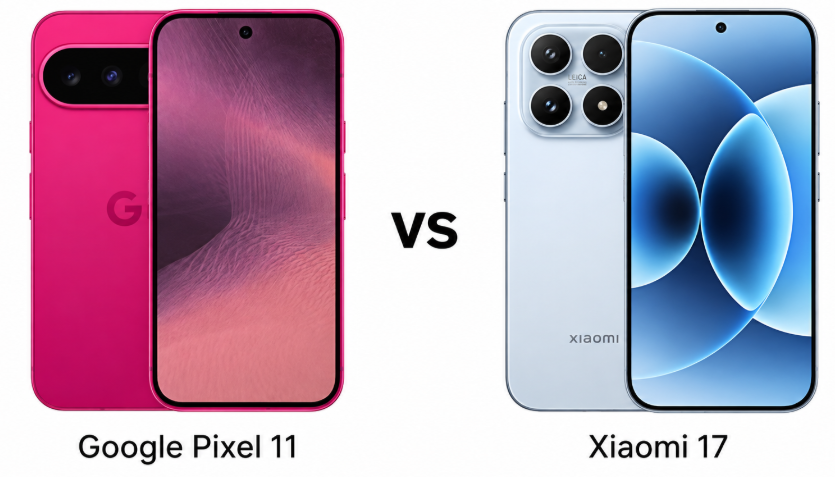
At the $1,000 (₹90,000) price point, smartphone buyers expect zero compromises. Yet, the Google Pixel 11 and Xiaomi 17 prove that manufacturers can take drastically different paths to reach the premium tier. Google leans heavily into software longevity, artificial intelligence, and computational photography, while Xiaomi counters with sheer brute force: a lightning-fast processor, a massive battery, and aggressive camera hardware.
For consumers ready to upgrade, the choice ultimately boils down to a simple question: Do you value long-term software refinement, or raw hardware power?
Specs at a Glance
| Feature | Google Pixel 11 | Xiaomi 17 | Edge |
| Display | 6.3″ OLED (1080p, 3000 nits) | 6.3″ LTPO AMOLED (1220p, 3500 nits) | Xiaomi |
| Processor | Google Tensor G6 | Snapdragon 8 Elite Gen 5 | Xiaomi |
| RAM & Storage | 12GB / Up to 512GB | Up to 16GB / Up to 1TB | Xiaomi |
| Rear Cameras | 48MP Main, 10.8MP (5x Tele), 13MP UW | 50MP Main, 50MP (2.6x Tele), 50MP UW | Xiaomi (Hardware) / Google (Zoom) |
| Front Camera | 10.5MP Ultrawide | 50MP Wide | Xiaomi |
| Battery & Charging | 4985mAh / 30W wired, 25W wireless | 6330mAh / 100W wired, 50W wireless | Xiaomi |
| Software | Android 17 (7 major updates) | Android 16 / HyperOS 3 |
Design and Display: Xiaomi Takes the Visual Crown
Both smartphones offer the premium build quality expected in this price bracket, featuring glass front and back panels, durable aluminum frames, and IP68 water and dust resistance. While Google utilizes Gorilla Glass Victus 2, Xiaomi opts for its proprietary Shield Glass (globally) and Dragon Crystal Glass (in China). Both devices also feature fast, ultrasonic in-display fingerprint scanners.
However, Xiaomi pulls noticeably ahead in display technology. While both phones sport 6.3-inch 120Hz screens, the Xiaomi 17 utilizes a sharper LTPO AMOLED panel (1220 x 2656 resolution) that hits a blinding 3,500 nits of peak brightness. It also boasts broader multimedia support with Dolby Vision and HDR Vivid. The Pixel 11 remains highly capable with its 3,000-nit OLED display, but Xiaomi’s superior resolution and outdoor visibility make it the definitive choice for media consumption.
Cameras: Computational Mastery vs. Leica Optics
The camera systems highlight the divergent philosophies of both brands. The Pixel 11 relies on a 48MP main sensor, a 13MP ultrawide, and a 10.8MP telephoto lens with an impressive 5x optical reach. Google’s real advantage here lies in its legendary computational photography algorithms, which consistently deliver excellent point-and-shoot reliability.
Xiaomi, on the other hand, takes a hardware-heavy approach. The Xiaomi 17 boasts a trio of 50MP sensors on the rear—including a massive 1/1.31-inch primary sensor—backed by premium Leica optics and laser autofocus. While its 2.6x optical zoom falls short of Google’s reach, Xiaomi wins on pure resolution, video capabilities (up to 8K 30fps), and a staggering 50MP front-facing camera that easily outclasses the Pixel’s 10.5MP selfie shooter.
Performance and Endurance: A One-Sided Fight
When it comes to raw specifications, the Xiaomi 17 dominates. It is powered by Qualcomm’s cutting-edge Snapdragon 8 Elite Gen 5 chipset, paired with up to 16GB of RAM and 1TB of UFS 4.1 storage. This makes it an absolute powerhouse for sustained gaming and heavy multitasking. Google’s Tensor G6, capped at 12GB of RAM, is purpose-built to drive AI experiences rather than top benchmark charts.
The battery gap is equally stark. The global Xiaomi 17 packs a colossal 6,330mAh silicon-carbon battery with 100W wired charging, easily leaving the Pixel 11’s 4,985mAh cell and 30W charging in the dust. While Google includes convenient Qi2.2 magnetic charging, Xiaomi’s combination of capacity and speed is undeniably more practical for power users.
The Verdict: Which Flagship Deserves Your Money?
At effectively the same price point (roughly ₹90,000 in India), the Xiaomi 17 is the objective hardware winner. It provides substantially better value for your money, offering a superior display, vastly better battery life, significantly faster charging, and top-tier processing power. It is the definitive choice for gamers, hardware enthusiasts, and heavy users.
However, the Google Pixel 11 remains a highly compelling option for a specific type of buyer. If you prioritize clean software, exclusive AI tools, reliable point-and-shoot photography with superior zoom, and the peace of mind that comes with seven years of guaranteed Android updates, the Pixel 11 is the safer long-term investment.
Disclaimer: Specifications and pricing are based on available pre-launch data and approximate conversions. Always verify details and regional variances from official sources before purchasing.
