

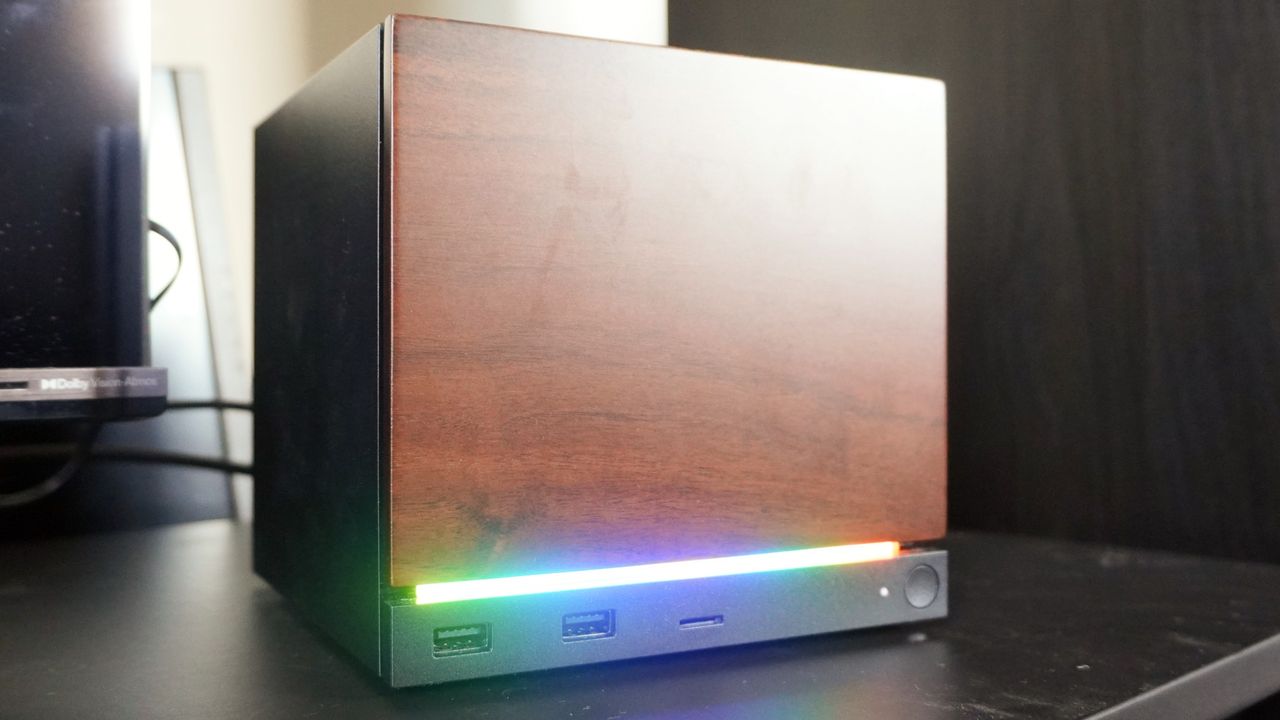
If you watch my video review of the Steam Machine, you can tell how heartbroken I was by it. This was supposed to be the perfect middle ground — PC gaming smashed together with a console experience to give you your massive Steam library in a box by your TV.
But it felt overpriced, unpolished and struggled to hit the performance metrics PC games need in 2026. Then, I started using it…and using it some more…and after weeks of relentless software updates, I have to admit that maybeI rushed to judgement.
I stand by the score for most of you reading this: console players can get better living room bang for their buck elsewhere (for now) and for PC players, the component math isn’t really mathing.
But for those in that small group like me who just want our massive Steam backlogs on the big screen without the headache of using Windows from the couch, this is where the Steam Machine turns from good to great.
This started as a test of the Lexar PLAY microSDXC card, and as you can see by my sprawling thoughts, has evolved into something more. Let me explain.
FSR 4.1 is a game changer
The proof is in the pudding, and Forza Horizon 6 was the first place where I really felt that proof. Recently, Valve updated the Steam Machine to support AMD’s FSR 4.1 resolution scaling and frame generation tech (otherwise known as FSR Redstone).
Now, it’s worth noting that Horizon 6 is a game that has FSR 4.1 options natively supported in its in-game menus. For others, like The Last of Us Part II, you will have to go into the game properties,and turn the compatibility layer to Proton Experimental.A small file downloads and you should be off to the races.
Even if the in-game settings says “FSR 3.1” of some sort, you’re getting FSR 4 — something that I saw when flipping over to Naughty Dog’s epic. The number changes are minor, but the real difference maker here is frame pacing and image quality.
Forza Horizon 6 had a real stuttering problem when I first played it on the Steam Machine, with driving gameplay feeling like it was on the framerate equivalent of an elastic band stretching and contracting.
Now with FSR 4, not only is ghosting drastically reduced, the 1% lows are much stronger for a massive improvement in consistency. The same can be said of The Last of Us too, as the surface textures don’t fizzle anymore and the frame pacing stability is much better.
|
Forza Horizon 6 (1080p Ultra FSR Performance) |
||
|
The Last of Us Part 2 (1440p Medium Dynamic resolution scaling) |
Throw in all the UI updates (like making resolution settings much clearer), stability improvements and support for USB wheels and pedals, and this is all coming together nicely! Not in a way that makes the price feel more worthwhile, but we’re heading in the right direction.
The remaining friction (and the hack)
While the software and frame rates have evolved, that price remains a massive hurdle — to the point that the base model is the only tier that makes sense. However, that limited internal drive will fill up fast after downloading just a couple of modern games.
So the fix? The smartest move is buying the base model and pairing it with a microSDXC memory card like the Lexar PLAY I’ve been using.
It’s cheaper to get a 1TB card than upgrading the internal storage, and while the read/write rates are slower than the internal storage, the speeds are fast enough to handle games without any stuttering.
There is a longer load time, but nothing too agonizing.
The comeback kid?
So, is the Steam Machine suddenly a five-star masterpiece? Let’s not get carried away.
So, is the Steam Machine suddenly a five-star masterpiece? Let’s not get carried away. The sticker shock is still very real, and for anyone wanting to roll up their sleeves and build their own compact living room machine, the dollar-to-performance ratio doesn’t add up.
But the integration of FSR 4 has transformed a choppy, frustrating experience into a genuinely viable console competitor. The Steam Machine proves that hardware specs on a spreadsheet are only half the story, and Valve is putting in the grueling software work to right the ship.
Plus, you can save a little bit of cash on that premium storage tax by slapping a high-speed Lexar PLAY 1TB microSD card into the base model. The math doesn’t really math as badly as before.
It might not be the undisputed king of the living room just yet, but it’s absolutely a console comeback kid worth rooting for.
- Nvidia’s RTX Spark N1X launches this October: My price predictions for the potential MacBook Pro killer
- I tested Acer’s wild Project DualPlay Mini — and it’s a gaming handheld and laptop in one gadget
- As a PC snob, I wanted to catch GTA 6 making console compromises. Instead, I’m in awe of the trickery
