

- News
- Technology News
- Reviews
- Sony Bravia Theatre Bar 7, Sub 8 and Rear 8 system review: Peak detailing
Trending
Top 10 Selling Smartphones
Marc Benioff
Sridhar Vembu
Operation Bluebird
Sony Bravia Theatre Bar 7, Sub 8 and Rear 8 system review: Peak detailing
Rating: 4/5
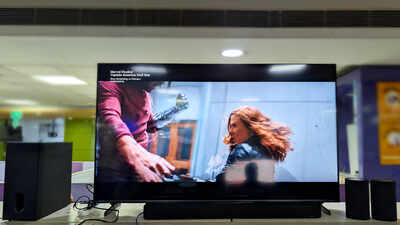
Modern televisions have completely changed how we watch movies at home. Display panels have grown larger and sleeker than ever with new-age technology delivering life-like picture quality that is pleasing to the eye – thanks to the punchy colours and details in textures. But the slim chassis leaves virtually no physical space for speaker drivers that match the video quality. This means that the result is muffled dialogue and nonexistent bass, driving movie lovers toward dedicated external audio.However, a pair of speakers or a soundbar setup that truly complements large, sophisticated display panels while also delivering true cinematic output have largely remained absent from the market. Sony spotted this gap and answered with a ‘modular’ system that – according to your budget – provides the core functionality of enjoying content in its absolute detail. Earlier this year, Sony launched a bunch of products, including the Bravia Theatre Bar 7 system, which pairs the core soundbar with wireless Sub 8 and Rear 8 surround units, for about Rs 1,75,000.This 5.1.2 setup easily outshines several options in the market by bringing a dynamic clarity and real spatial height to modern TV viewing. After putting the system through its paces over a month, the results are clear and here’s what you need to know before shelling out a hefty amount on a soundbar.
Sony Bravia Theatre Bar 7
setup: Specifications at a glance
Now before we reveal the individual price of each component, one of the classic things that Sony has done is to give users a choice. Out of a bunch of products launched, the Japanese tech company is allowing users an option to mix and match the products that fit well in their budget.For example, you can just purchase the Bar 7 (model HT-A7100) at a price of Rs 99,990 that offers a 5.0.2 channel configuration using nine drivers, putting out 405W of power. It supports Wi-Fi 6 along with Bluetooth 6.0, and is capable of handling Dolby Atmos, DTS:X, IMAX Enhanced, Dolby TrueHD and DTS-HD MA. Ports include one HDMI input and one HDMI output supporting eARC/ARC.

You can pair it with BRAVIA Theatre Sub 8 (SA-SW8) that costs Rs 34,990, runs a single-channel subwoofer setup, delivers 300W of output, and relies entirely on Sony’s proprietary wireless connection. Want punchier bass – purchase a BRAVIA Theatre Sub 9.The BRAVIA Theatre Rear 8 (SA-RS8) speakers are priced at Rs 39,990 for the pair, offering a 4.0 configuration with two 2-way drivers, delivering 100W total output split as 50W per speaker. Just like the Sub, you can pair the bar with BRAVIA Theatre Rear 8/9 for a more inclusive sound.
Sony Bravia Theatre Bar 7 design
With basics now covered, let’s talk about the design. Sony has kept the Bar 7’s design fairly restrained.It easily slots neatly beneath a 65-inch television. A bundled spacer tilts the bar slightly upward, which helps direct dialogue more clearly toward the listener. As mentioned, physical connectivity is kept minimal which means less wires for cleaner setup. You get a single HDMI input meant for connecting a source directly, such as a gaming console or streaming stick, along with one HDMI output supporting eARC/ARC that connects to your television. There’s no optical port and no USB port for local media playback.With just one HDMI input available, you’ll need to decide whether to plug your gaming console or streaming box directly into the bar itself, routing everything else through your TV’s eARC connection instead. Depending on your television, this setup could limit full Atmos passthrough in certain configurations. The Sub 8 houses a 200mm driver inside a 12.2kg enclosure. Despite pushing out 300W, its footprint remains small enough to tuck beside a TV unit without much hassle. The Rear 8 speakers turned out to be the most surprising part of the setup with each one weighing 1.1kg.Both the subwoofer and rear speakers communicate wirelessly with the main bar using Sony’s proprietary protocol, but each unit still needs to be plugged into a wall socket for power. If your living room doesn’t already have outlets positioned near your seating area, you’ll want to plan around that before setup. It is recommended that you either don’t use an extension cord or use a high-quality option.
Sony Bravia Theatre Bar 7 performance
The wireless connection performed flawlessly throughout testing, with zero dropouts, no noticeable latency and no compression artifacts – even during particularly fast paced, chaotic action sequences like the ones in MadMax movies and John Wick series. Setting everything up simply involved pressing the LINK button five times on each speaker to switch to wireless mode, followed by pairing through the Bravia Connect app.360 Spatial Sound mappingthrough mapSony’s signature spatial audio technology works by studying how humans naturally perceive sound direction, then manipulating the speaker positioning to trick your ears into hearing audio from spots where no actual speaker exists by essentially creating “phantom speakers.” With the Rear 8 units connected, the system can simulate up to 11 virtual speaker positions across five front channels, four rear channels and two overhead channels.This showed itself during multiple battle sequences in movies like Avengers: Infinity War and Avengers: Endgame, Dune: Part One and Dune: Part Two and shows like Monarch: Legacy of Monsters Season 2. However, Sony’s movies like Spiderman: No Way Home sounded immersive. We could listen to the “Thwip” (sound of sputtering hiss of web shooters) all around us during intense action scenes.The “Whoosh” (sound to simulate the web flying through the air or whipping past the camera and artists and cinematic thuds and air whooshes from swinging objects were clear, without being overpowered by background score.Another example of an immersive, cinematic experience is the sound of sand/ soil in Dune when it moves ahead of the sandworm’s arrival. When Paul Atreides is with his father in the ornithopter, we could easily listen to the sound in that particular scene: Dialogue, the sound of ornithopter wings, the faint noise of Crawler or spice harvester in background, among others.Whether Sound Field mode is switched on or off makes a noticeable difference too. With it on, the soundstage widens considerably, though vocal precision softens (volume drops) slightly. Switching it off narrows the presentation but sharpens dialogue focus.Dialogue and TV showsWhen used purely as a standalone unit, the Bar 7’s biggest strength becomes obvious: dialogue clarity. Its dedicated center channel keeps voices firmly anchored to the middle of the screen while multiple speakers throw sound from different directions: from top, sides in a way that it seems to envelop the viewer. While watching Monarch: Legacy of Monsters Season 2, the dialogues remained sharp and easy to follow even as background music swelled in intensity. Subtle ambient sounds, like the click of insects or the shuffling and hissing of trees came through with impressive clarity.During football broadcasts like LaLiga and English Premier League, the 360 Spatial Sound Mapping technology created a genuinely immersive stadium-like atmosphere. Crowd noise wrapped around the room with the sound of drums and trumpet coming from multiple directions as if we were sitting in the stadium, yet commentary stayed firmly rooted to the center channel. We could listen to the ‘thud’ when the player kicked the ball from different speakers – depending on where the ball was on the pitch.Overall, the Bar 7 handles dialogue and television content very well. Its compact size and lack of a built-in dedicated subwoofer mean it lacks deep bass on its own, but it produces a balanced mid-range that renders speech with real detail. This is helped further by the discrete center channel, which keeps voices well-positioned within the soundstage.It is to be noted that the peak performance of this sound system can be experienced with a Bravia television. This is because Sony created these devices keeping in mind the Bravia ecosystem. This means you lose out on several features like Voice Zoom 3’s dialogue enhancement, Acoustic Center Sync (which uses your TV’s speakers as an additional center channel), remote integration and automatic lip-sync correction if you don’t have Bravia TV.Having said that, the speaker system performs well enough if you have a TV from a different brand. Also, the setup is aimed to complement large TVs – 65-inch and above.
Sony Bravia Theatre Sub 8 Bass
Straight out of the box, the Sub 8’s 300W output tends to overpower the rest of the system, resulting in a boomy, thumping sound signature. The lows are constrained to well complement the speaker system but if you like clarity over thump, you can adjust the settings. The scenes in Dune movies when Shai-Hulud – the Fremen term for the colossal, sacred sandworms of the desert planet Arrakis – the system produced a low-end rumble so immersive it felt as if the room itself was shaking in real time.The Sub 8 itself delivers deep, powerful, and remarkably well-controlled bass that blends effortlessly with compatible Sony audio systems. Setup through the 360 Spatial Sound Mapping system and Bravia Connect app is refreshingly simple, and the flexibility to position it as needed, along with support for pairing two Sub 8 units in larger rooms, makes it a genuinely future-ready choice.For anyone already invested in a compatible Sony home theatre setup, the Sub 8 is an excellent upgrade, delivering hi-fi-level low-frequency performance from a surprisingly small enclosure. Its blend of power, precision, and effortless integration makes it one of the better wireless subwoofers currently available, provided you’re staying within Sony’s ecosystem.Bringing it all togetherTaken as a complete package, the Bar 7, Sub 8 and Rear 8 work cohesively as a modular surround system. Together, they deliver genuine Dolby Atmos immersion without a tangle of visible cables, wireless performance that never faltered during a month of testing. The soundstage is noticeably wider than what purely virtual surround setups can achieve, thanks to Sony’s 360 Spatial Sound Mapping.
Verdict
In an all-win scenario, choose the Sony Bar 7 if you already own a Bravia TV from 2024 or later, value the flexibility of a modular upgrade path, and want DTS:X support paired with hassle-free wireless connectivity. Its 360 Spatial Sound Mapping produces a wider soundstage than what many competitors offer. As a complete system, the Sony Bravia Theatre Bar 7, Sub 8, and Rear 8 bundle delivers genuine Atmos immersion without visible cable clutter.Wireless connectivity held up perfectly through a month of daily use, build quality feels premium while using sustainable materials, and the 360 Spatial Sound Mapping produces a noticeably wider soundstage compared to virtual-only alternatives. The complete bundle costs a steep Rs 1,74,970 which may prompt you to take a step backward. Also, without a Bravia television, you lose access to Voice Zoom 3 and Acoustic Center Sync, both of which matter considerably for watching Indian content.If you’re already using Sony products across your home entertainment setup, this bundle stands out as one of the cleanest and most flexible surround sound systems currently available, filling a room with genuine spatial depth. The core audio quality does justify the price tag.An honest recommendation would be: Start with the Bar 7 at Rs 99,990; add the Sub 8 once you feel the need for deeper bass, and then bring in the Rear 8 speakers when you’re ready for full surround sound. Thanks to Sony’s engineering, this modular approach lets users spread the cost over time and upgrade gradually, one component at a time.
