

Most Read
1.

World’s 2nd richest country records 2,101 restaurant closures in first seven months

Singapore-born billionaire Low Tuck Kwong reportedly negotiating sale of majority stake in flagship coal mining firm

Village in world’s 2nd most visited country turns to digital nomads to fight depopulation

Wife of Southeast Asia’s richest man becomes Vietnam’s 2nd wealthiest

8-year-old prodigy attends chemistry classes at Asia’s third-best university

Daughter of Singapore’s former oil tycoon OK Lim fails to exclude evidence from trial

Madam Pang draws attention with helpless smile after Thailand player misses penalty in ASEAN Cup final
<img src="https://vcdn1-english.vnecdn.net/2026/08/25/chc4942-jpg-1787561850-8820-1787624346.jpg?w=100&h=100&q=100&dpr=1&fit=crop&s=zJJzTEoJprCezb2HvQPrSw" alt="Surging prices drive lychee exports down” title=”Surging prices drive lychee exports down” loading=”lazy”>
Surging prices drive lychee exports down

Southeast Asia’s richest man ranks among world’s top 5 one-day wealth gainers

4 richest Indonesians add $6B to wealth in a month
World’s best airport embraces AI, automation with new Terminal 2
Airport officials have described the revamped facility, which began handling departures in May, as the world’s most digitally advanced terminal, with technology designed to automate much of the departure process and reduce reliance on staff, The Straits Times reported.
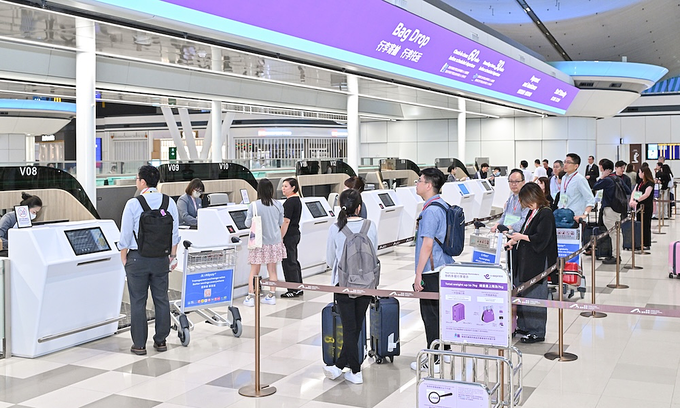
It has 68 self-service bag-drop counters, 58 smart check-in kiosks and 108 hybrid check-in counters. One of its key technologies is a self-service baggage system developed in-house by the airport authority. Each unit uses 10 AI-powered cameras to read barcodes and determine whether luggage can safely move through the baggage system. The airport says passengers can complete the biometric-enabled bag-drop process in about 45 seconds
Facial recognition is also being used at 20 electronic security gates leading to the restricted area. Passengers who have already registered their biometric information can pass through without presenting their passports at the gates.
Automation extends to security screening, where 15 smart lanes allow passengers to leave laptops and liquids of less than 100 ml inside their carry-on luggage. The terminal also has 35 electronic immigration channels and 60 immigration counters.
|
Passengers at the Hong Kong International Airport Terminal 2. Photo courtesy of HKIA |
Airport officials say the combination of technology and a redesigned layout can reduce the journey from the terminal entrance to the boarding gate to less than 20 minutes. Passengers traveling with only carry-on luggage can reach the restricted area about two and a half minutes after getting out of a taxi, according to the South China Morning Post.
The technology-focused terminal was redeveloped as part of the airport’s HK$141.5 billion (US$18.1 billion) three-runway system project, intended to increase capacity and improve efficiency as Hong Kong faces strong competition from other major aviation hubs in Asia.
It is designed to eventually handle up to 30 million passengers annually. Together with Terminal 1’s annual capacity of 70 million, it is expected to lift the airport’s total capacity to 100 million passengers a year.
The Airport Authority expects the revamped terminal to handle about 8 million passenger trips during its first year. The entire airport served 61 million passengers in 2025
Hong Kong International Airport was named “Best Airport in the World” at the Global Travel Awards 2026. It was also the world’s eighth-busiest international airport by airline capacity in 2025, with 38.7 million seats, according to aviation data provider OAG.
For now, passengers checking in at Terminal 2 still travel by automated people mover to Terminal 1 to board their flights. That is expected to change with the planned opening of the new Terminal 2 Concourse next year, which will allow passengers to use boarding gates connected directly to Terminal 2.
Get VnExpress first in Google SearchSee more of the news you trust. Make VnExpress a preferred
