

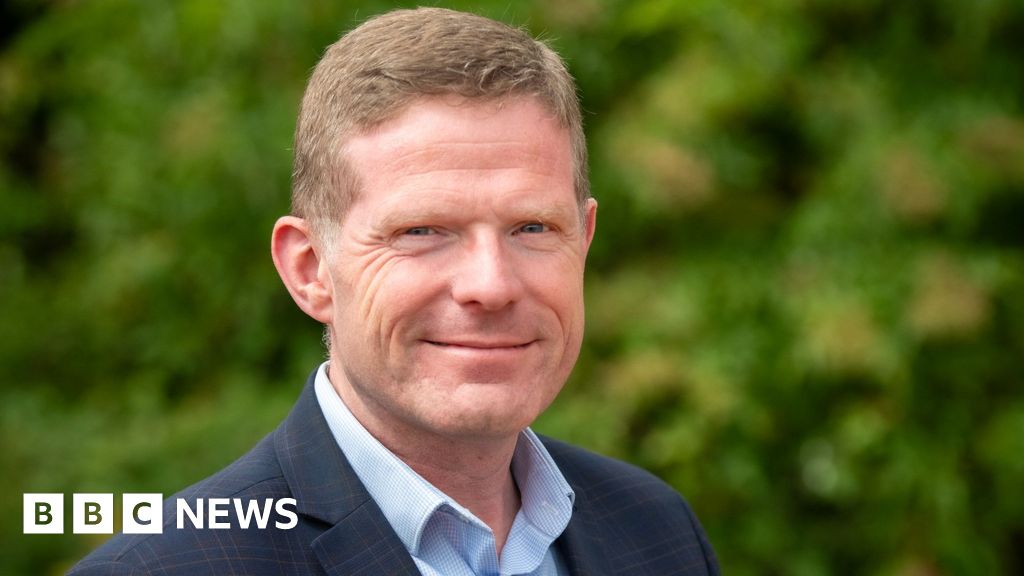
World’s first patient to undergo live AI-assisted brain surgery has tumour removed

BBC
The world’s first patient to have brain surgery with live artificial intelligence assistance has successfully had his tumour removed.
Rhys Hibbert, a father-of-two from Bedfordshire, could have lost his sight without the operation, said surgeons at University College London Hospital.
The AI tool analysed a video feed of the operation as it happened and advised surgeons on how to avoid crucial but hidden vessels and nerves in the brain. It allowed them to safely remove as much of the tumour as possible.
“From a patient safety perspective, I can see absolutely the benefit. There are no road signs inside our head,” said Hibbert.
Until 18 months ago, 48-year-old Hibbert, a customer services manager, was fit and healthy, going on a two-mile walk every lunchtime.
It was on one of these walks that he fell unconscious and started fitting in the road.
A brain scan revealed he had an 11mm (0.433in) non-cancerous tumour growing on the pituitary gland – a marble-sized organ at the base of the skull.
The gland secretes vital hormones that help with processes like growth, metabolism and regulating blood pressure and temperature.
Crucially it sits very close to the carotid arteries which are vital vessels that supply blood to the brain, and the optic nerves that control vision.
As Hibbert’s tumour began to press on his optic nerves, it narrowed his peripheral vision.
Severely fatigued and dizzy
Although he didn’t need surgery straight away Hibbert started to trip over things and felt severely fatigued and dizzy.
“For 18 years of married life I’ve always got out of bed and made my wife a cup of coffee,” Hibbert said, “and I wasn’t going to let this tumour stop that.”
He said the biggest impacts for him were emotional and psychological.
“Though I had a lot of people kindly offering help, you don’t want to be a burden on people,” he added.
When surgeons gave him the option to be the first person to try the operation with their bespoke AI tool involved, he didn’t hesitate.
“If patients are not prepared to join research how can doctors ever learn and how can medicine ever progress?” he said.
The surgery involved inserting an endoscope – a thin camera on a stick –
At this point the tumour was close but hidden behind layers of bone and tough membrane.
Identifying the safest place to extract it was not straightforward, particularly as anatomy tends to differ between individuals.
Complication rates vary but there was a 25–50% chance of not getting the whole tumour out and a 0.5–2% chance of injuring a major blood vessel.
This is where the AI tool came in.
‘Surgical ChatGPT’
On a second screen it analysed the live video feed,, tracked the surgical instruments, and marked up areas where the vessels and nerves were most likely to be, highlighting areas where it is safest to remove the tumour.
It is similar to facial recognition technology on phones, but recognises important and often hidden anatomical structures instead.
The average UK surgeon performs about 10 to 20 of these operations a year, relying on scans done before surgery to familiarise themselves with the patient’s anatomy.
Researchers trained and evaluated their AI system on hundreds of videos of pituitary tumour removals – carefully drawing around the vessels and nerves on each video to help the system capture data and begin to “recognise” the most important structures.
“It is trained on more operations than most surgeons see or do in a lifetime and can act like an expert second pair of eyes,” said Prof Hani Marcus, who helped carry out the procedure.
And unlike other experimental AI tools, it works in real time, he added.

UCH
The team wants to make clear that the AI tool is just assisting and the surgeons retain full control.
Their long-term ambition is to develop a type of ChatGPT for surgeons, so there can be “another expert in the room they can turn to for advice if they want it – or leave if they disagree with it,” said Prof Marcus.
Funded by the National Institute for Health and Care Research and Google, the team tried and tested their AI technology in the lab for years.
They are pleased with how the first steps have gone in real-life surgery and are working on a larger trial.
‘It’s given me my life back’
“When I opened my eyes after the operation it felt like I had got 360-degree vision – I hadn’t seen that clearly for a year,” said Hibbert.
And in the eight weeks since surgery, he has noticed his sight improving every few days.
“I also have my energy back and all of the side effects I was suffering before surgery have gone.
James Frith, health innovation Minister, said he was pleased that Rhys that he had “life-changing surgery” as part of government funded research.
“AI needs proper safeguards and we will always ensure that safety is taken seriously.
“But we will also ensure we benefit from the opportunities it brings,” he added.

Get our flagship newsletter with all the headlines you need to start the day. Sign up here.
Surgery
Brain
Medical technology
Artificial intelligence
Medical research
Health
Technology
