

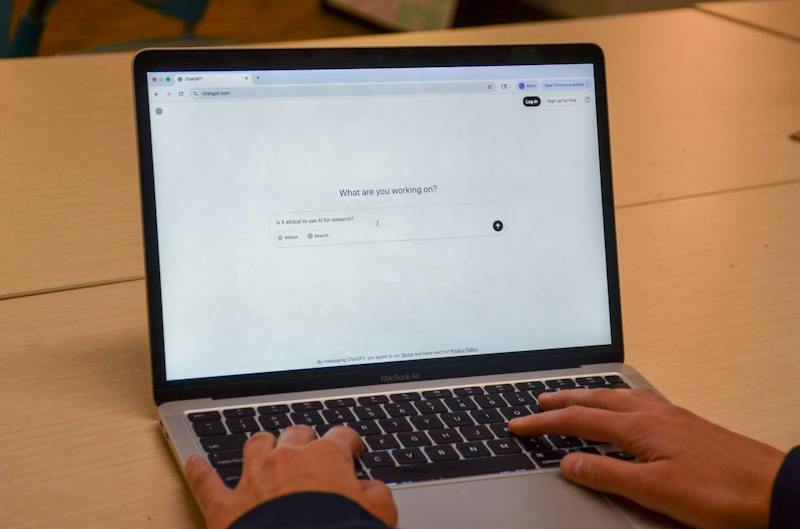
OPINIONS: How U.Va. should respond to the changing artificial intelligence landscape
Four opinion columnists write about how students, departments and the University administration could transform their relationship with AI
Estimated reading time: 5 minutes
Miles Dyckoff: Generative AI is a mirage in higher education
Generative artificial intelligence should not hold a place in general higher education. In an era where one-third of the U.S. stock market is owned by corporations heavily invested in AI, the push for the use of this technology has been ubiquitous. Even some at this paper have fallen to this corporate narrative, with The Cavalier Daily’s Editorial Board pushing a narrative that portrays recent college graduates as modern-day Luddites. This further bolsters AI-invested companies’ control over the market and the astro-turfed opinion that AI will dominate every aspect of our waking lives.
When approaching education and AI, I am reminded of Ray Bradbury’s “Farenheit 451,” where books are first simplified for the general public and then destroyed — both of which AI companies havedone.
When AI becomes a replacement, or even a secondaryom which AI is trained. A dataset trained on its own outputs will implode, and a society trained on a common set of knowledge generated by a homogeneous algorithm will stymie the progress we can make as learners and in our fields of study
People often forget that AI is a predictive language model. When compared to any otheredge, a phantom projection without real substance. We may be able to see the outlines of knowledge, but true understanding comes from engagement with the real thing, whether that is a dense economics paper, literary tome or biology methodology. Reject AI, reject its corporate ownership and accept the fact that AI is not inevitable
Zehra Hasnain: Writers must resist the siren song of AI
At first glance, the advent of large language models seems like the best thing since sliced bread. Why toil over another convoluted paper — worth far more of your grade than it should be — when an omniscient black box can churn it out in mere minutes? This offer is all the more enticing for students at elite universities like the University where productivity is paramount.
However, much like bringing a forklift to the Aquatic & Fitness Center to lug around dumbbells, using LLMs, namely ChatGPT and Claude, to write essays is utterly inane. In other words, one does not write simply for the production of more words. Rather, the act of deciphering some dense text and forming your own opinion on the matter, then attempting to verbalize those thoughts on paper — clearly enough that others may follow — is both the process and the “point” of writing. As a humanities student, my English professors often remind me that writing is thinking — and indeed it is. The often painstaking act of critical thinking lies in its messy process instead of a polished product — and any intellectual benefit is thus absent in the production of some glib AI-generated paragraph.
Indeed, I do not intend to characterize those who use AI for these things as intellectually complacent or naive. The values of efficiency and productivity have been drilled into University students — so, understandably, my warnings may be unpopular. Nonetheless, with instant gratification and comfort capturing the current zeitgeist, one must embrace the struggle of learning. Ultimately, all eyes are on higher education and how it should respond to AI. Yet, rather than the University regulating from the top down, the onus is on students not to abandon critical thinking under the false allure of technological efficiency.
Ishaan Satija: ChatGPT, sit this one out
During my sophomore year of high school, I began using ChatGPT for my long, take-home essays. I supplied the model with the argument, and it created incredibly well polished paragraphs in an instant. The once-intimidating blank Google Doc had become considerably less so, and I foolishly convinced myself that I was “learning.” Timed essays, however, were much less forgiving. Later, without an AI window beside me, it took me longer to form sentences and my writing became less inventive. The blank page, it turns out, had been doing a lot more work than I gave it credit for.
My experience here at the University has made this lesson much clearer. The discussions in my history and politics courses have changed my perspectives on many of the things I thought I had a good grasp on. Reading political theory, arguments about facism or accounts of historical movements force me to understand an author’s logic and occasionally realize that my first interpretation was completely wrong. Education’s primary goal is to train us to wrestle with information and produce something of our own from it, whether it be an essay or a worldview. Unfortunately, AI is often used to undermine this aim.
To protect this purpose, I believe the University should create a uniform policy on AI and give professors much clearer guidance on how it can be harnessed in the learning process. Students utilizing AI to understand difficult concepts outside of the classroom is perfectly acceptable, but as soon as students are being assessed on something that requires their own thought process to produce, AI should be completely off-limits. AI has no place in any setting where students must produce an original output, and thus should be tightly regulated in educational institutions. It can be an incredibly useful tool. However, if the purpose of an assignment is to develop an argument or deeper thought, the student should be the one struggling through that process.
Scarlett Sullivan: Before U.Va. builds its AI future, it should ask who needs it
The University cannot rebrand its way into success within the era of AI. Take, for example, the College’s recent elevation of its Digital Humanities Initiative into a formal Program in Digital Humanities and AI. University administrators presented the change as a significant investment in the future of AI education, but what precisely has changed for the humanities students who stand to benefit? And more importantly, who asked for it?
Even as a humanities student myself, I am not sure what might be in store for a shiny, new — and digital — diploma. The Cavalier Daily contacted six professors across several disciplines, none of whom could speak to the program nor the anticipated benefits of this institutional investment in digital humanities — a curious position for an initiative supposedly designed to meet the needs of an existing academic community. I do not intend to cast aside the scholarship and curiosity behind digital humanities as a burgeoning field. Rather, I ask again who asked for this initiative — and how the University effectively captured student and faculty voices before deciding what this investment should look like.
Humanities students, in particular, have a stake in how AI is introduced into our classrooms and research. Humanities, a discipline crafted in ambiguity, depth and good old-fashioned reading, is uniquely threatened by AI’s competitive angle of speed and efficiency. We need opportunities to thoroughly interrogate the technology’s limitations where apparent and understand what it means for the future of scholarship. The University should be able to facilitate those needs through a defined curriculum, demonstrable faculty excitement, undergraduate buy-in and research opportunities that extend beyond the novelty of the technology itself. Until then, the Program in Digital Humanities and AI risks offering students a new academic label — a bare-bones rebranding — without a clear intellectual foundation.
Miles Dyckoff and Ishaan Satija are viewpoint writers, Zehra Hasnain is an opinion columnist and Scarlett Sullivan is the Executive Editor of The Cavalier Daily. They can be reached at opinion@cavalierdaily.com.
The opinions represented in this roundtable are not necessarily those of The Cavalier Daily. Roundtables represent the views of the authors alone.

Scarlett Sullivan is the executive editor for the 136th and 137th terms of The Cavalier Daily. She is a fourth-year College student, majoring in history, minoring in public writing and rhetoric and completing an Accelerated Master of Public Policy at the Frank Batten School of Leadership and Public Policy. She is from Williamsburg, and enjoys writing about state and local politics in Virginia and student self-governance at the University. You can reach her at s.sullivan@cavalierdaily.com.
